












Quick answer: lighting products described as “daylight” are commonly sold around 5000K to 6500K, but daylight is not one universal Kelvin value. A 5000K source usually appears less cool than a 6500K source. The label alone does not tell you brightness, color rendering, spectrum, glare, flicker, or whether the source suits a particular space.
The useful buying question is therefore not “Which number is true daylight?” It is “Which CCT, color-rendering performance, distribution, controls, and sample result fit this task?”
Kelvin Describes Color Appearance, Not Heat in the Room
Kelvin is used for correlated color temperature (CCT), a compact description of how warm, neutral, or cool a white light source appears. Lower values such as 2700K look warmer and more yellowish. Higher values such as 5000K or 6500K look cooler and can appear more blue-white.
The word correlated matters. Most white LEDs are not heated radiators. Their chromaticity is compared with a reference locus, and the nearest corresponding temperature is reported as CCT. The U.S. Department of Energy notes that reducing color appearance to CCT loses substantial information. Two sources with the same CCT can still render materials differently because their spectral power distributions differ.

Why “Daylight” Can Mean 5000K or 6500K
The International Commission on Illumination (CIE) defines standard illuminants for color measurement. CIE D65 represents average daylight at approximately 6500K. CIE D50, used extensively in graphic arts and photography, represents another daylight reference near 5000K.
Those references explain why both numbers appear in daylight discussions, but they do not make every 5000K or 6500K lamp spectrally identical to natural daylight. They are reference distributions for colorimetry. A commercial LED product still needs its own photometric and color data.
Natural daylight also changes with time of day, weather, sky condition, location, and the mix of direct sunlight and skylight. The CIE continues to study geographical, seasonal, and time-of-day variations in daylight spectra. One fixed indoor CCT can provide a selected white appearance; it cannot reproduce every condition outdoors.
5000K vs 6500K: Which Should You Choose?
Neither is automatically better. Use 5000K when a neutral-to-cool daylight appearance is wanted without pushing as far toward blue-white. Use 6500K when the cooler appearance is intentional or when a defined process requires a D65-related viewing condition. If finishes, printed colors, merchandise, or camera output matter, evaluate the complete source and viewing setup rather than choosing from CCT alone.

| Decision point | 5000K | 6500K | What to verify |
|---|---|---|---|
| Visual impression | Daylight-white, usually less cool | Cooler, more blue-white | Review real samples beside the intended surfaces |
| Common reference association | Near the D50 daylight reference | Near the D65 daylight reference | Do not assume a lamp reproduces the reference spectrum |
| Mixed-light risk | Can contrast with 3000K–4000K areas | The contrast can be stronger | Check adjoining zones and available daylight |
| Color-critical work | CCT alone is insufficient | D65 may be specified for some viewing conditions | Confirm the applicable standard, spectrum, CRI/TM-30 data and viewing booth |
| Project approval | Suitable only after a task-based review | Suitable only after a task-based review | Sample, dimming behavior, glare, distribution and controls |
CCT Is Not Lumens, CRI, TM-30, or Spectrum
Four different questions are often collapsed into the word “daylight”:
- CCT: What shade of white does the source appear to be?
- Lumens: How much visible light does it emit in total?
- Color rendition: How do object colors appear under it? CRI is one established measure; IES TM-30 provides a broader set of fidelity, gamut, and hue information.
- Spectrum: How is optical power distributed across wavelengths?
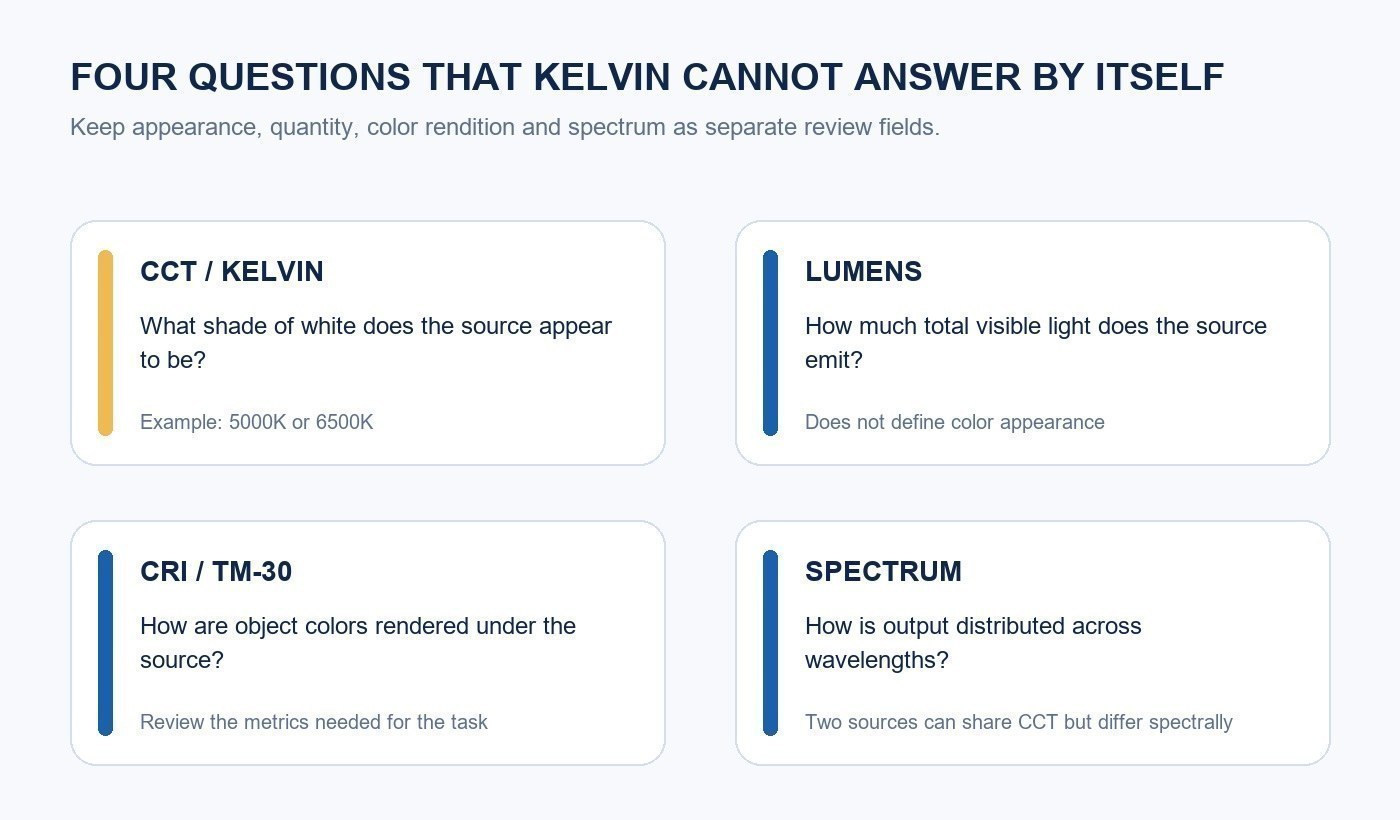
A 6500K lamp is not necessarily brighter than a 5000K lamp. A high lumen value does not guarantee good color rendition. Equal CCT and equal CRI do not guarantee identical spectra or identical appearance of every material. DOE describes CCT as color appearance and color fidelity as a separate property; its TM-30 guidance treats multiple measures as a system rather than a single pass/fail number.
For commercial interiors, the related guide to color temperature and color rendering in retail, office, and industrial lighting goes deeper into the RFQ fields that should be separated.
How to Select Daylight-White Lighting by Application
Offices and learning spaces
Start with the visual task, daylight entering the room, finishes, screen use, glare control, dimming, and the lighting standard that applies to the project. Do not treat 5000K or 6500K as a universal productivity setting. A representative mock-up is more useful than a color name when people will work under the system for long periods.
Retail and display lighting
Merchandise color, texture, contrast, and brand presentation can matter more than the difference between two nearby CCT values. Compare samples on the actual materials and ask for color-rendering information that matches the decision. If the project uses panels, the LED panel product range is a commercial starting point, not a substitute for project-level color approval.
Inspection and color evaluation
When a process specifies D50, D65, or another viewing condition, follow the applicable method rather than substituting any lamp whose package says “daylight.” The viewing geometry, surround, adaptation, spectrum, and maintenance of the viewing system can all affect the result.
Residential and hospitality areas
The intended atmosphere and adjacent lighting usually dominate the decision. Daylight-white sources may be useful for selected utility or task areas, but they can create a visible mismatch beside warmer ambient lighting. Compare the full scene, not an isolated lamp.
Artificial skylight and daylight-oriented systems
These products may combine luminous surfaces, directional light, optics, controls, and changing scenes. A single Kelvin number cannot describe the system. The article on what “daylight LED panel” means separates ordinary high-CCT panels from systems designed around a broader daylight effect. New Lights also maintains an artificial skylight and daylight solution overview for projects where distribution and spatial appearance matter alongside CCT.
A Buyer Checklist for a “Daylight” Lamp or Luminaire
Before approving a specification or sample, record:
- The numeric nominal CCT—not only “daylight.”
- The CCT tolerance or chromaticity target used for production.
- Luminous flux or delivered illuminance for the intended layout.
- CRI and any additional color-rendering data required by the application.
- Dimming range and whether color appearance shifts at reduced output.
- Distribution, glare, diffuser appearance, and surface luminance.
- Flicker or temporal-light performance where it affects the project.
- The result of a representative sample review under the intended materials, controls, and available daylight.
For an RFQ, keep each field separate. “6500K daylight, high brightness, good color” is not a testable specification. “Nominal 6500K, stated chromaticity tolerance, required lumen package, defined color-rendering metrics, control protocol, and sample acceptance conditions” gives suppliers and buyers a common basis for comparison.
A Simple Decision Sequence
Use this order:
- Define the task. General illumination, merchandise, inspection, video, or a daylight-effect installation do not have the same acceptance criteria.
- Choose an initial CCT range. Use 5000K or 6500K as a testable starting direction, not as proof of suitability.
- Add the missing metrics. Specify light quantity, distribution, color rendition, controls, and any process standard.
- Compare a representative sample. Review the real surfaces and mixed-light conditions.
- Freeze the approved evidence. Tie the approved sample to the exact model, revision, datasheet, and production tolerance.
This sequence prevents a familiar procurement error: approving a color name first and discovering later that the brightness, rendering, glare, or controls do not match the project.
Frequently Asked Questions
Is daylight 5000K or 6500K?
Both values are used in daylight contexts. Many product families use “daylight” somewhere around 5000K–6500K. CIE D50 is near 5000K and CIE D65 is approximately 6500K, but product labels vary and neither number alone defines the complete light quality.
Is 6500K the same as natural daylight?
No. It can have a similar cool-white color appearance to a daylight reference, but natural daylight varies and has a spectral distribution that cannot be established from CCT alone.
Is 6500K brighter than 5000K?
Not necessarily. Brightness depends on light output, distribution, the illuminated surfaces, adaptation, and the viewing context. Compare lumens or illuminance separately from CCT.
Which Kelvin is best for an office?
There is no universal office value. Use the project standard, visual tasks, daylight contribution, finishes, glare control, controls, and a mock-up to choose. CCT is one field in that decision.
Can two 5000K LEDs look different?
Yes. Their chromaticity tolerance, distance from the reference locus, spectral distribution, color-rendering properties, optics, and surrounding materials can differ. Evaluate the exact products, not only the nominal number.
Turn the Color Name into a Testable Specification
If you are comparing LED lamps, panels, or a daylight-oriented system, send New Lights the application, target market, desired CCT range, light-output requirement, color-rendering criteria, controls, and sample conditions. The project inquiry form provides a structured starting point.
Editorial Sources
- International Commission on Illumination, ISO/CIE 11664-2:2022 Colorimetry — Part 2: CIE Standard Illuminants: https://www.cie.co.at/publications/colorimetry-part-2-cie-standard-illuminants-0
- International Commission on Illumination, CIE Standard Illuminant D65 dataset: https://www.cie.co.at/datatable/cie-standard-illuminant-d65
- International Commission on Illumination, Spectral Daylight Characteristics: https://www.cie.co.at/technicalcommittees/spectral-daylight-characteristics
- U.S. Department of Energy, LED Basics: https://www.energy.gov/cmei/ssl/led-basics
- U.S. Department of Energy, TM-30 Frequently Asked Questions: https://www.energy.gov/cmei/ssl/tm-30-frequently-asked-questions