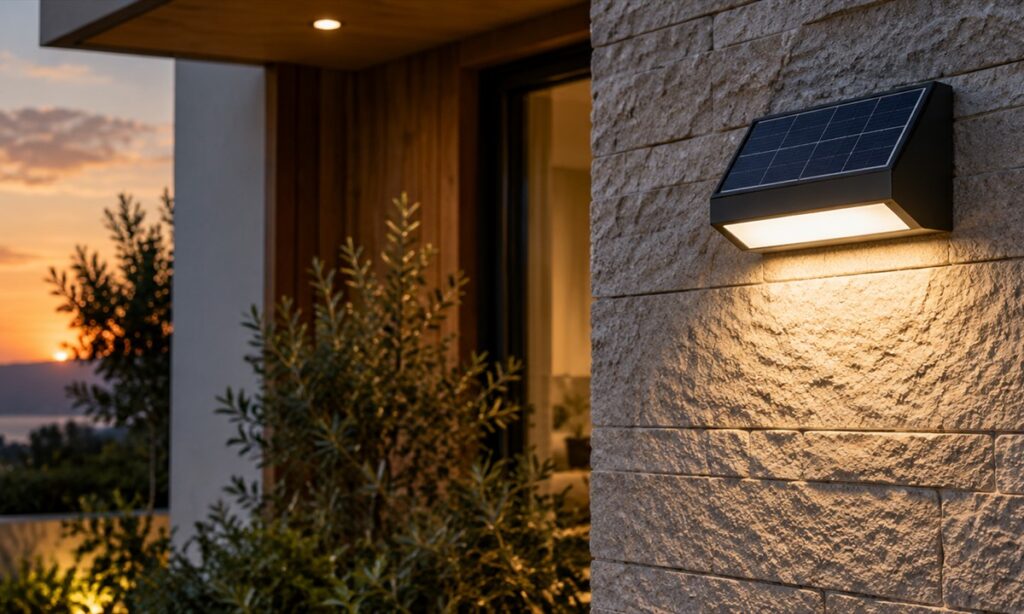













A solar street light is a small off-grid power system, not simply an LED luminaire with a panel attached. If a buyer compares quotations by “lamp wattage” alone, two products with the same label can deliver very different night-time performance.
The reliable way to specify a system is to work backwards from the site: required light, operating profile, local solar resource, worst-season autonomy and structural conditions.
Start with the road, not the product catalogue
Define the application before requesting a model. Record road or path width, pole spacing, mounting height, traffic type, surrounding ambient light and any local lighting criteria. Roadway design is not reduced to a single lux value: uniformity, glare, visibility of conflict areas and environmental spill also matter.
Ask the supplier for a photometric calculation based on the proposed optic, mounting height and spacing. The document should identify the luminaire file used, maintenance assumptions and the calculation grid. A lumen claim without an optic or layout cannot confirm useful light on the target surface.
Convert the lighting schedule into daily energy
The key quantity is daily watt-hours, not peak luminaire watts. A simple screening calculation is:
Daily load (Wh) = operating power (W) × hours at that power, summed across every dimming stage.
For example, a 60 W luminaire at full output for 5 hours and 30 W for 7 hours uses 510 Wh per night before controller and conversion losses. Motion sensing or scheduled dimming can reduce the energy requirement, but the quotation must state the actual profile rather than an undefined “smart mode.”
Size the panel with the worst useful solar month
Panel wattage is meaningful only with site solar data, orientation, tilt and system losses. Use a recognized solar-resource model for the project coordinates and review the low-resource design period—not only the annual average. Then account for temperature, dust, shading, wiring, controller efficiency and module ageing.
Request the calculation sheet. It should show the assumed peak-sun-hours or irradiation source, panel rating, loss factor and expected daily energy yield. A larger nominal panel does not compensate for shade from trees, buildings or the pole itself.
Treat battery capacity as usable energy
Battery comparisons should include chemistry, rated voltage, rated amp-hours, permitted depth of discharge, temperature range and end-of-life capacity assumption.
Nominal battery energy (Wh) = voltage × amp-hours.
Usable energy is lower after depth-of-discharge limits, low-temperature derating, ageing reserve and conversion losses. Therefore, “12 V 100 Ah” is not a complete autonomy statement.
Autonomy means how long the system can meet the agreed lighting profile without adequate solar recharge. Specify the required number of nights and the pass condition. Also ask what the controller does when state of charge becomes low: gradual dimming, a shorter schedule or abrupt shutdown.
Match pole height to optics and structure
Pole height influences coverage and uniformity; it cannot be selected independently from road width, optic and spacing. The solar panel also creates wind load near the pole top. The project engineer should check wind zone, panel area and angle, luminaire EPA, pole material and wall thickness, bracket geometry, base plate, anchor bolts and foundation.
For split systems, check cable routing and theft protection. For all-in-one systems, confirm access for battery and controller replacement. A technically adequate system still becomes expensive if routine service requires replacing the complete luminaire.
Put these items in the RFQ
- Project coordinates, road geometry and required operating nights.
- Lighting criteria and photometric calculation format.
- Hour-by-hour dimming or sensing schedule.
- Solar-resource source and worst-month design assumption.
- Panel rating, technology, orientation and loss allowance.
- Battery chemistry, usable Wh, autonomy and end-of-life basis.
- Controller protections, low-charge logic and monitoring options.
- Pole, bracket, anchor and foundation design inputs.
- Ingress, electrical-safety and market-specific compliance documents.
- Replaceable parts, warranty boundaries and claim evidence.
A practical quotation comparison
Create one table with three layers: lighting outcome, energy balance, y mechanical/serviceability. Mark any supplier entry that is only a catalogue claim and request the underlying test report or calculation. The best proposal is not automatically the one with the largest wattage or battery; it is the one whose assumptions are visible and appropriate for the site.
New Lights can review project inputs and prepare a model-level proposal for solar street lighting. Send the site location, road dimensions, desired schedule and installation constraints with your RFQ.
References
- Departamento de Energía de Estados Unidos, Consideraciones sobre alumbrado vial y de áreas alimentado por energía solar
- NREL, PVWatts documentation
- Illuminating Engineering Society, ANSI/IES RP-8-25 roadway and parking lighting
- IEC, IEC 60598-1:2024 general requirements and tests for luminaires
- New Lights, LED solar street light