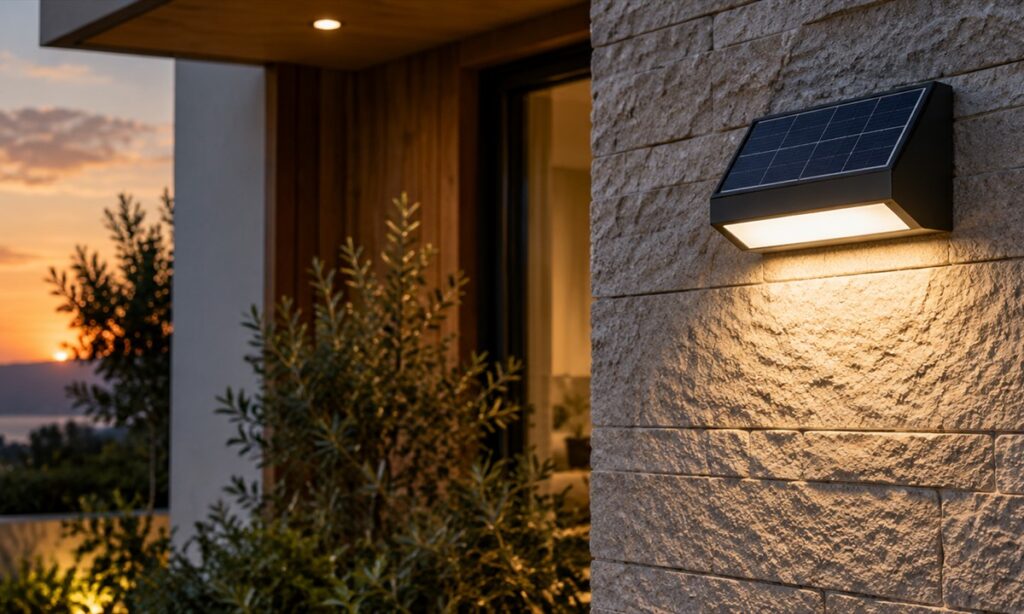













An IP rating does not tell a buyer whether an outdoor wall light will resist corrosion. IP testing concerns enclosure protection against access, dust and water under defined conditions; corrosion performance depends on the environment, metals, coatings, joints, fasteners and maintenance.
Coastal hotels, swimming-pool surroundings, industrial sites and ordinary urban façades should therefore not share one vague “weatherproof” specification.
Classify the real exposure
Describe distance from the sea, prevailing wind, salt deposition, humidity, rainfall, pollutants, temperature cycling and cleaning chemicals. Note whether the luminaire is under an eave, exposed to driven rain, mounted close to the ground or installed where water can remain in a recess.
ISO 12944-2 provides corrosivity categories for steel structures and is a useful language for environmental discussion, although a luminaire contains multiple materials and needs its own product specification. The buyer should translate the site description into agreed material and coating requirements.
Review the complete material stack
Ask for the base material and grade of the housing, bracket, screws, washers and springs. Identify die-cast alloy, stainless steel grade and any dissimilar-metal contact. Galvanic couples become more important when an electrolyte such as salty moisture bridges the metals.
For coated housings, request the pretreatment, coating type, target dry-film thickness, curing control and inspection method. Edges, tapped holes, cut surfaces and concealed interfaces often fail before the broad front face.
Use salt-spray evidence correctly
ISO 9227 and ASTM B117 define controlled salt-spray test environments. They do not select a universal exposure time or acceptance rule for every product, and they should not be used alone to predict years of outdoor service. ISO explicitly notes that salt-spray methods are useful for detecting coating discontinuities and maintaining process quality, not for ranking all materials or predicting long-term resistance.
A useful report identifies the test method and edition, specimen construction, pretreatment and coating, scribe condition if any, exposure duration, evaluation intervals and acceptance criteria. Confirm whether the tested sample represents the mass-production luminaire—including fasteners and joints—or only a flat coated coupon.
Inspect fasteners, joints and drainage
Corrosion risk often concentrates at screw heads, bracket interfaces, cable entries and areas where water sits. Check:
- compatible corrosion-resistant fasteners and washers;
- isolation of dissimilar metals where necessary;
- gasket compression without water traps;
- downward-facing or protected cable entries;
- drainage and ventilation strategy;
- coating coverage after machining;
- installation instructions for sealants and wall interfaces.
Do not assume a high IP code solves drainage. A fitting can resist a test jet yet retain condensation or corrosive deposits in service.
Add production and maintenance controls
The purchase specification should define incoming material verification, pretreatment bath controls, coating-thickness sampling, cure checks, adhesion or appearance criteria and traceability by batch. If a supplier changes alloy, powder vendor or pretreatment, require notification and risk-based revalidation.
Maintenance instructions should explain safe cleaning, prohibited chemicals, inspection intervals and replacement of damaged fasteners or seals. Coastal installations may need regular fresh-water cleaning; confirm the regime with the project designer and product supplier.
Lista de verificação de RFQ
- Site exposure and expected maintenance.
- Housing, bracket and fastener material grades.
- Pretreatment and coating system.
- IP evidence for the final construction.
- Salt-spray method, specimen and acceptance criteria.
- Dissimilar-metal and drainage controls.
- Production inspection and change notification.
- Installation and cleaning instructions.
New Lights can review outdoor-wall-light requirements by site rather than by IP code alone. Include installation photos, coastal distance, finish, mounting condition and target market in your inquiry.
References
- ISO, ISO 9227:2022 salt spray tests
- ASTM International, ASTM B117-26 salt spray apparatus
- ISO, ISO 12944-2:2017 classification of environments
- IEC, IEC 60529 — IP Code