


APPLICATION-SPECIFIC UV LIGHTING
UVA & UVB Specialty Lighting Solutions
Explore UVA and UVB lighting products for reptile care, insect attraction, aquarium applications, UV exposure processes and specialized test requirements. Select products according to wavelength, application and operating conditions—not lamp shape alone.
UVA315–400 nm
UVB280–315 nm
Selection LogicApplication before lamp format
01 / SpectrumUnderstand UVA and UVB ranges
02 / PerformanceCompare six technical factors
03 / ApplicationRoute by target response
04 / SafetyIdentify output and exposure path
05 / Inquiry DataPrepare measurable requirements
SPECTRUM BASICS
Understanding the UVA and UVB Spectrum
CIE defines ultraviolet radiation as optical radiation shorter than visible radiation and commonly subdivides it into UVA, UVB and UVC ranges. This page routes UVA and UVB applications; UVC belongs to a separate product and safety logic.
WAVELENGTH SPECTRUM
UVA
UVB
SHORTER WAVELENGTH →
400 nm
315 nm
280 nm
100 nm
UVA — 315–400 nm
UVA is the ultraviolet band closest to visible light. Depending on wavelength and source structure, it is used in insect-attraction systems, photochemical exposure, blacklight applications and selected biological lighting systems. Visible violet brightness does not measure UV output.
UVB — 280–315 nm
UVB has a shorter wavelength and is used in selected biological, animal-care and test applications. Suitability depends on the target species or process, spectral output, working distance and exposure conditions.
Same UV band does not mean the same product. Two lamps may both be described as UVA or UVB while having different peak wavelengths, spectral distributions, irradiance levels and application suitability.
APPLICATION LOGIC
Why UV Products Cannot Be Selected by Wavelength Band Alone
A reptile lamp, insect-attraction lamp and UV exposure lamp may all contain UVA output, but they are not interchangeable because their target response and operating conditions are different.
BIO-01
Reptile Lighting
Species, habitat, distance, barriers and available lighting gradient.
ENT-02
Insect Attraction
Target insect, spectrum, source position, trap structure and competing light.
IND-03
UV Exposure
Material response, irradiance, working distance, area and uniformity.
AQU-04
Aquatic Habitat
Species, water depth, covers, fixture position and operating cycle.
LAB-05
Test Products
Standard number, method, spectral range and measurement conditions.
PERFORMANCE DATA
Six Factors That Determine UV Performance
Electrical wattage, visible purple brightness and lamp length cannot replace spectral and installation data.
Spectral Distribution
The complete distribution shows where the source delivers radiation. A single peak-wavelength number does not describe the entire output.
Irradiance
Irradiance describes UV power received by a surface at a defined position. It is not the same as lamp rated power or total system consumption.
Working Distance
UV at the target changes with distance, fixture geometry, reflector design and installation conditions. A comparison needs a defined measurement distance.
Exposure Time & Dose
Process results depend on both irradiance and exposure time. Industrial exposure and biological lighting use different control logic.
Optical Barriers
Glass, plastic covers, mesh screens, water and fixture materials can change the radiation reaching the target.
Output Maintenance
A source may continue producing visible light while useful UV output changes. Follow product data and measured performance—not visible brightness alone.
APPLICATION ROUTES
Explore UV Lighting by Application
Define what the source must achieve before comparing lamp format, rated power or dimensions.
UVA and UVB lighting products for reptile, amphibian and controlled habitat applications.
Confirm before selection
Species and habitat · Fixture distance · Enclosure and screen structure
UVA sources for mosquito lamps, insect traps and commercial insect-attraction equipment.
Confirm before selection
Target insect · Trap structure · Lamp dimensions and electrical requirements
UV sources for photosensitive materials, printing plates and industrial exposure processes.
Confirm before selection
Material spectral response · Exposure area · Irradiance and working distance
Specialty UVA and UVB products for selected aquarium, amphibian and aquatic habitat requirements—not UVC water treatment.
Confirm before selection
Target species · Water or cover structure · Fixture position and operating cycle
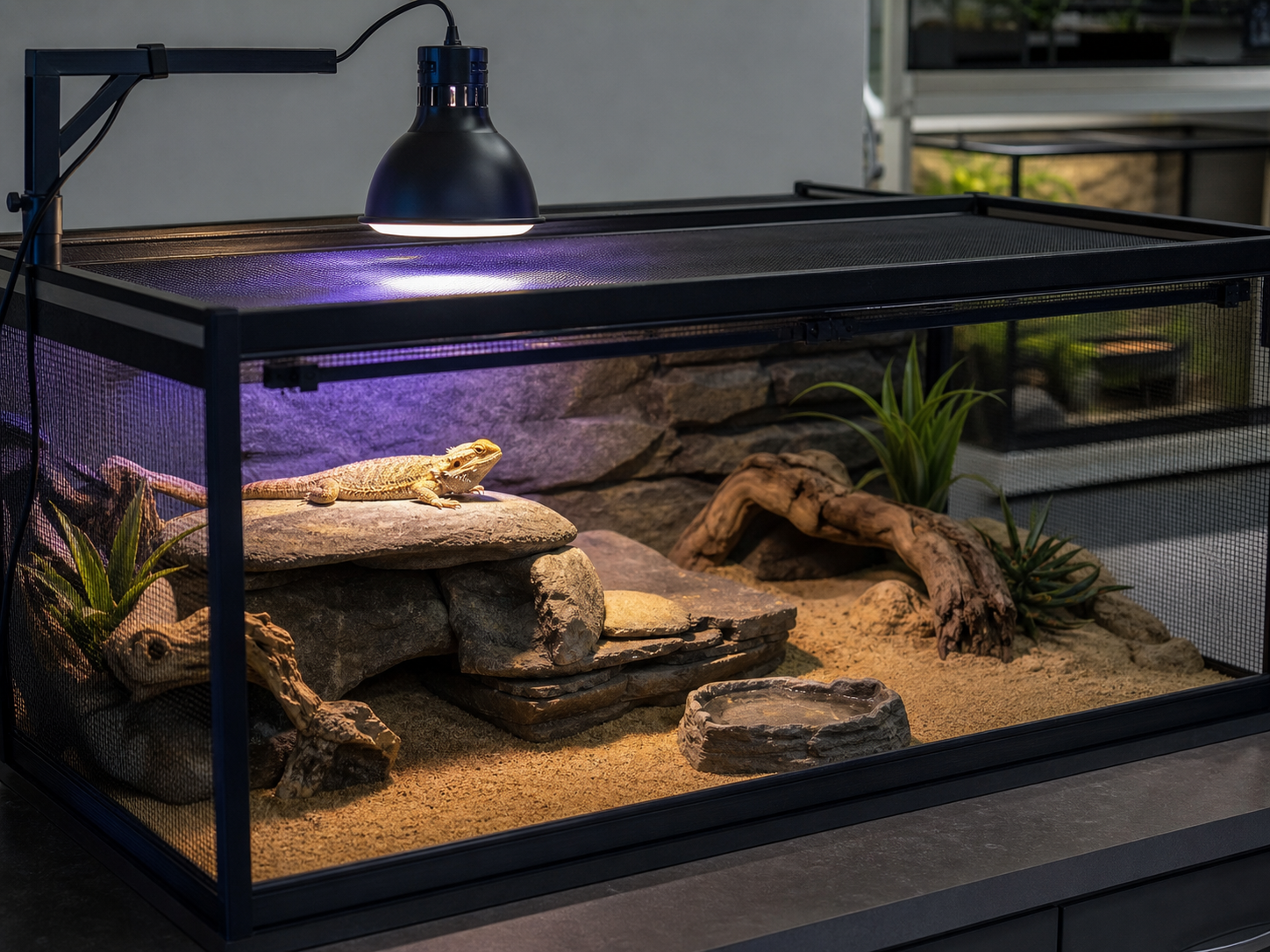
05 / REPTILE & AMPHIBIAN GUIDE
Design the Habitat, Not Just the Lamp Position
UVB selection should be considered together with species, habitat type, enclosure height, fixture position and any mesh or transparent barrier between the source and the animal.
A habitat should allow movement between different lighting conditions. UV radiation, visible light and infrared heat are separate functions and cannot automatically replace one another.
Important: This page does not prescribe one distance, exposure time or UVI range for every species.
SPECIALTY GUIDES
Application Notes That Prevent Incorrect Substitution
Each route requires a different target response, system structure and verification method.
Insect Attraction Is One Part of the System
The UVA source attracts target insects toward equipment. Capture is completed by the trap structure—such as a glue board, electric grid, airflow system or another collection mechanism. Attraction lamps should not be described as germicidal lamps.
Aquarium UV Must Be Defined by Purpose
“Aquarium UV light” is not precise enough. Buyers should define habitat lighting, biological exposure, visual presentation or water-treatment equipment. UVC water treatment belongs to a separate route.
Test Classification Needs a Standard
Specify the applicable standard, edition, measurement method and required classification when requesting a UV test source.
Visible Purple Light Is Not a UV Meter
UV output cannot be judged reliably by eye. Product selection and maintenance decisions should use specified optical data and measurements made under defined conditions.
UV Exposure Process Chain
01UV Source
02Optical Distribution
03Photosensitive Material
04Exposure Time
05Process Result
Spectral matching, output uniformity, working distance, thermal management and reflector geometry should be reviewed together for photosensitive-material processes.
DECISION MATRIX
UV Product Selection Matrix
Start with the target response, then confirm measurable optical, electrical, physical and application data.
| Application | Target Response | Primary Data to Confirm | Common Selection Risk |
|---|---|---|---|
| Reptile lighting | Animal habitat requirement | Species, distance, barriers, UV spectrum | One output for every species |
| Insect attraction | Target insect response | Spectrum, lamp format, trap design | Treating UVA as the complete trapping system |
| UV exposure | Photosensitive material response | Spectrum, irradiance, area, time | Selecting only by electrical power |
| Aquarium application | Aquatic or amphibian habitat | Species, water depth, cover, position | Confusing UVA/UVB with UVC treatment |
| Test application | Standard-defined response | Standard, method, measurement conditions | Using Class A without a standard reference |
08 / RESPONSIBLE USE
UV Safety Starts with Correct Product Identification
Artificial UV products require protection based on their band, output, exposure path and operating environment. Excessive UV exposure can harm eyes and skin; instructions must be product- and application-specific.
01Do not look directly at an operating UV source.
02Avoid unintended skin and eye exposure.
03Use shielding appropriate to the product and application.
04Follow product-specific distance and operating instructions.
05Restrict access where industrial exposure equipment is used.
06Do not reuse one generic instruction for different UVA and UVB products.
INQUIRY DATA
Technical Data Required for UV Product Selection
A useful request describes what is measured, where it is measured and how the source is installed—not only lamp wattage.
Optical Data
UV band
Peak wavelength
Spectral distribution
Irradiance
Measurement distance
Measurement area
Output maintenance
Electrical Data
Rated power
Input voltage
Frequency
Driver or ballast requirements
Lamp base
Starting method
Physical Data
Lamp length
Tube diameter
Fixture dimensions
Connector or base type
Reflector structure
Installation orientation
Application Data
Target material or species
Working distance
Exposure cycle
Environmental conditions
Required standard
Equipment compatibility
PRODUCT ROUTES
Explore UVA and UVB Product Families
Compare lamp format, electrical requirements and application conditions using the selected product’s technical data.
Reptile UV Lamps
UVA, UVB or combined sources for defined habitat applications.
Insect Attraction Lamps
UVA sources for compatible mosquito and insect-attraction equipment.
UV Exposure Lamps
Sources for photosensitive materials and industrial exposure systems.
Aquarium UV Lamps
Specialty habitat lighting, explicitly separated from UVC treatment.
Test & Reference UV
Products selected against a defined standard and test configuration.
11 / OEM & PROJECT SUPPORT
Support for UV Equipment Manufacturers and Specialty Lighting Buyers
For equipment manufacturers, distributors and private-label buyers, system verification comes before bulk supply.
01. Application Definition
Identify the target material, species, equipment or process before selecting a UV family.
02. Technical Matching
Compare wavelength, lamp format, electrical requirements and application conditions.
03. Sample & System Verification
Confirm the selected product inside the actual fixture, equipment or habitat structure.
04. Production & Supply
Coordinate approved products, private labeling, packaging and bulk-order preparation.
12 / TECHNICAL FAQ
UVA & UVB Specialty Lighting FAQ
Find guidance on spectrum, installation conditions and application requirements.
Tell Us What the UV Source Needs to Achieve
Send the application, target wavelength, product format, equipment information and operating conditions. Our team will help identify a suitable UVA or UVB product family for further confirmation.
Technical reference basis: CIE ultraviolet wavelength terminology · WHO ultraviolet health effects · Merck Veterinary Manual reptile housing and lighting. Product-specific instructions take priority over general educational content.