












“Daylight LED panel” is not one precise product category. It can mean an ordinary LED panel with a cool-white color appearance, an LED panel connected to daylight-responsive controls, or an artificial skylight designed to create a sky-and-sun impression. These options solve different tasks and require different evidence.
A palavra luz do dia alone does not prove that a panel senses ambient light, dims automatically, changes color temperature or reproduces natural daylight. Before comparing quotations, identify the intended function and exact model.
Identifique primeiro qual o significado aplicável
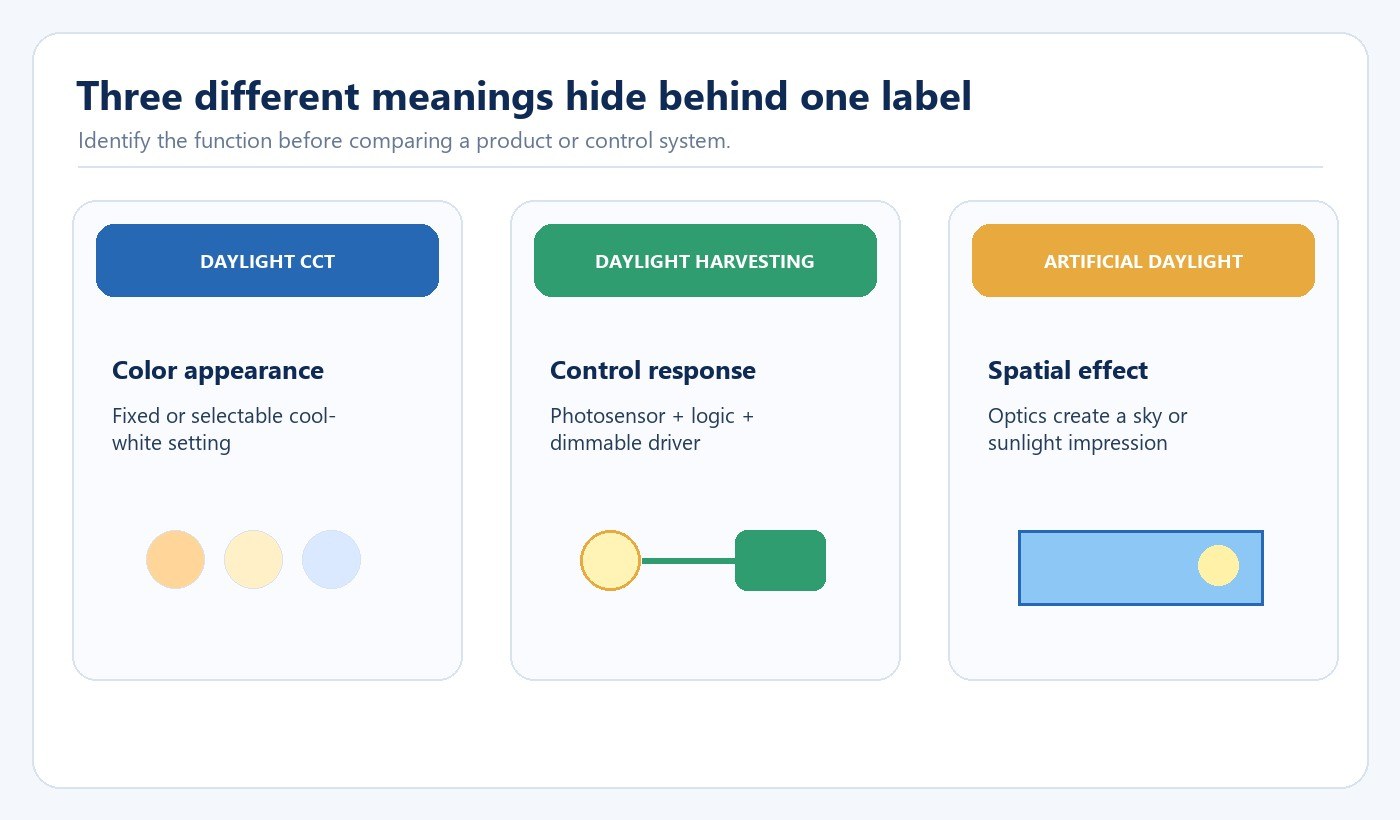
| Se o projeto significa… | Sistema necessário | Evidência a solicitar primeiro |
|---|---|---|
| Uma cor branca semelhante à luz do dia | Fixed-CCT or CCT-selectable LED panel | Exact CCT, chromaticity tolerance, color rendering, output and driver data |
| Resposta automática à luz natural da janela | Photosensor, control logic, dimmable driver and commissioned zone | Sensor type, topology, protocol, sequence, dimming range and commissioning method |
| Um efeito visual de céu ou luz solar | Sistema ótico de claraboia artificial | Aspeto instalado, construção ótica, dimensões, direcionalidade, controlos e fotometria |
Meaning 1: Daylight Can Describe CCT
Na linguagem de retalho e de projeto, luz do dia often describes a cooler white correlated color temperature. The U.S. Department of Energy defines CCT as a condensed description of white-light color appearance. It does not identify the complete spectrum, color rendering, direction or source of the light.
A fixed-CCT panel can be a conventional edge-lit or back-lit luminaire with no sensor and no automatic response. Its driver powers the LED array while the optical system spreads light across the luminous surface. An edge-lit design sends light through a guide plate; a back-lit design positions LEDs behind a diffuser with space for optical mixing.
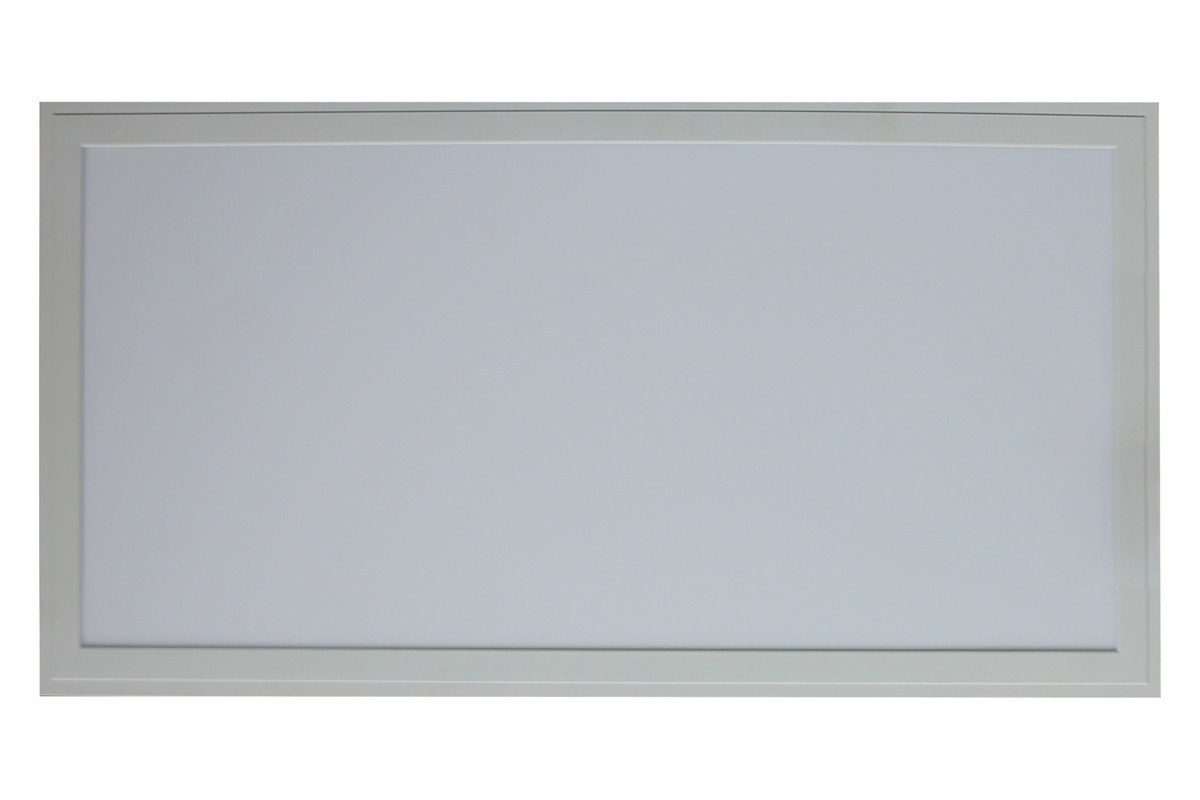
The visible face and frame do not reveal whether the quoted model is fixed-CCT, selectable or controllable. Sample approval should record that function together with the exact product code, driver and control interface.
For size, mounting, optics and driver selection, use the broader commercial LED panel selection guide. O guia de planeamento de painéis versus downlights aborda a intenção da configuração, e não o significado da designação daylight.
CCT Is Not a Complete Description of Daylight
Natural daylight changes with time, weather, orientation, glazing and surrounding surfaces. Its spectrum, intensity and direction all vary. A source carrying a daylight CCT label represents a color-appearance region; it does not automatically match those other properties.
Two LED sources with a similar CCT can render materials differently because their spectral power distributions differ. The DOE therefore treats CCT as useful but incomplete and discusses color fidelity separately. For a color-sensitive project, review chromaticity tolerance, CRI or other specified color-quality measures, and evaluate a representative sample under the real finishes.
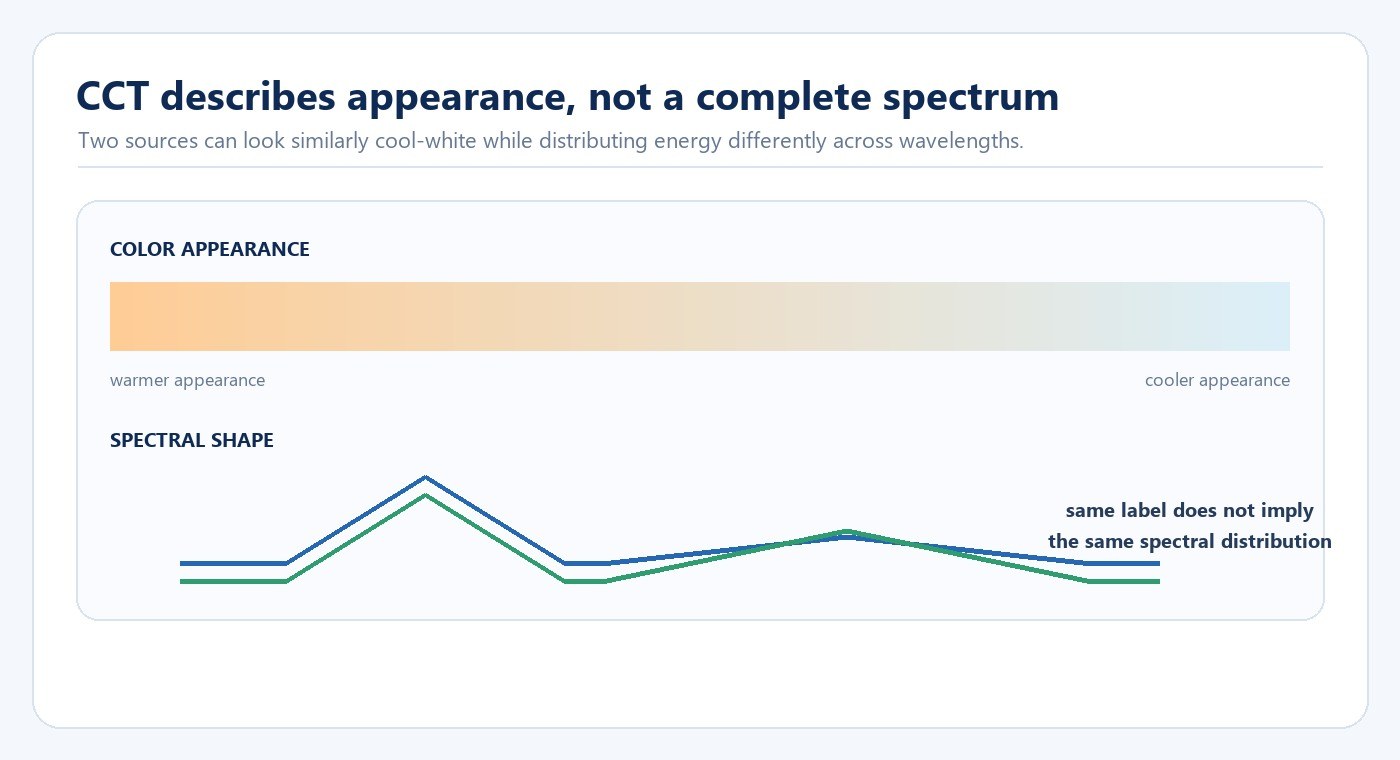
Do not treat the word daylight as evidence of sunlight equivalence, circadian performance or suitability for a color-critical task. Those conclusions need separately defined metrics and test conditions.
Selectable CCT and Tunable White Are Separate Functions
A CCT-selectable panel normally offers discrete settings chosen during installation. A tunable-white system can move between warm and cool white using multiple LED channels and a compatible controller. The DOE notes that the control architecture and mixing algorithm determine how intensity and color behave across the range.
Neither feature automatically responds to window daylight. A project can combine tunable white with daylight harvesting, but the specification must separate intensity control, color control, schedules, sensor response and user overrides. Otherwise two suppliers may quote systems with very different behavior under the same informal label.
| Função da cor da luz | Definições disponíveis | Limite de controlo típico |
|---|---|---|
| Fixed CCT | Um ponto de branco definido de fábrica | A intensidade pode ser fixa ou regulável separadamente |
| CCT-selectable | Vários pontos de branco discretos | A definição é habitualmente selecionada durante a instalação |
| Branco ajustável | Uma gama contínua ou programada de quente a frio | Comandos de intensidade e cor separados ou coordenados |
| Branco ajustável com aproveitamento da luz natural | Gama de cor mais resposta automática do fluxo luminoso | A lógica de cor, a resposta à luz natural e as substituições devem ser comissionadas em conjunto |
Significado 2: o aproveitamento da luz natural é um sistema de controlo
The U.S. Department of Energy and PNNL describe daylight-responsive lighting as a coordinated control system. Daylight harvesting uses available natural light as an input to reduce electric-light output when the controlled area already has sufficient light. The behavior belongs to the complete system: photosensor, control logic, controllable driver, zoning and commissioning.
A closed-loop sensor views the occupied area and responds to the combined result of daylight and electric lighting. An open-loop sensor views incoming daylight without directly measuring the controlled electric-light contribution. The choice affects placement, calibration and stability.
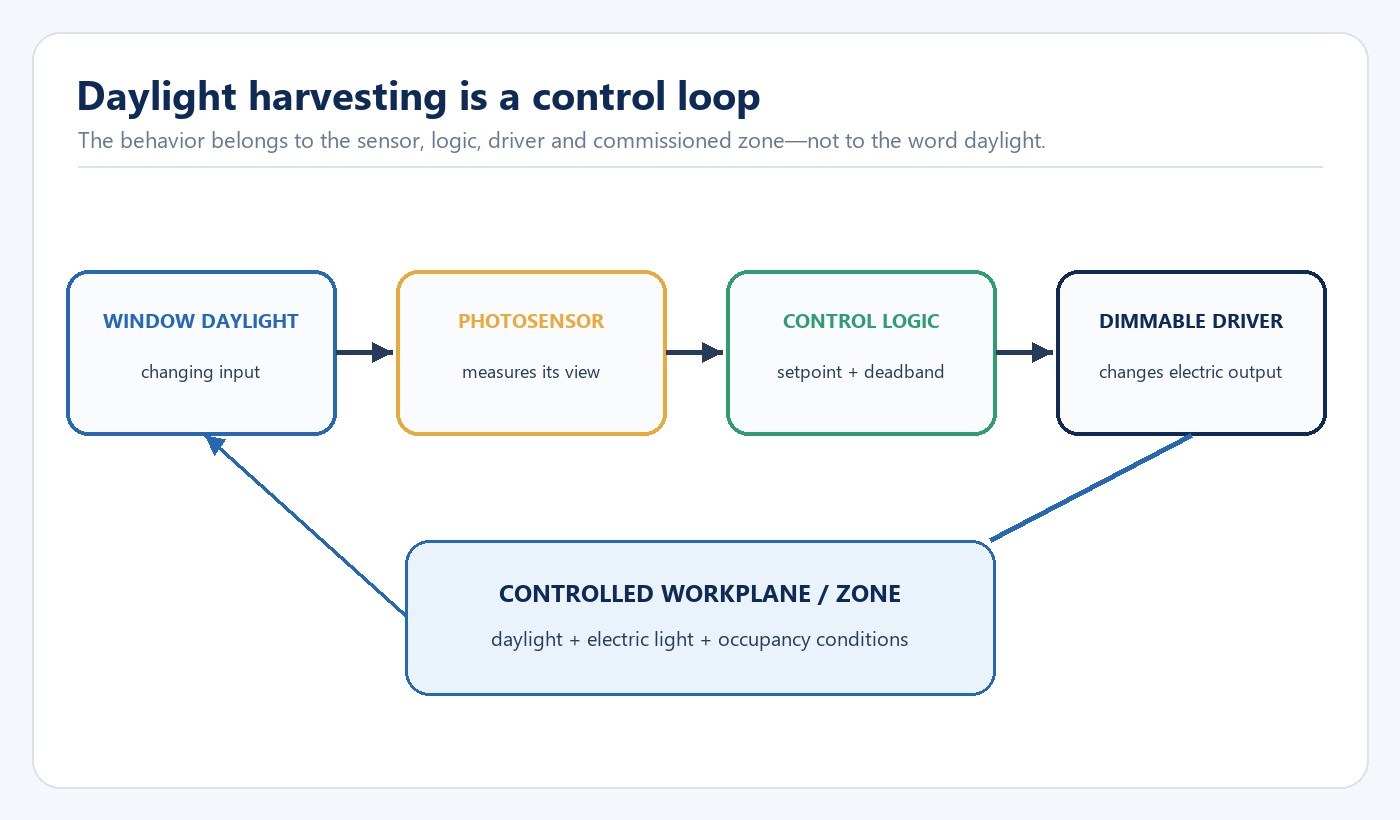
The controller can command the driver through 0–10 V, DALI, a digital network, wireless control or another supported interface. Protocol compatibility alone is insufficient: the minimum dimming level, fade behavior, failure state and control sequence must also match the project.
O comissionamento determina se o circuito funciona
Commissioning establishes the high level, minimum level, setpoint, response speed and deadband. Deadband limits repeated brightening and dimming when clouds move or readings fluctuate near a threshold. Occupancy controls, schedules and manual overrides must be coordinated with the daylight response.
Sensor placement matters because a sensor can be dominated by the luminaire, window glare, a bright work surface or an unrelated zone. Furniture, blinds, finishes and later space changes can alter the relationship between the sensor reading and the task area. The design therefore needs a documented control zone and a practical recommissioning method.
| Sintoma | Limite provável a inspecionar | Evidência útil |
|---|---|---|
| As luzes oscilam em dias nublados | Tempo de resposta, banda morta ou campo de visão do sensor | Registo de comissionamento e observação de tendências em tempo real |
| A fila junto à janela reduz a intensidade, mas a fila interior não | O zoneamento ou a sequência podem ser intencionais ou incorretos | Desenho das zonas e sequência de operações |
| O fluxo luminoso nunca diminui o suficiente | Mínimo do driver, limite do controlador ou ajuste de limite superior | Curva do driver e limites programados |
| A área torna-se demasiado escura após alterações no mobiliário | A relação entre o sensor e a tarefa foi alterada | Nova medição em pontos de tarefa definidos |
Significado 3: a claraboia artificial é uma categoria ótica
An artificial skylight aims to create a visual impression associated with a window, blue sky or directional sunlight. It may use a deep optical cavity, a luminous sky surface, directional optics, tunable color or programmed scenes. That goal is different from providing uniform general lighting with a flat panel.

An artificial skylight may also use schedules, sensors or tunable controls, but those are added functions. Its optical effect does not prove daylight harvesting, and daylight harvesting does not create a realistic sky view. Review the guia de planeamento de projetos de claraboias artificiais para a geometria de visualização, a profundidade do rebaixo, as superfícies da sala e as decisões relativas à maqueta.
Uma Sequência de Decisão para Compradores
Comece pelo resultado de que a sala necessita, não pela designação do produto.
- Defina o resultado. Is the task cool-white appearance, automatic electric-light reduction, tunable color, or an architectural sky effect?
- Defina as variáveis controladas. State whether intensity, CCT, scene, occupancy and daylight response are fixed or adjustable.
- Identifique os componentes incluídos. Separate luminaire, driver, sensor, controller, gateway, user interface and commissioning service.
- Solicite evidências específicas do modelo. Match photometry, color, dimming and control documents to the quoted product code and revision.
- Construa uma maqueta representativa. Test the actual finishes, window condition, sensor location and viewing positions.
- Congele a configuração aprovada. Record product codes, settings, addresses, sensor location and change-control requirements.
O LED lighting sample evaluation checklist provides a repeatable way to record identity, configuration, test purpose and acceptance criteria. For manufacturing and configuration-control questions, review fábrica da New Lights e capacidades de fabrico.
O que incluir no RFQ
For a fixed or selectable panel, request dimensions, mounting, input, power, lumens, efficacy, CCT settings, chromaticity tolerance, color rendering, UGR or luminance data where relevant, flicker, driver, dimming method and thermal limits.
For daylight harvesting, add sensor type, placement rules, zoning, topology, protocol, dimming range, setpoints, response time, deadband, fail state, override behavior and commissioning deliverables. Confirm which parts and services are included.
For an artificial skylight, request optical construction, dimensions, recess depth, directional effect, color range, control behavior, mounting, photometry and representative installed evidence. Do not compare it with a flat panel on lumens alone.
Se o requisito ainda for ambíguo, contacte a New Lights with the room dimensions, ceiling, window orientation, desired visual effect, CCT behavior and control sequence.
Perguntas Frequentes
Does every daylight LED panel have a light sensor?
No. Daylight may describe only the white-light color. Daylight-responsive operation requires a photosensor, control logic and a compatible dimmable driver.
Um painel daylight é automaticamente branco ajustável?
No. It may have one fixed CCT or several selectable settings. Continuous tunable-white behavior must be specified for the exact model and controller.
O aproveitamento da luz natural altera a temperatura de cor?
Not necessarily. Its primary control variable is usually electric-light output. Color tuning is a separate function unless the sequence explicitly coordinates both.
Can a daylight LED panel reproduce sunlight?
A CCT label does not establish spectral, directional or visual equivalence to sunlight. Artificial-skylight products use a different optical architecture and still require model-specific evaluation.
Porque é que as luzes reativas à luz natural continuam a mudar em dias nublados?
The response time, deadband, setpoint or sensor view may be unsuitable. Review and recommission the complete control zone before replacing the panel.
Todos os URLs legados traduzidos podem redirecionar para este artigo em inglês?
Not by default. The English, French, German and Spanish legacy URLs remain separate migration decisions until language-equivalent destinations and redirect scope are approved.
Fontes editoriais
- Departamento de Energia dos EUA, LED Basics
- Departamento de Energia dos EUA, LED Color Characteristics
- Departamento de Energia dos EUA, Understanding LED Color-Tunable Products
- U.S. Department of Energy and Pacific Northwest National Laboratory, Guia de controlos de iluminação