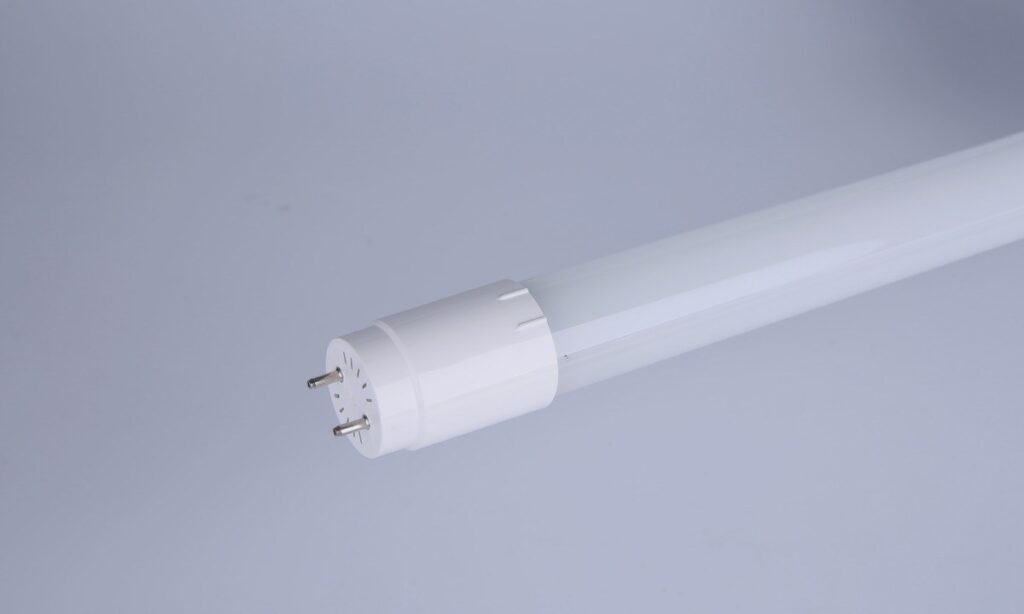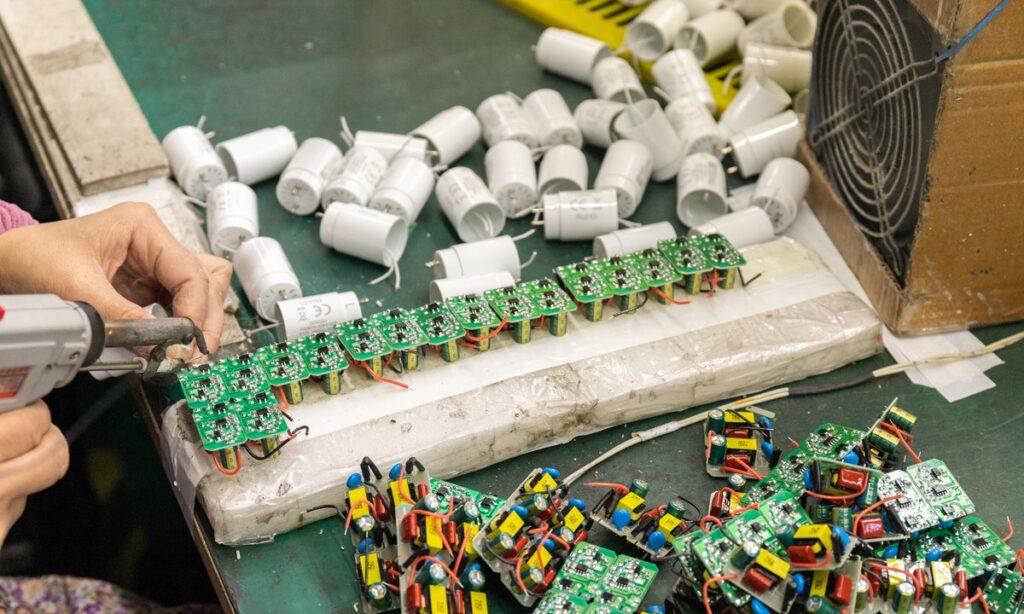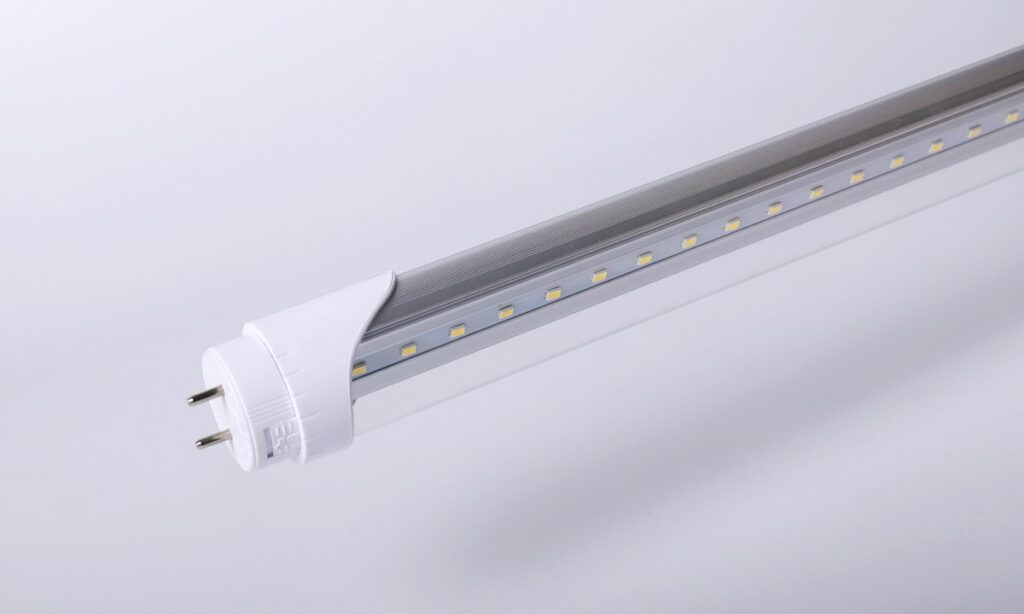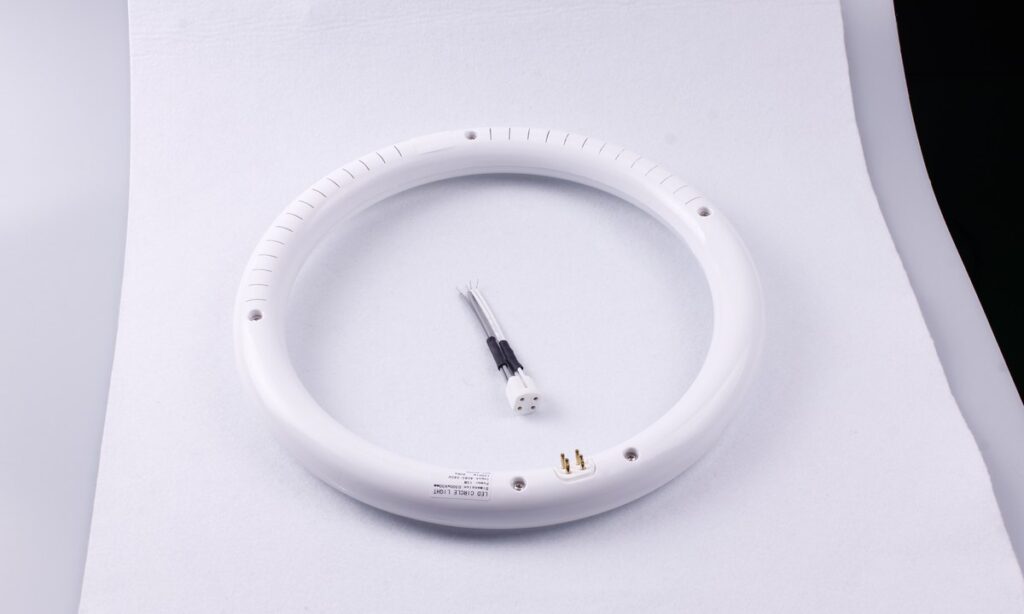













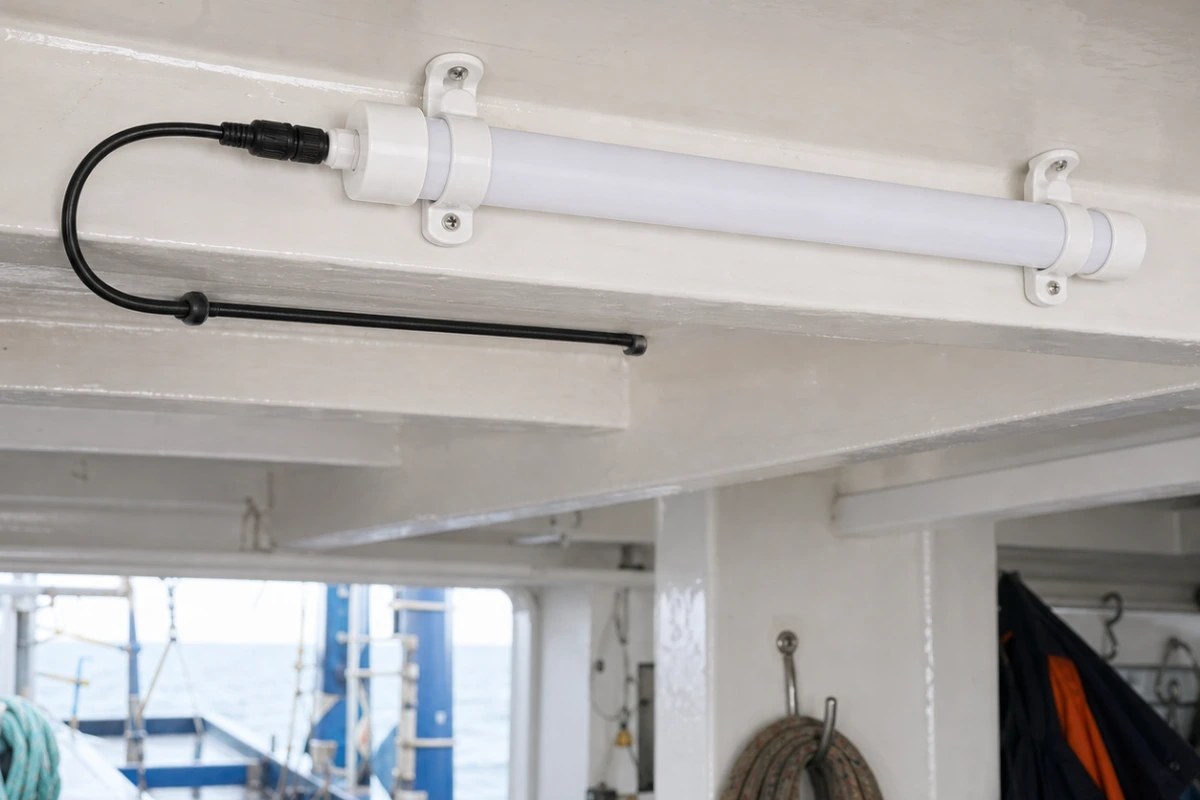
New Lights publishes a T10 LED tube family for fishing-boat and other applications with AC/DC 12–24V input, M10 connectors and an IP65 claim. These features can suit selected auxiliary lighting, but they do not make the tube submersible, saltwater-proof or approved as a navigation, emergency or hazardous-location light.
When a tube flickers, dims or stops operating, diagnose the complete circuit. Boat batteries, chargers, converters, cable runs, connectors, linked loads, mounting and environmental exposure can all contribute.
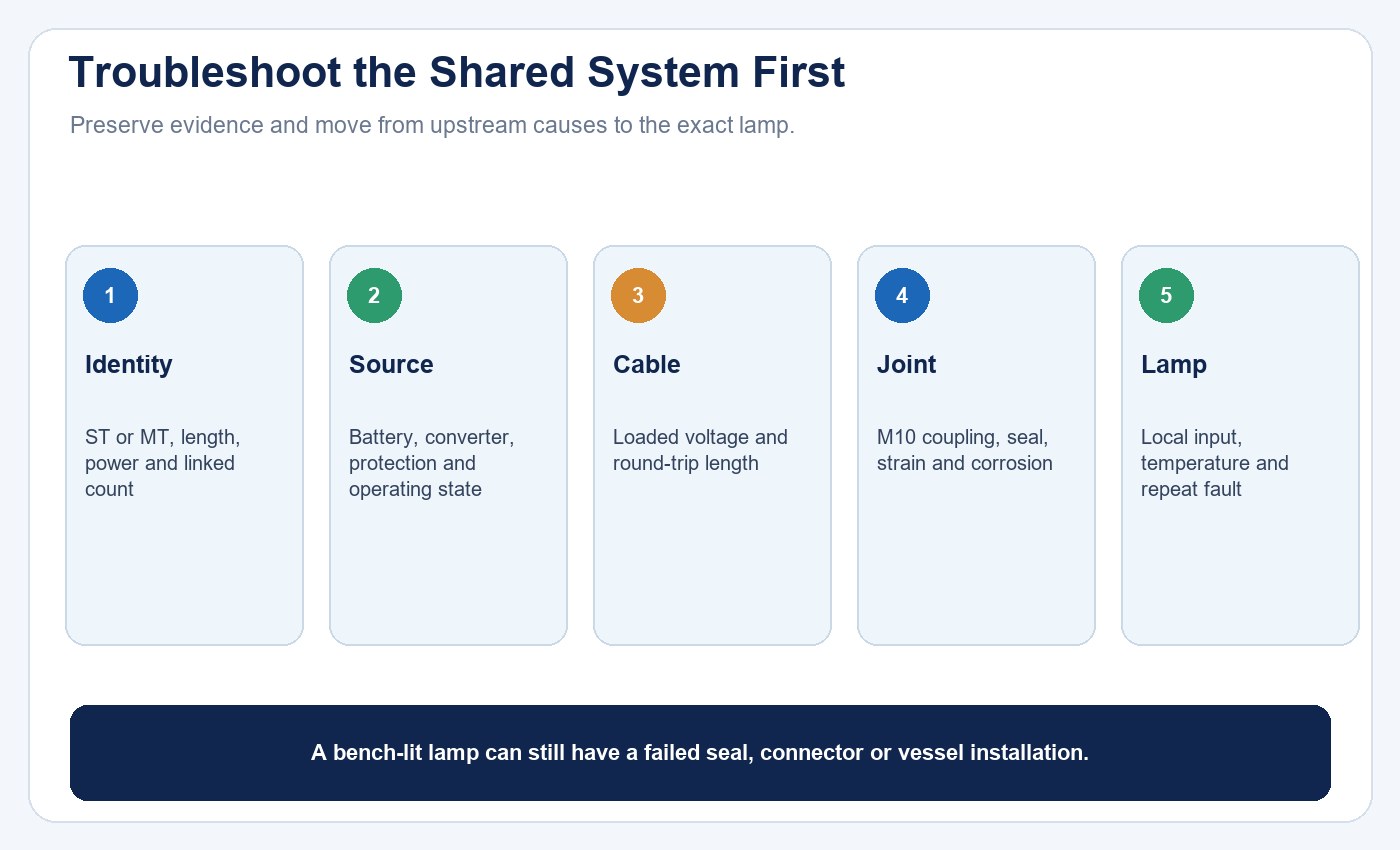
Start with shared system causes before replacing the lamp. Preserve the failed configuration so the evidence is not lost during troubleshooting.
O mais amplo LED failure diagnosis guide explains how to separate supply, driver and LED-board causes. This article applies that logic to the New Lights low-voltage T10 fishing-boat family.
Identifique os Modelos ST e MT
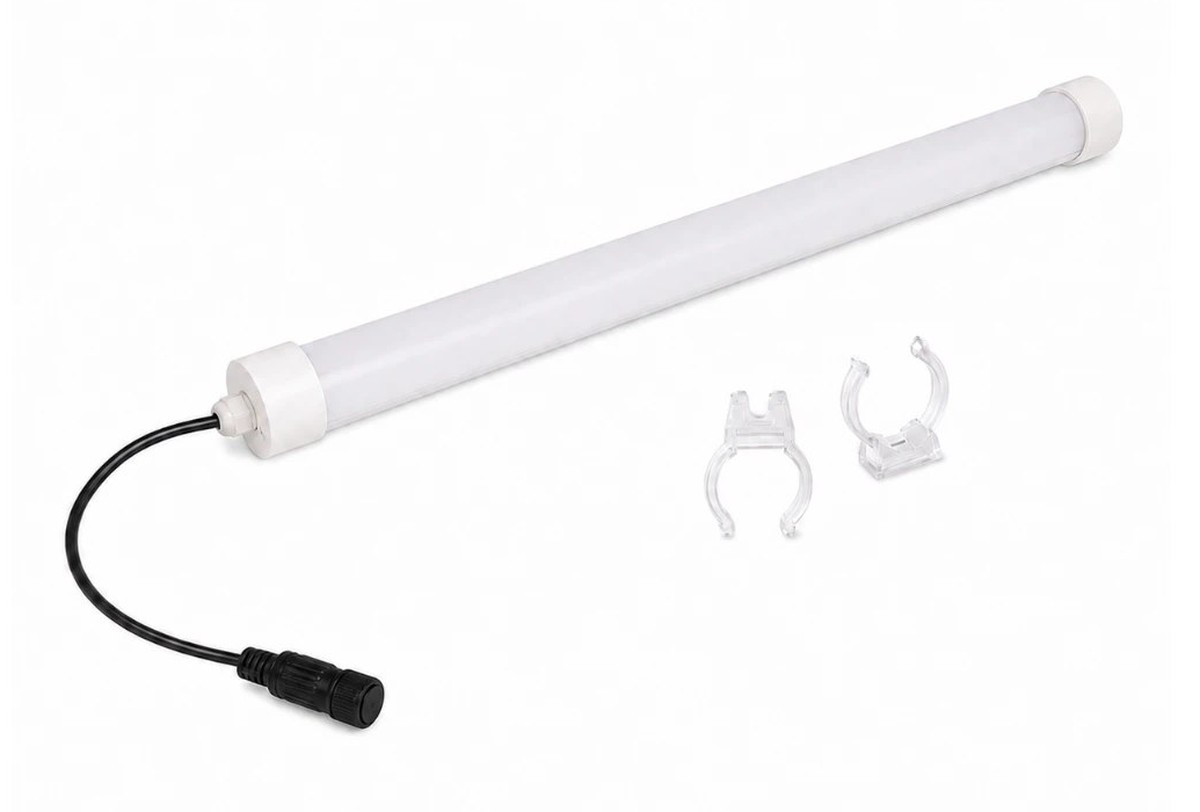
The published range includes 350, 550 and 750 mm tubes at 10W, 20W and 30W. Each size appears in an ST and MT version.
The table marks ST models as not interconnectable and MT models as interconnectable. The page says that up to three lamps can be linked. Do not connect an ST product merely because its connector looks similar, and do not exceed the approved linked quantity.
Record the complete model, input arrangement, serial or batch, cable, power source and linked count before troubleshooting.
| Campo de identificação | Versão ST | Versão MT | Consequência para o diagnóstico |
|---|---|---|---|
| Comprimentos publicados | 350, 550 and 750 mm | 350, 550 and 750 mm | Confirme o modelo físico antes de substituir componentes |
| Potências publicadas | 10, 20 and 30 W | 10, 20 and 30 W | Current and voltage-drop calculations depend on the exact load |
| Interligação | Não identificado como interligável | Interligável, no máximo três lâmpadas | Nunca construa uma cadeia apenas com base na aparência |
| Input family | 12–24 V AC/DC | 12–24 V AC/DC | Obtain exact tolerance, polarity and protection for the model |
Problema 1: Sem Luz
Start with safe checks at the circuit level. Confirm that the supply is available, the correct circuit is selected and protective devices have not operated. Inspect cables and connectors for damage, looseness, contamination or corrosion.
The page states AC/DC 12–24V, but the exact input tolerance, polarity behavior and protection details were not retrieved. Follow the model instruction. Do not assume that every DC polarity or AC source is accepted simply from the range label.
Qualified personnel can verify voltage at approved points under appropriate vessel procedures. A normal reading at the battery does not prove adequate voltage at the last lamp after cable and connector losses.
Record voltage with the circuit loaded, not only open-circuit. Compare the source, first connector and lamp input while the symptom is present. Note whether the charger, engine or other loads were operating, because a fault that appears only in one vessel state may be upstream of the lamp.
Problem 2: Flicker or Intermittent Operation
Flicker can be caused by a loose M10 connector, damaged cable, unstable converter, charger interaction, poor battery connection, voltage drop, internal driver fault or moisture. Note whether the symptom follows engine speed, charging, another load, waves, movement or rain.
Gently observing whether vibration changes the symptom can help locate a mechanical connection issue, but do not pull or twist energized damaged wiring. Isolate power before opening or reseating components according to instructions.
If several lamps flicker together, investigate the shared supply and upstream connections. If only one lamp is affected, compare its connector, cable section and tube with the others while preserving evidence.
Utilize o lista de verificação de cintilação, fator de potência e THD to separate visible symptoms from electrical measurements. On a low-voltage vessel circuit, source and converter stability remain part of the test boundary.
Problem 3: Voltage Drop in Linked Runs
A 12V or 24V circuit can experience meaningful voltage drop across long or undersized cables and multiple connectors. The final lamp may dim, cycle or fail to start even when the source voltage is acceptable.
Calculate the circuit from actual load current, conductor size, round-trip length, connector resistance and source limits. The New Lights page states a maximum of three interconnected lamps, but it does not publish cable-length or current rules in the retrieved content. Obtain those limits before designing a chain.
Do not treat “maximum three” as proof that any three wattages can operate on any adapter or cable. Verify total load and protection.
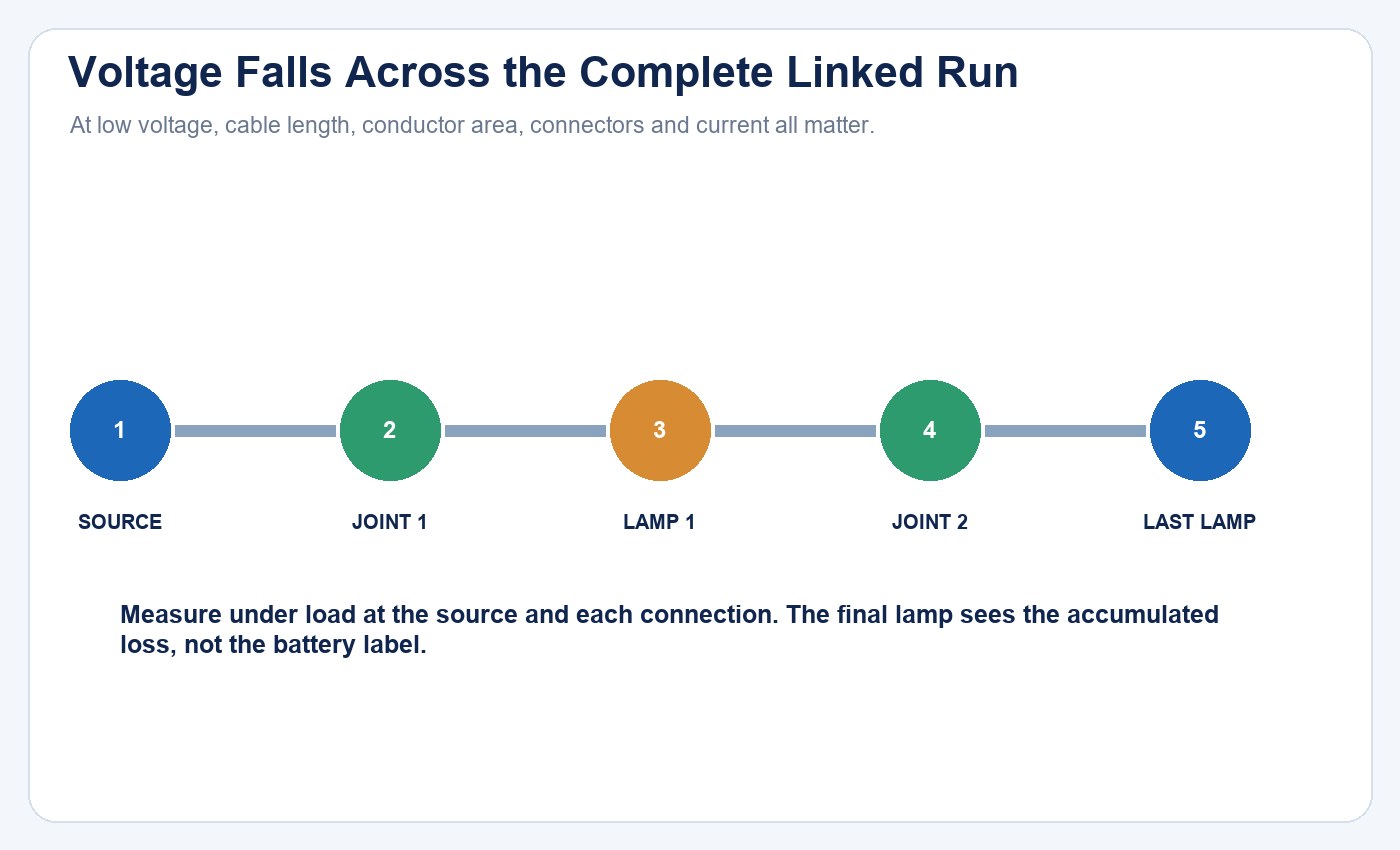
Every cable section and connector adds resistance. Measure the final lamp under load and compare the result with the exact model input limit.
| Observação | Limite provável | Teste que separa as causas |
|---|---|---|
| Todas as lâmpadas escurecem em conjunto | Battery, converter or shared feed | Measure source and feed voltage under the same load state |
| Apenas a última lâmpada entra em ciclo | Comprimento do cabo, resistência do conector ou limite da cadeia | Measure voltage at each connection under load |
| A avaria acompanha um tubo | Lâmpada ou o respetivo conector local | Troque apenas dentro de configurações idênticas aprovadas e registe o resultado |
| A avaria altera-se com o motor ou o carregador | Regulação da alimentação ou interferência | Compare estados de funcionamento definidos da embarcação |
Problema 4: Corrosão do Conector
Salt, moisture and dissimilar materials can increase contact resistance. Early signs include discoloration, deposits, heat marks, intermittent light or a voltage difference across a connection.
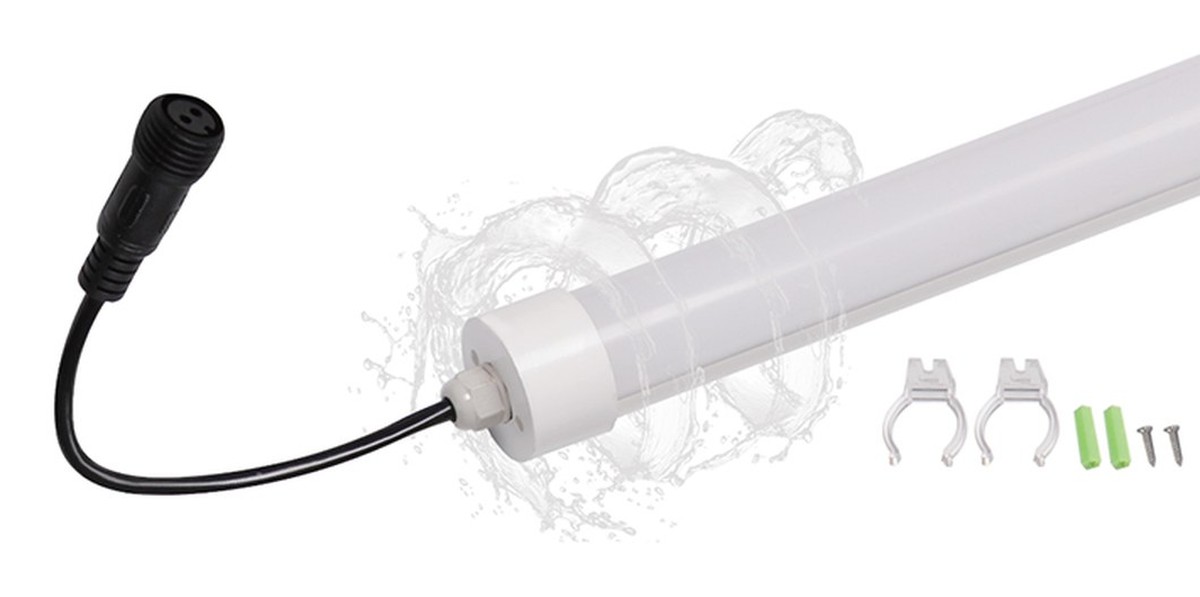
Inspect M10 mating surfaces, seals, cable strain relief and caps. Replace damaged parts with approved components; improvised connectors may change ingress protection and current capacity.
Do not claim corrosion resistance from IP65. IP tests address defined dust and water ingress conditions, not salt-mist durability or galvanic compatibility. A marine or coastal claim needs separate evidence.
O guia de manutenção de iluminação e peças sobresselentes ajuda a estruturar inspeções recorrentes, identidades de substituição aprovadas e registos de falhas.
Problema 5: Entrada de Água e Condensação
IP65 does not mean immersion protection. Check end caps, connector joints, cable entries, cracks, mounting orientation and evidence of trapped water. Photograph the tube before disassembly and keep the failed configuration for supplier review.
The complete IP report should identify tested model, connectors, caps, cables and orientation. If lamps are interconnected, verify that the linked joint was inside the test scope.
Condensation can occur even without an obvious external leak because temperature and humidity change. IP65 alone does not establish condensation performance.
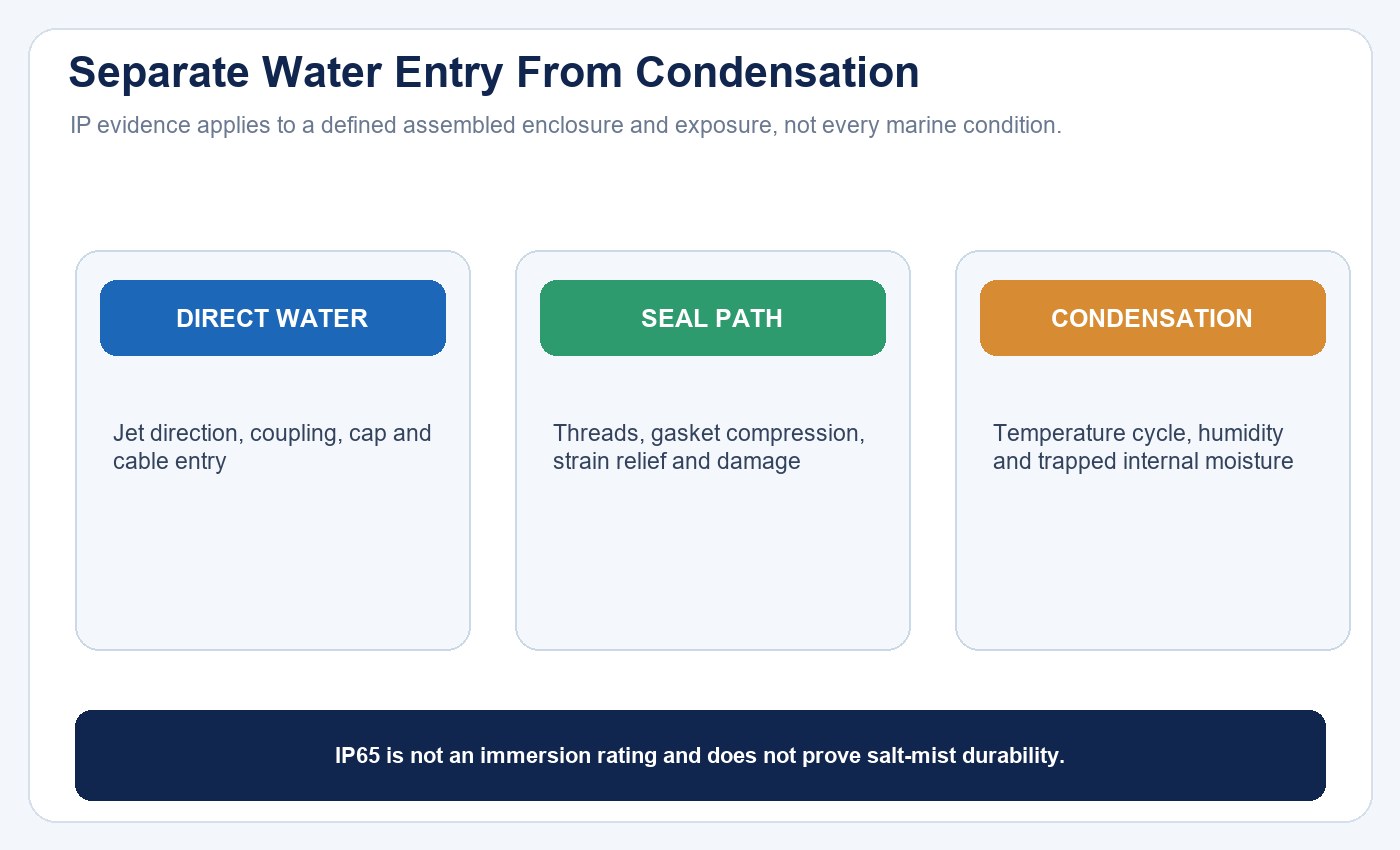
External water entry and internal condensation are different mechanisms. Inspect the complete assembled path and the vessel’s temperature cycle.
| Evidência de humidade | Mecanismo possível | Resposta necessária |
|---|---|---|
| Água junto de um conector | Acoplamento solto, vedante danificado, tensão no cabo ou tampa incorreta | Isole, documente e substitua os componentes de vedação aprovados |
| Gotículas distribuídas no interior | Condensação ou ciclos de pressão | Reveja o ciclo de temperatura e humidade e a construção do produto completo |
| Falha repetida após limpeza | Direção do jato, ataque químico ou vedantes deslocados | Verifique o método de limpeza e a compatibilidade dos materiais |
| Evento de submersão | Exposure outside the IP65 boundary | Retire de serviço e siga o procedimento de inspeção aplicável |
Para uma explicação mais ampla das classificações de invólucro, utilize o guia de classificação IP e o IP65 fixture selection guide.
Problema 6: Vibração e Danos de Montagem
Boat motion can loosen brackets, fatigue cables or load connectors. Over-tightening may also crack plastic parts or distort seals. Use the approved supports, spacing and fastener limits.
Inspect for movement, abrasion, cracked clips and cable tension. The connector should not carry the tube’s mechanical load unless specifically designed to do so.
No vibration or shock report was retrieved for this family, so do not describe it as vibration-resistant without evidence. A rough-service installation may need additional validated retention or a different product.
Problema 7: Redução de Luz ou Alteração de Cor
Reduced output can result from low voltage, dirt, lens aging, high temperature, driver behavior or LED aging. Color change can involve optical materials, LEDs or heat exposure.
Clean only with materials compatible with the tube and seals. Aggressive solvents can haze or crack plastics. Request approved cleaning instructions for fish oils, salt deposits or other site contaminants.
The published table does not provide a reliable efficacy value: the column labelled “Lumen Efficacy” contains interconnection text. Obtain total lumens, efficacy and photometry for the exact model before evaluating performance loss.
Problema 8: Acumulação de Calor
Low-voltage LEDs still produce heat. An enclosed compartment, nearby engine equipment, direct sun or restricted airflow can raise the tube and driver temperature.
Request permitted ambient and case-temperature limits. Test the installed tube after stabilization under representative operation. Do not infer high-temperature capability from a low-voltage input or tube shape.
Temperature can also affect cable seals and connector materials. Inspect for hardening, discoloration and loss of elasticity during maintenance.
Mantenha as funções de segurança separadas
Auxiliary tube lighting should not be used as a navigation, collision-avoidance, life-saving, emergency or hazardous-location light unless the exact product carries the required approval and performance evidence.
Color, intensity, distribution, redundancy, power source and placement requirements for regulated vessel lights are not established by a general T10 product page. Maintain required safety lighting independently.
The U.S. Coast Guard warns that unapproved LED, rope, underwater or decorative lighting may violate navigation-light provisions. Treat this tube as auxiliary work lighting unless the exact installation has the approvals and photometric performance required by the vessel’s jurisdiction.
Lista de verificação de inspeção preventiva
Em intervalos adequados à embarcação e à exposição, inspecione:
- Modelo do tubo e identificação ST/MT.
- Supply, protection and shared loads.
- Abrasão, tensão e suportes do cabo.
- Assentamento e corrosão do conector M10.
- Tampas de extremidade, vedantes, fissuras e evidência de água.
- Clipes de montagem e desgaste por vibração.
- Output stability at different operating states.
- Quantidade interligada e comportamento da lâmpada final.
- Danos causados por limpeza, UV e calor.
- Repita as falhas por localização e lote.
After service, verify function and the restored protection boundary. A tube that illuminates on a bench may still have a damaged seal or connector.
O LED lighting sample evaluation checklist can be adapted to a representative vessel trial. Include the most exposed mounting positions, longest approved cable run and every intended operating state.
Evidências a solicitar antes da compra
Solicite documentação ao nível do modelo para:
- input range, polarity and protection;
- classificações da cablagem e do conector M10;
- combinações interligadas permitidas e limites de cabo;
- lúmenes totais, eficácia e fotometria;
- IP65 complete-test configuration;
- névoa salina, corrosão, UV, vibração e impacto, quando exigido;
- limites de temperatura ambiente e da caixa;
- compatibilidade de materiais e limpeza;
- applicable marine or market compliance;
- service parts and warranty.
| Pacote de evidências | Pergunta mínima do projeto |
|---|---|
| Desenho elétrico | What input, polarity, protection, connector and linked combination are approved? |
| Registo de ensaio IP | Que lâmpada, cabo, tampa, conector, orientação e condicionamento foram ensaiados? |
| Evidências ambientais | A névoa salina, os UV, a vibração, o impacto e os produtos químicos de limpeza estão dentro do âmbito? |
| Registo fotométrico | Does the work area receive the required output and distribution? |
| Controlos de produção | Como se manterão consistentes os materiais aprovados, as peças de vedação e a cablagem? |
Utilize o LED product compliance checklist para associar as evidências ao mercado-alvo, e o guia de avaliação de fornecedores para controlar alterações da amostra à produção. A página da fábrica da New Lights fornece contexto de fabrico sem substituir evidências ao nível do modelo.
Conclusão
Common T10 boat-tube problems are best handled by tracing the complete low-voltage system. Identify the ST or MT model, verify supply and voltage drop, inspect M10 connectors and seals, check mounting and environmental exposure, and preserve evidence before replacing parts.
New Lights publishes a six-model 12–24V family. For a bounded review, contacte a New Lights com o modelo, alimentação, quantidade interligada, comprimento do cabo, sintoma e fotografias da instalação.
Perguntas Frequentes
Can an IP65 T10 tube be submerged?
No. IP65 is not an immersion rating. Keep the product within its verified installation scope.
Os seis modelos podem ser todos interligados?
Não. A página indica que os modelos MT são interligáveis e os modelos ST não são interligáveis.
Why does the last linked lamp flicker?
Possible causes include voltage drop, connector resistance, source limits or an overloaded chain. Verify the approved circuit and measurements.
Does 12–24V mean polarity does not matter?
Não necessariamente. Siga as instruções exatas de cablagem e polaridade do modelo; estas não foram apresentadas na tabela obtida.
O tubo é resistente à corrosão em ambientes de água salgada?
That is not proven by IP65. Request salt-mist, material and connector evidence for the intended exposure.
Pode servir como luz de navegação?
Não com base na página de produto obtida. A iluminação de navegação regulamentada requer aprovações específicas e desempenho fotométrico.
Fontes editoriais
- New Lights, “IP65 T10 Fishing Boat LED Tubes”: https://www.new-lights.com/products/led-tube-lights/t8-led-tubes/ip65-t10-led-fishing-boat-tube/
- IEC, “IEC 60529 — Degrees of protection provided by enclosures”: https://webstore.iec.ch/en/publication/2452
- U.S. Coast Guard, “Marine Safety Alert issued for Navigational Lights”: https://www.uscgboating.org/multimedia/news-detail.php?id=512
- UK Maritime and Coastguard Agency, “Marine engineering safety requirements”: https://www.gov.uk/guidance/marine-engineering-safety-requirements