

Commercial lighting buyers in 2026 need one decision trail that connects the application, photometric result, electrical behavior, controls, exact product identity, market documents and service plan. Unit price and headline efficacy remain useful comparison inputs, but neither can show whether a luminaire will fit the space, work with the specified controls or remain supportable after installation.
The practical priority is traceability. Define the result first, then require each drawing, photometric file, sample, report, label and quotation line to identify the same model and controlled configuration.
Start With the Application and Acceptance Method
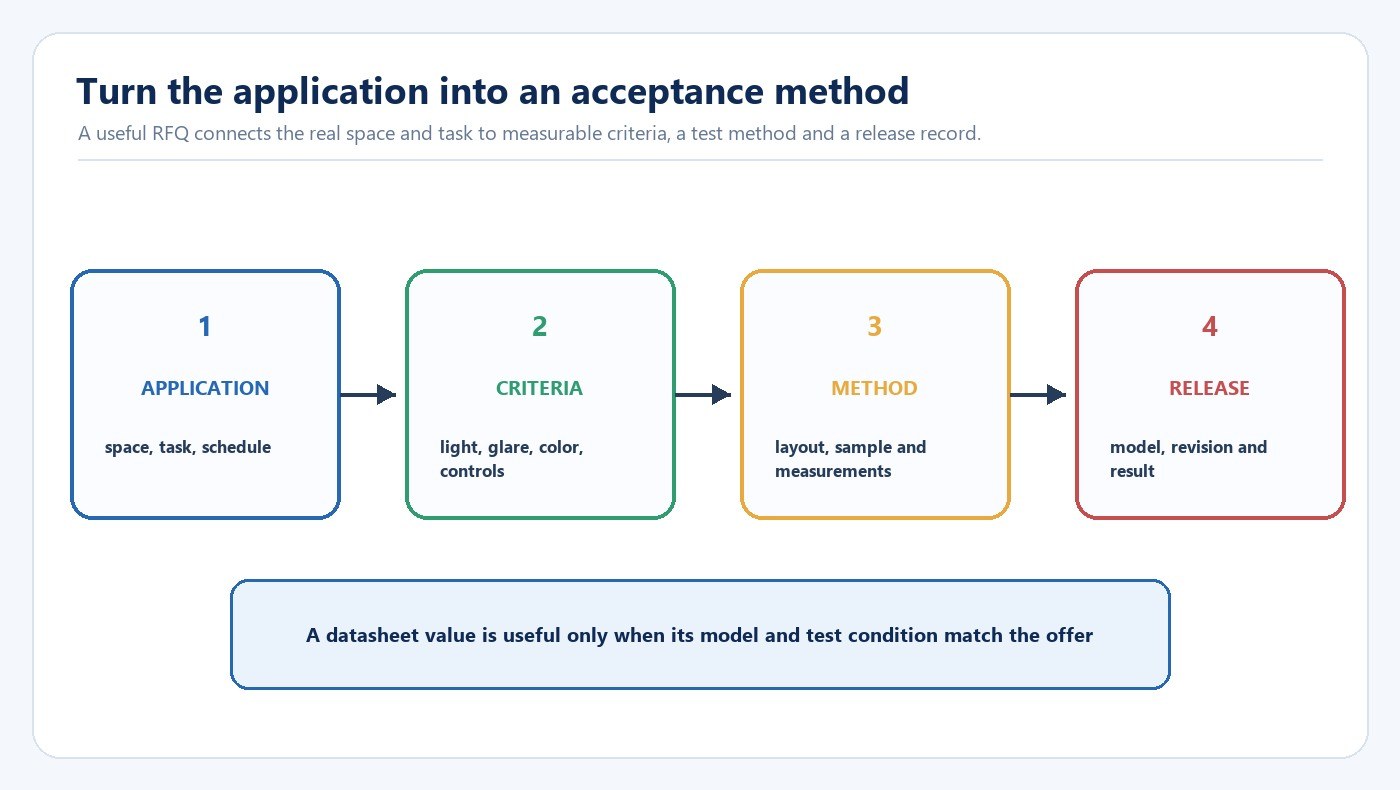
Define the space, task, mounting position, operating schedule and physical constraints before comparing luminaires. Translate those inputs into acceptance criteria: illuminance and uniformity where relevant, glare or visual-comfort requirements, color characteristics, switching and dimming behavior, environmental limits, installation fit and service access.
| Project input | Required evidence | Acceptance decision |
|---|---|---|
| Space and task | Dimensions, mounting, reflectance and task locations | Does the proposed layout serve the intended work? |
| Visual criteria | Photometry, illuminance, uniformity, glare and color data | Does the result meet the approved design basis? |
| Electrical system | Voltage, driver, protection, controls and wiring | Is the exact combination compatible and commissionable? |
| Environment | Temperature, moisture, dust, cleaning and duty cycle | Is the construction suitable for the operating conditions? |
| Installation and service | Drawings, brackets, access and replacement route | Can the system be installed and maintained as planned? |
A datasheet value becomes useful only when its test condition and product identity match the offer. Keep the photometric file, dimension drawing, driver reference, options and sample label tied to the same model and revision.
Compare Performance as a System
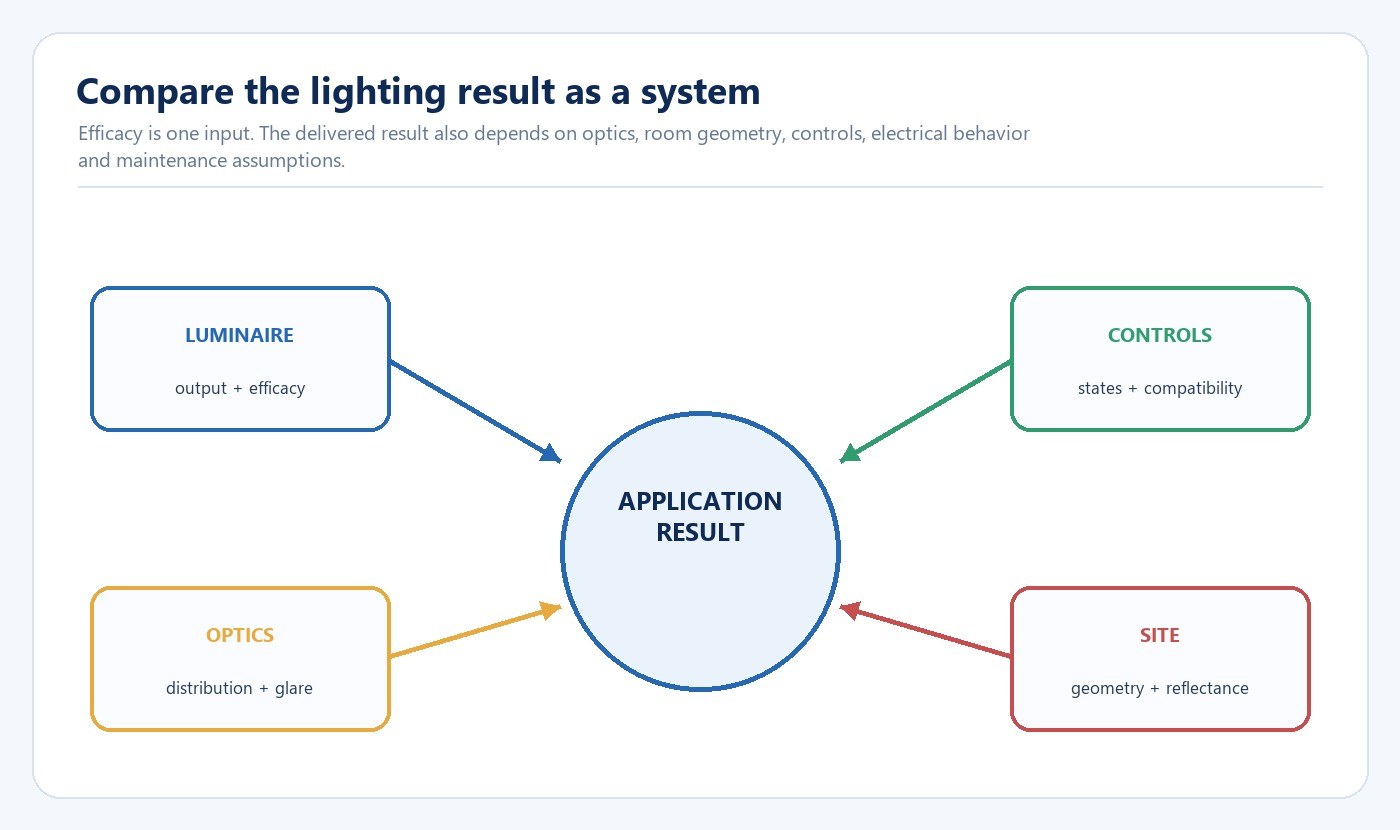
Luminaire efficacy does not replace distribution, glare review, color quality, flicker, thermal behavior or control performance. The U.S. Department of Energy Federal Energy Management Program advises federal buyers to compare efficiency only among like products and to consider functional needs and life-cycle cost. Its published thresholds apply to covered U.S. federal procurement; other projects need their own market rules and acceptance criteria.
Ask for the exact photometric file and driver configuration. Recalculate or re-review the layout when mounting height, room reflectance, optic, output, control strategy or maintenance assumptions change. A substitution that preserves watts and lumens can still change beam shape, glare, uniformity, color, flicker or control behavior.
The Commercial & Retail Lighting Solutions page provides application context for shops, offices and public spaces. Use it to define the project setting, then keep the final decision at model and layout level.
Make Controls Part of the Product Definition

The word “dimmable” is incomplete without the protocol, controller, driver range, minimum stable level, load, sensor responsibility, zoning, commissioning and recovery behavior. Define normal output, commanded dimming, occupancy or daylight response, manual override, power restoration and any failure state that matters to the project.
Review the driver, dimming and control compatibility guide before approving substitutions. A representative sample should use the planned controller, wiring, driver and load, or an agreed setup that reproduces the decision-relevant conditions.
Keep Market Documents Tied to Product Identity
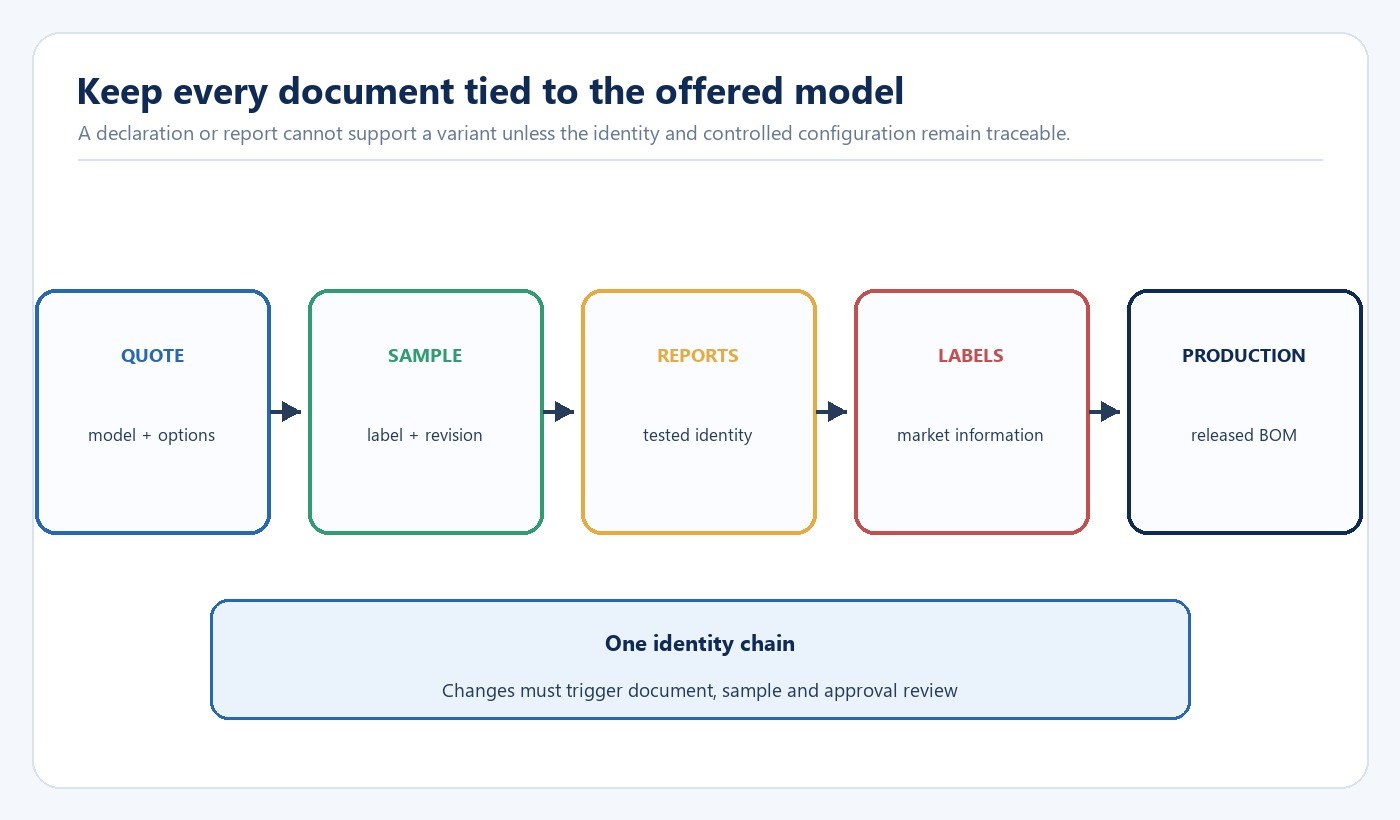
The European Commission states that Ecodesign rules for covered light sources and separate control gear are mandatory for manufacturers and importers placing those products on the EU market. It also distinguishes light sources from containing products and notes that some luminaires may themselves meet the definition of a light source. Classification, exemptions, registration and labeling therefore need to be checked for the exact product and market role.
Use the LED product compliance document checklist to map each declaration, report, label and registration to the quoted model. A family name alone is not enough when drivers, optics, output settings, color versions or control options change the tested configuration.
Use a Comparison Sheet That Exposes Missing Evidence
Do not score suppliers only by the number of documents submitted. Compare whether the evidence is applicable, current, traceable and reproducible.
| Decision area | Information to request | Red flag |
|---|---|---|
| Application performance | Photometry, layout assumptions and acceptance criteria | Generic file or different optic/output |
| Electrical and controls | Driver reference, protocol, wiring and state tests | “Dimmable” without tested combination |
| Mechanical fit | Drawing, mounting details and representative sample | Dimensions without tolerance or accessory identity |
| Market access | Classification, declarations, reports, labels and registrations | Family document does not name the quoted variant |
| Service planning | Replaceable parts, revision control and spare route | No notification path for component changes |
| Commercial comparison | Included accessories, tests, packaging and exclusions | Low unit price with missing project deliverables |
The LED lighting sample evaluation checklist helps reconcile the received sample with the offer before the project relies on its test result.
Plan Serviceability and Change Control
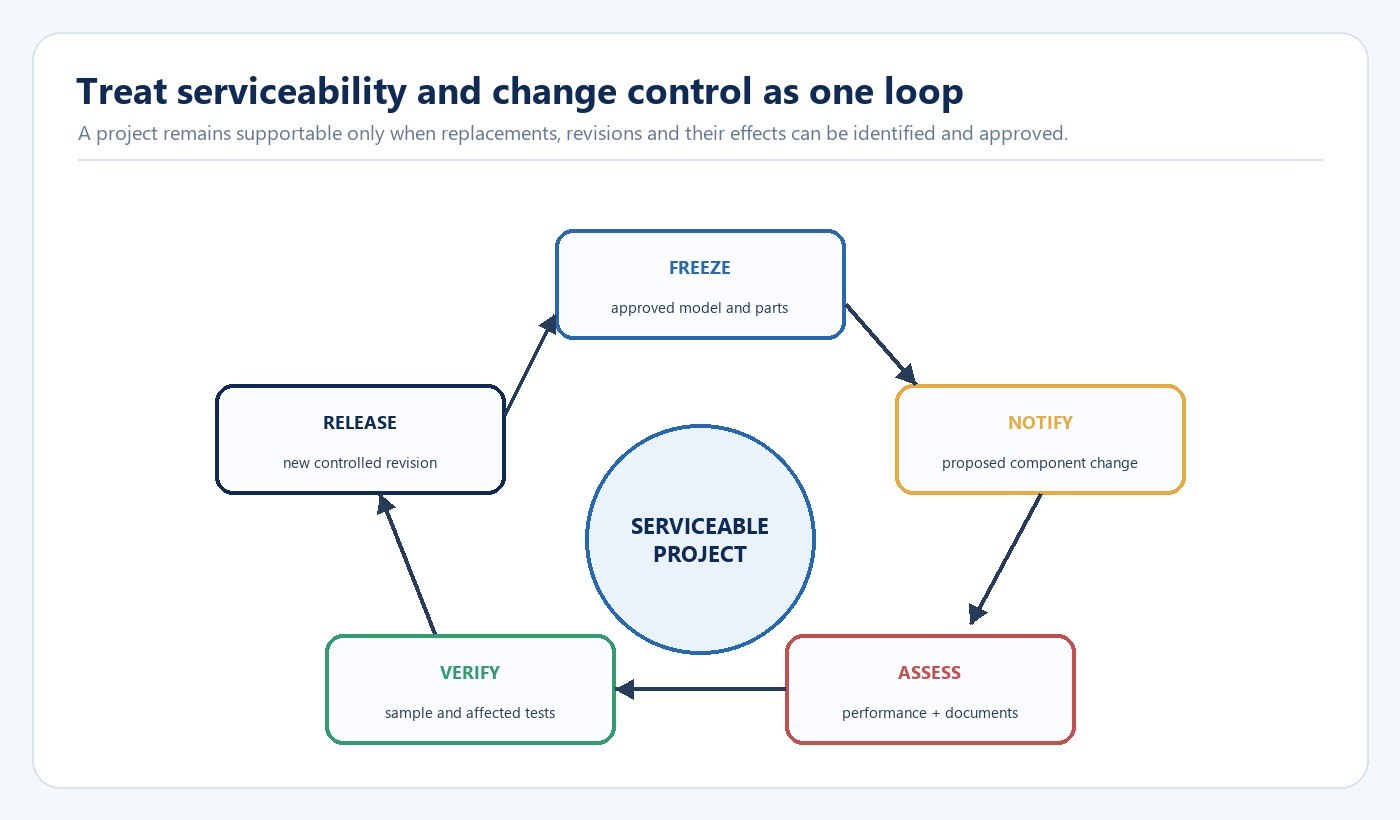
Ask which components can be replaced, how part references are controlled and which substitutions need customer approval. A change to the driver, LED board, optic, cable, connector, bracket, finish or firmware can affect performance, documents, labels, installation and spare compatibility.
Freeze the approved configuration and define the notification path before production. When a change is proposed, identify the affected drawings, photometry, electrical tests, market documents, samples and service parts. New Lights’ factory and manufacturing capabilities page is the appropriate starting point for discussing sampling, production coordination and change-control evidence; the exact release still depends on the agreed product and project requirements.
Build the 2026 RFQ and Release Checklist
- Define the application, task, schedule and installation constraints.
- State the target market and responsible economic operator or project party.
- List measurable visual, electrical, environmental and mechanical criteria.
- Identify the controller, driver, sensors, zones and commissioning responsibility.
- Require model-matched drawings, photometry, reports, labels and instructions.
- Record the sample identity, approved options and allowed alternatives.
- Compare included accessories, tests, packaging, documentation and exclusions.
- Set change-notification, spare-part and service-access expectations.
- Release production only after evidence and sample deviations are closed.
To prepare an exact project comparison, contact New Lights with the application drawing, market, quantities, operating schedule, control requirements and acceptance criteria.
Frequently Asked Questions
Is efficacy enough to compare commercial luminaires?
No. Compare it with photometric distribution, visual requirements, electrical behavior, controls, thermal conditions and the intended layout. Efficiency comparisons should also be made between products serving the same task.
Does every EU luminaire need an energy label?
No. The European Commission distinguishes light sources and containing products, while noting that some luminaires may meet the light-source definition. Check the exact classification and applicable rules before choosing a labeling route.
What should be frozen before production?
Freeze the approved model, drawings, controlled components or options, sample reference, required documents, labels, packaging and acceptance criteria. Define which changes require notification, new evidence or reapproval.
What makes a supplier comparison genuinely comparable?
Use the same application inputs, test conditions, evidence fields, included accessories, documentation scope and commercial exclusions. Record missing items instead of treating an incomplete offer as a lower equivalent price.
Editorial Sources
- U.S. Department of Energy, Federal Energy Management Program, “Purchasing Energy-Efficient Commercial and Industrial LED Luminaires”: https://www.energy.gov/cmei/femp/purchasing-energy-efficient-commercial-and-industrial-led-luminaires
- European Commission, “Light Sources”: https://energy-efficient-products.ec.europa.eu/product-list/light-sources_en