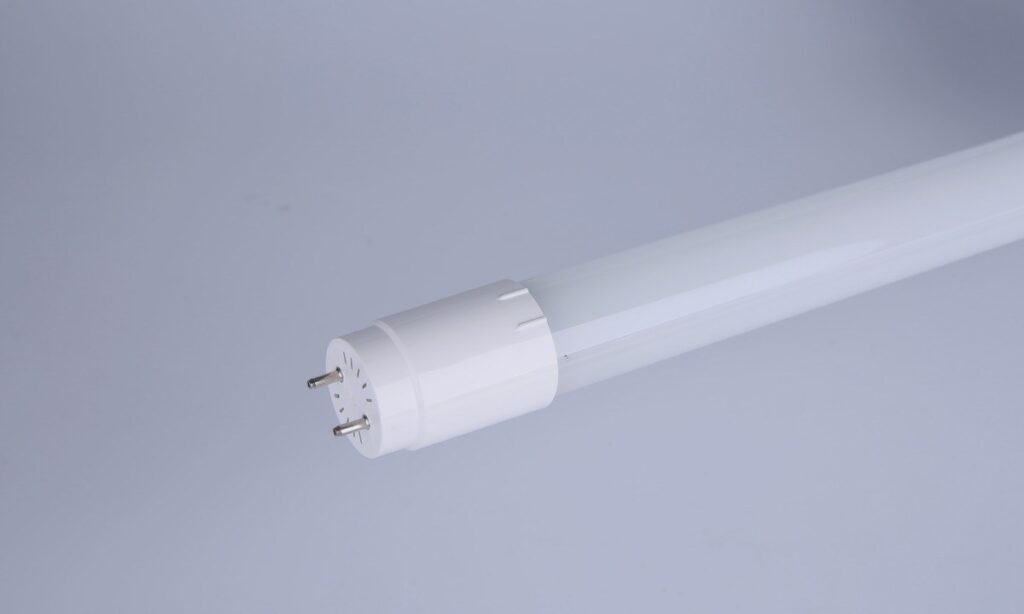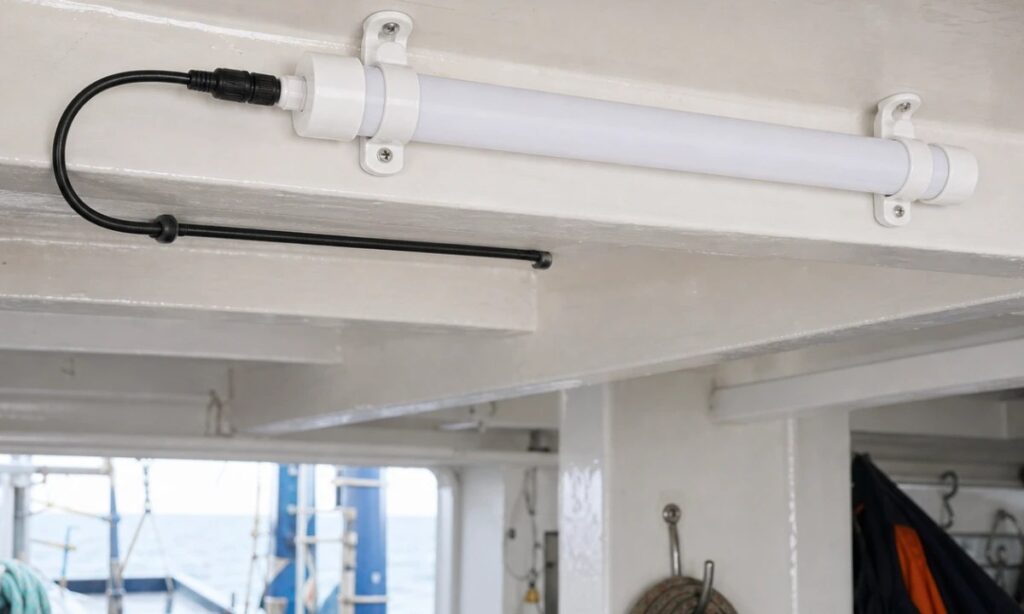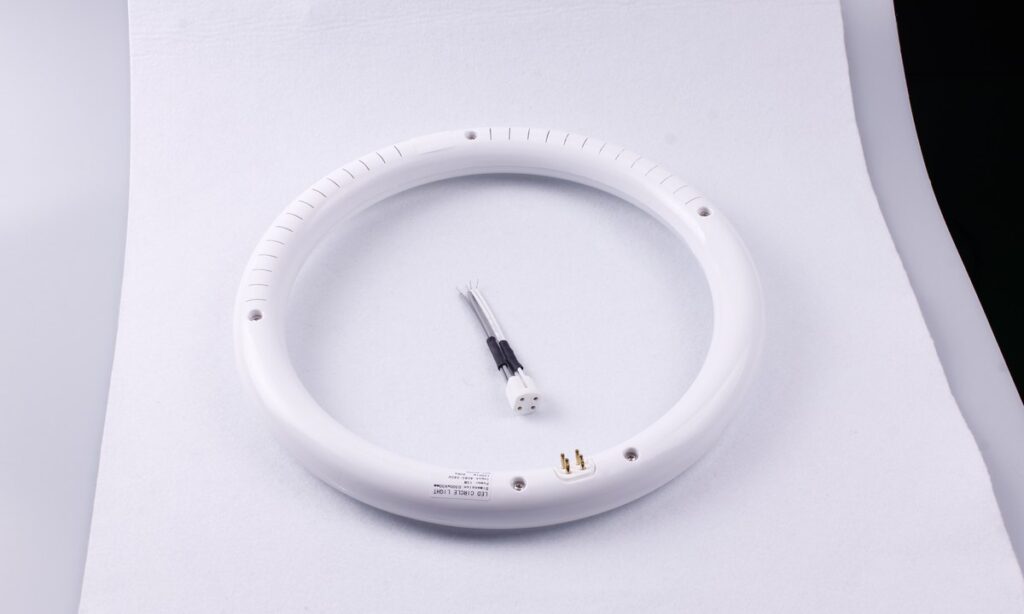


A T8 ALU+PC LED tube combines an aluminium heat-spreading section with a polycarbonate light-transmitting cover. That construction can be useful in an industrial retrofit, but the material name alone does not establish compatibility, light distribution, thermal performance or environmental resistance.
The practical decision is whether one exact tube configuration works safely in one defined fixture group. Record the existing electrical system, mechanical fit, task lighting, ambient conditions and maintenance process before approving an order. If the housing, lampholders or wiring are already deteriorated, a retrofit kit or new luminaire may be the better route.
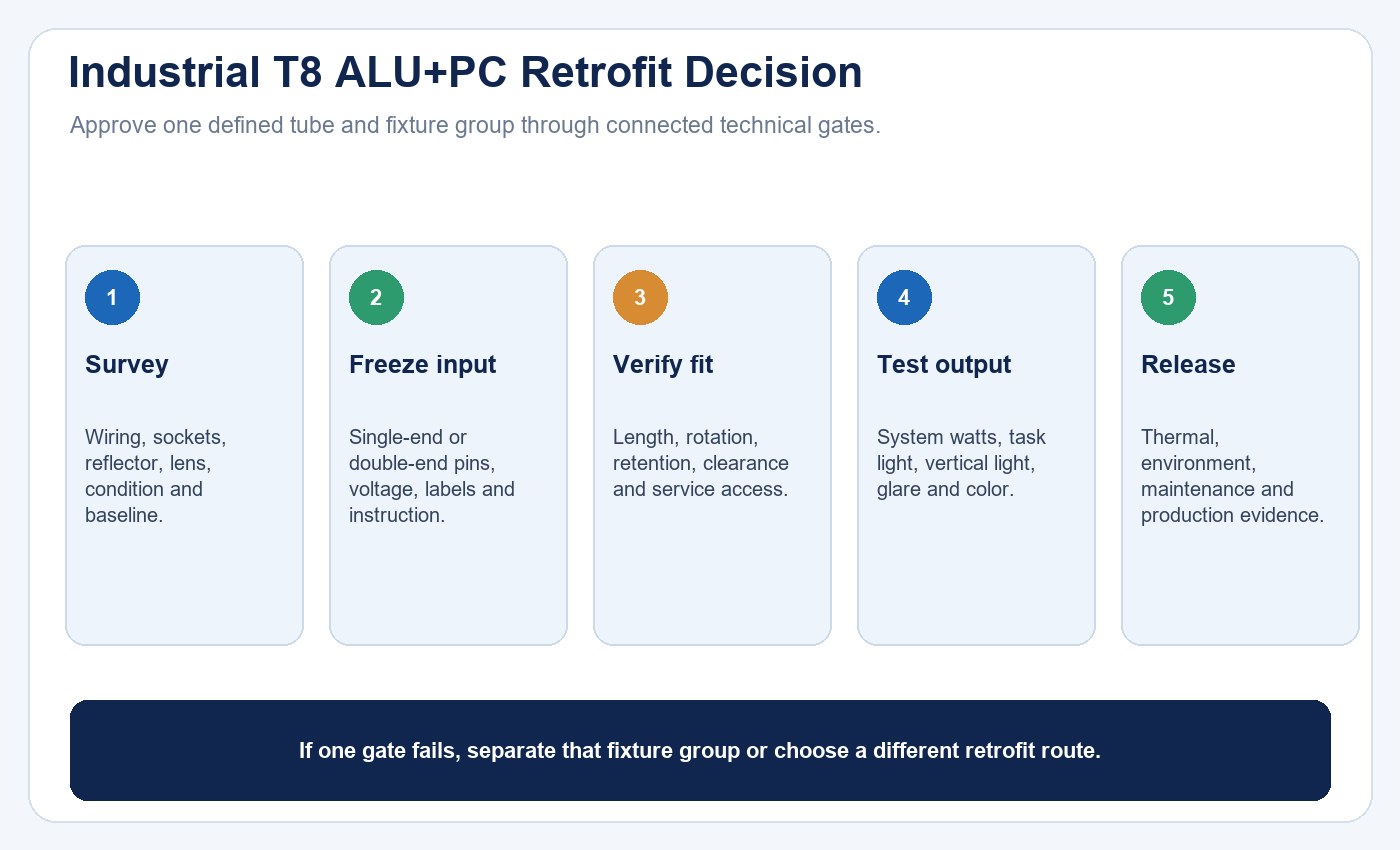
Move from fixture survey to an exact electrical route, then verify fit, light, heat and environment in a representative pilot.
Define What ALU+PC Construction Changes
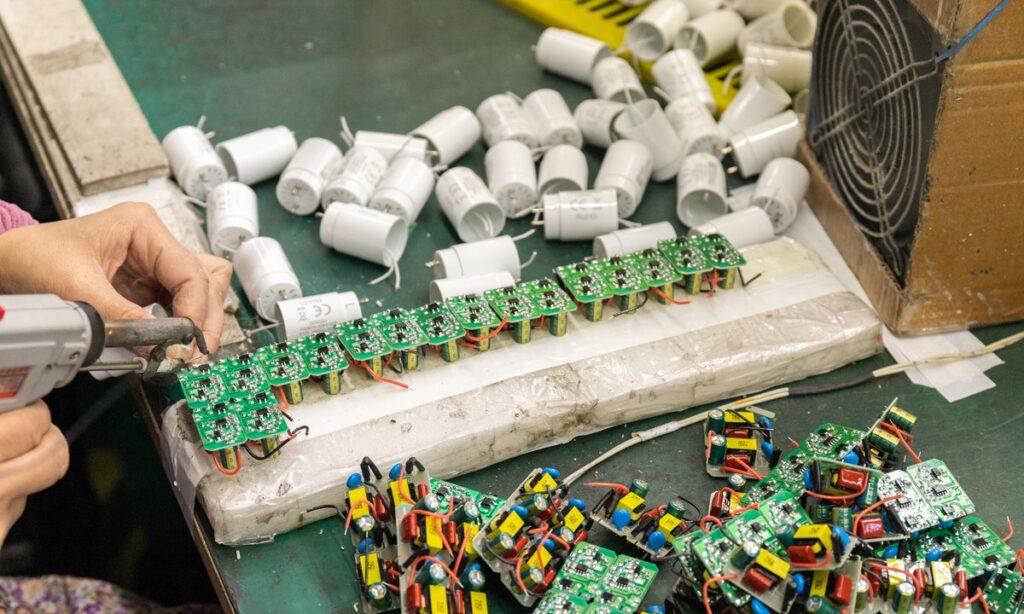
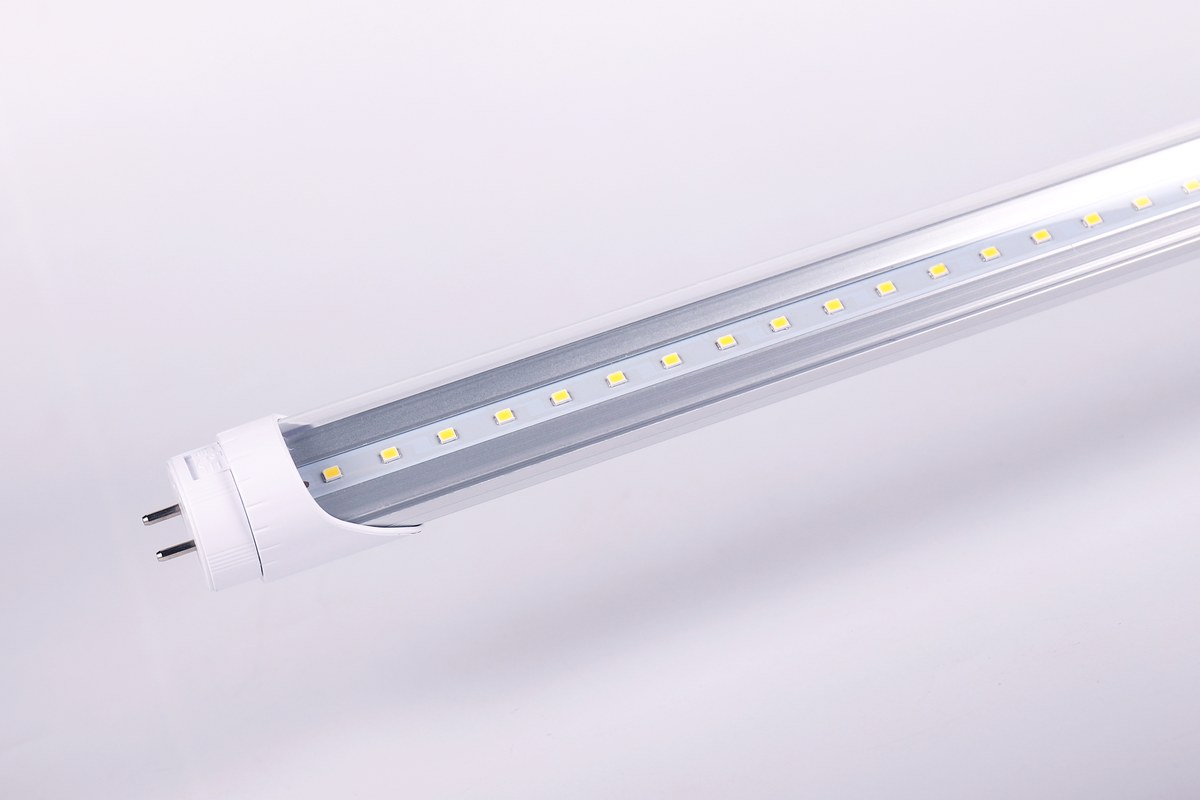
The aluminium section can receive heat from the LED board and spread it along the tube. The PC cover protects the light source and diffuses the individual LED points. End caps, pins, internal driver, board attachment and interface materials complete the system.
This design is directional compared with a fluorescent tube that emits around most of its circumference. The aluminium back therefore affects both heat flow and optical distribution. Rotation in the lampholder can change where the useful light goes, and an existing reflector may contribute less than it did with fluorescent lamps.
| Construction element | Intended role | What the buyer should verify |
|---|---|---|
| Aluminium section | Spreads heat and supports the board | Profile mass, board contact, installed temperature and orientation |
| PC cover | Transmits and diffuses light | Transmission, flame rating, impact evidence, yellowing and chemical compatibility |
| LED board | Produces light and transfers heat | Layout, board attachment, rated current and change control |
| Internal driver | Converts and regulates power | Input range, wiring type, flicker, switching and thermal limit |
| End caps and pins | Connect and retain the tube | G13 dimensions, pin wiring, rotation and socket condition |
Separate Construction Benefits From Project Proof
ALU+PC construction can support a defined heat path, protect the LED board and create a controlled luminous surface. It does not automatically prove high-temperature operation, impact resistance, low glare, high efficiency or long life. Each result depends on dimensions, materials, driver design, fixture enclosure and operating conditions.
The current New Lights product record identifies a 26 mm tube family with direct-AC configurations, single-ended or double-ended input options and multiple lengths and powers. Those are useful family facts. Voltage, pin wiring, lumen output, certification and environmental limits still have to be frozen for the ordered model.
For a wider comparison between lamp-only conversion, retrofit kits and full fixture replacement, use the LED retrofit options guide. Choose the route before comparing purchase prices.
Survey the Existing Fixture Group
Group fixtures only when their housing, ballast, lampholders, wiring and mounting conditions are materially the same. Two fixtures with identical external labels may contain different replacement ballasts or socket types after years of maintenance.
Photograph the lamp marking, ballast label, wiring diagram, lampholders, reflector, lens and available service space. Check for brittle sockets, heat-darkened conductors, corrosion, loose contacts and damaged covers. Measure existing system input power and agreed lighting points rather than relying on lamp wattage.
| Survey field | Evidence to record | Why it changes the decision |
|---|---|---|
| Electrical baseline | Supply, ballast, starter, wiring and measured system watts | Determines the valid conversion route and real energy baseline |
| Mechanical baseline | Length, G13 holders, rotation, lens and clearances | Determines fit, retention and beam orientation |
| Lighting baseline | Horizontal and vertical illuminance, uniformity and glare observations | Defines what the retrofit must maintain or improve |
| Environment | Ambient temperature, dust, moisture, oil, chemicals and vibration | Establishes product and enclosure evidence needed |
| Maintenance | Access method, labour, downtime and replacement controls | Reveals whether lamp-only conversion is economical and repeatable |
The LED lighting sample evaluation checklist provides a repeatable evidence structure for the survey and pilot.
Freeze the Electrical Architecture
Direct-AC T8 LED tubes bypass the fluorescent ballast according to their approved design. A single-ended tube and a double-ended tube are not interchangeable wiring descriptions. The exact model label and instruction must identify which pins receive line and neutral, whether lampholders must be shunted or non-shunted and what fixture marking is required.
Qualified personnel should isolate and verify the circuit, remove or disconnect obsolete components as instructed, inspect the holders and prevent a future incompatible lamp from being inserted. Generic wiring diagrams are not a substitute for the model instruction.
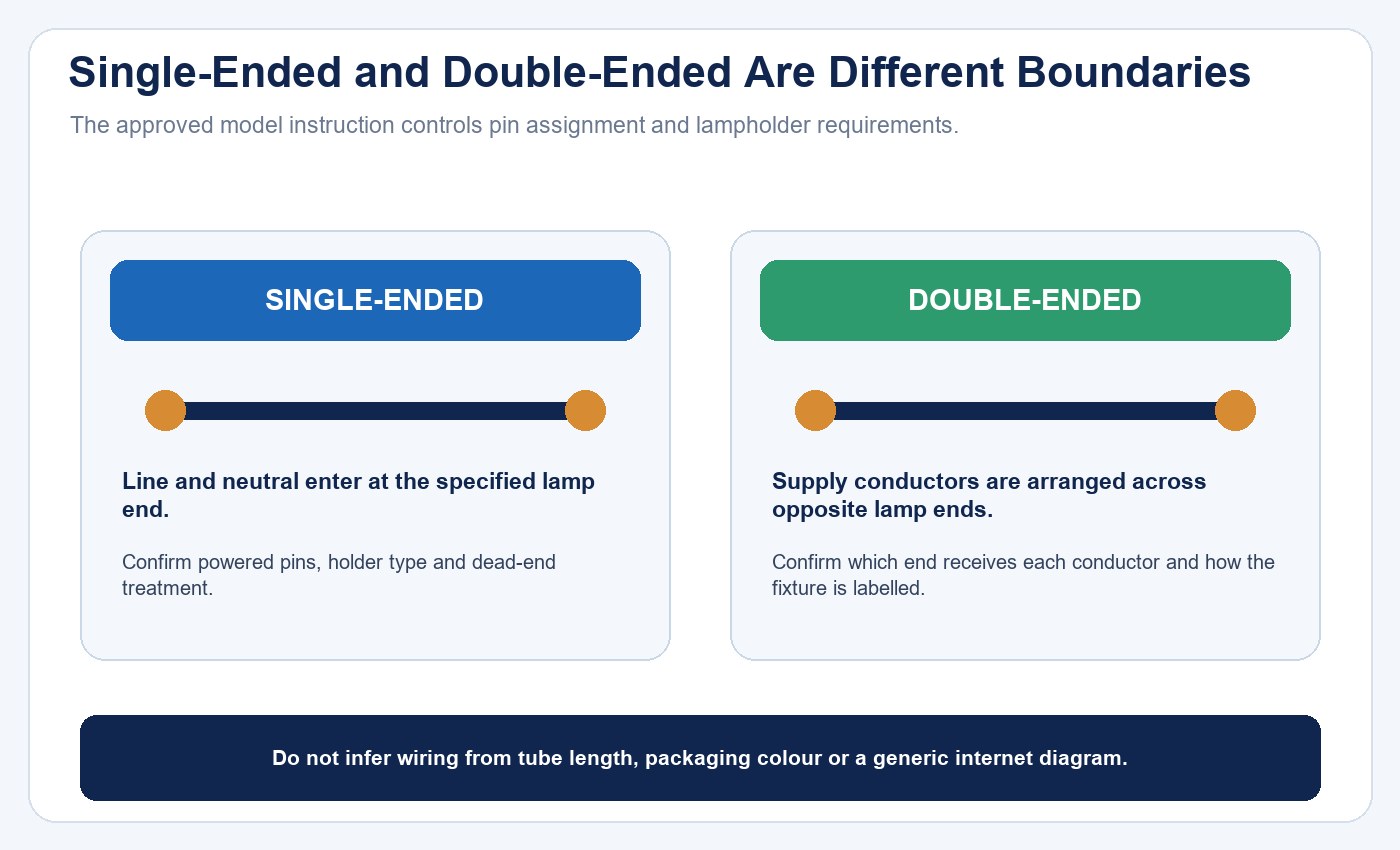
The input architecture must be fixed before installation: supply location, pin assignment, lampholder requirement and fixture label travel together.
The single-ended and double-ended T8 guide explains the distinction in more detail. The LED tube installation guide covers the broader operating-type identification boundary.
Verify Mechanical Fit and Orientation
Match tube length, diameter, cap dimensions and G13 pin geometry. Check whether the lampholders allow the luminous face to point toward the work area after the pins lock. In a long fixture, verify straightness, support and clearance from the lens or guard.
The aluminium side may face the reflector while the PC side faces the task, but the correct orientation depends on the product and fixture. If rotation is fixed, test the actual combination rather than assuming the beam can be redirected later.
Reflector and interconnectable variants need their own drawings and electrical limits. Do not extend a feature across every length merely because the products share a family name.
Compare Complete-Fixture Light
Bare-lamp efficacy is not the installed result. The aluminium back, PC diffuser, existing reflector, lens dirt and tube orientation shape the light leaving the fixture. A high lm/W value can coexist with poor vertical illumination on racks or excessive brightness at normal viewing angles.
Request total lumens and a photometric file for the exact model. Calculate the layout, then measure a pilot at the same points used for the baseline. Industrial aisles often need both floor illuminance and vertical visibility. Production tasks may require local uniformity, shadow control, color discrimination or glare limits.
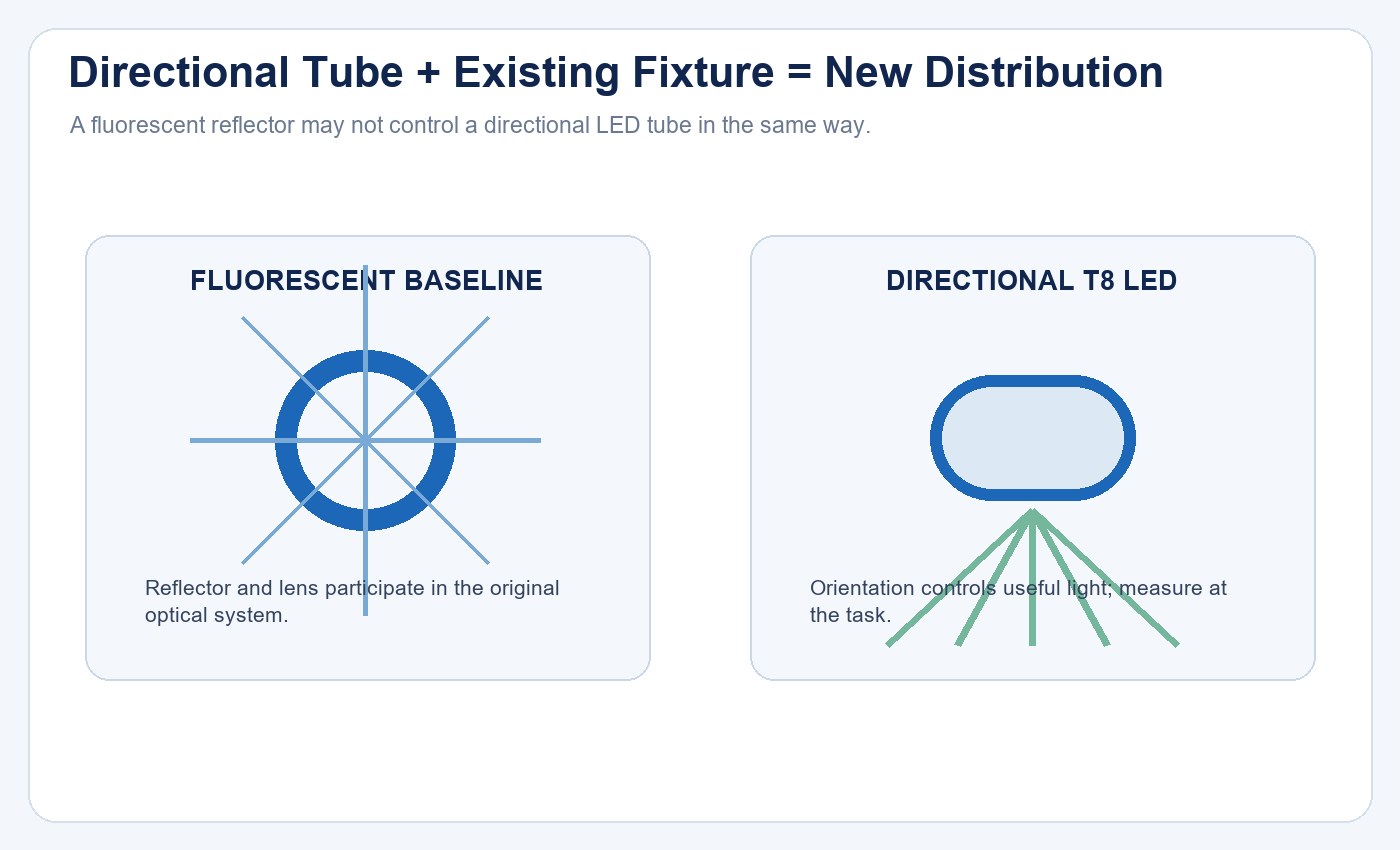
A directional T8 LED tube changes the role of the old reflector. Evaluate useful light at the task, not only the bare-lamp output.
| Comparison item | Weak shortcut | Better acceptance method |
|---|---|---|
| Energy | LED watts versus fluorescent lamp watts | Measure complete existing and proposed fixture input |
| Output | Claimed equivalent wattage | Confirm model lumens and measured task illuminance |
| Distribution | Visual brightness below one fixture | Review photometry, vertical light, uniformity and glare |
| Color | CCT name only | Freeze CCT and CRI; inspect the real task and finishes |
| Flicker | “Flicker-free” label | Obtain the method and measure at relevant supply/control states |
The LED tube versus fluorescent tube comparison explains why the complete system, rather than lamp wattage alone, is the correct comparison boundary.
Test the Thermal Path in the Intended Housing
Aluminium is thermally conductive, but it only helps when heat can move from the LED board through the interface and profile to surrounding air. Poor board contact, a small profile, hot driver components or a closed lens can still produce high operating temperatures.
Ask for the permitted ambient range and the defined case-temperature point. Run the exact tube in the intended fixture until temperatures stabilize, using the most demanding normal operating condition. Include high mounting locations, enclosed housings and areas with accumulated dust where relevant.
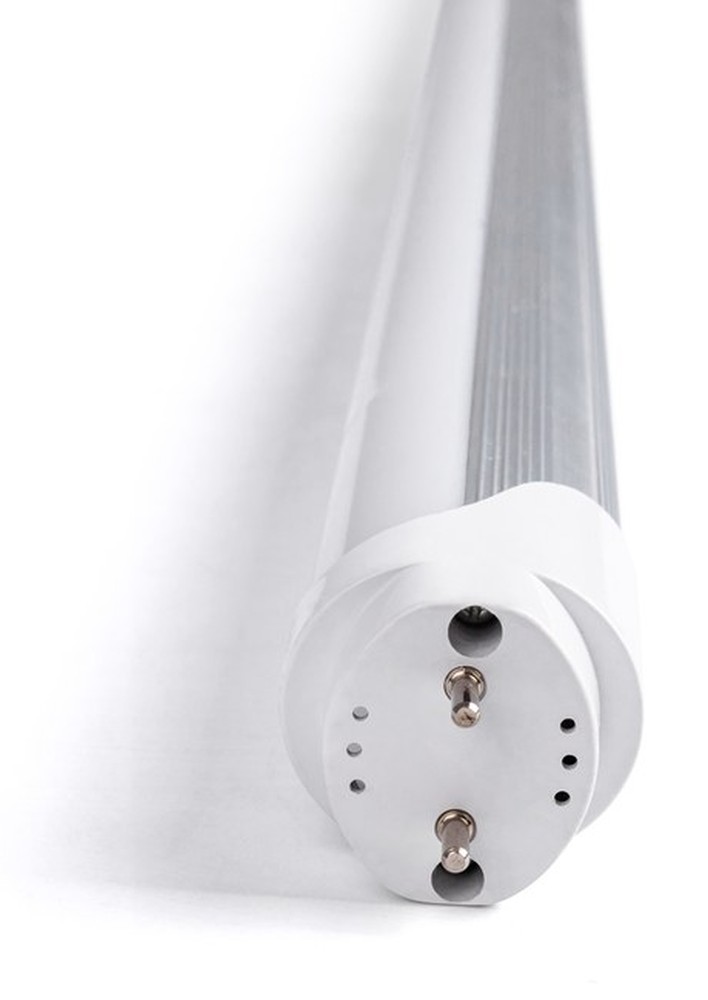
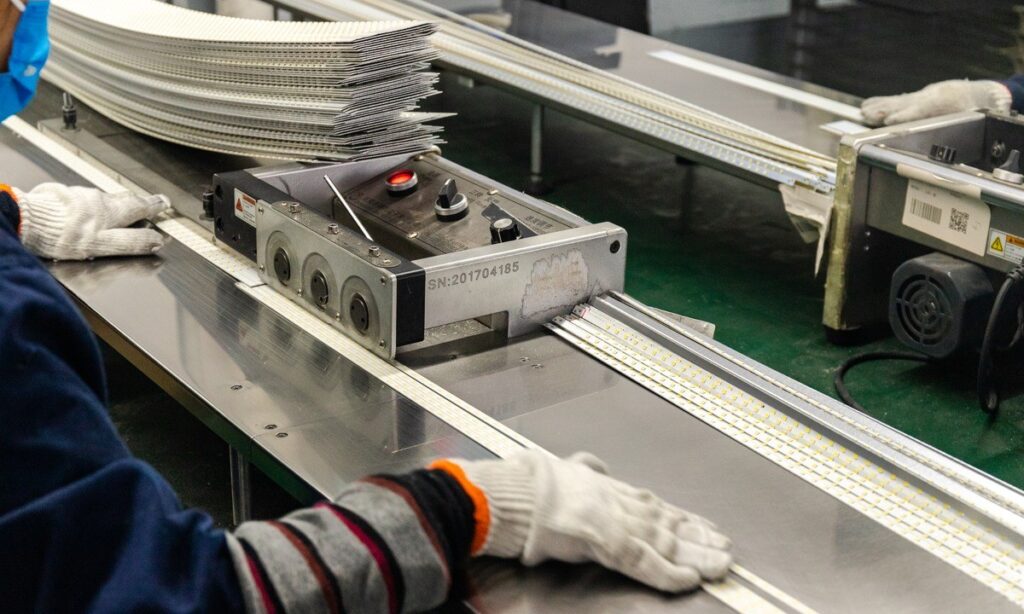
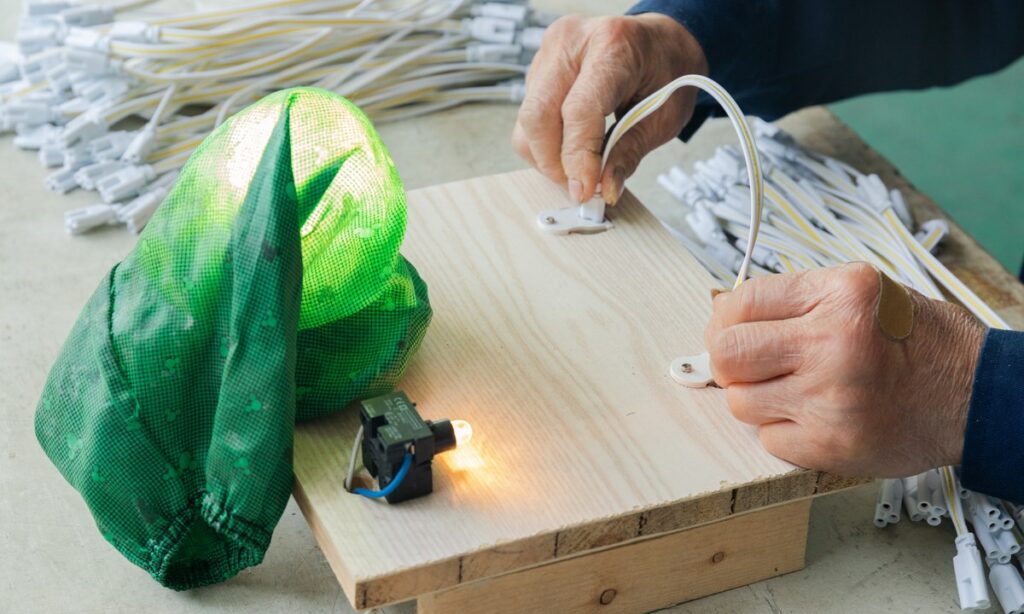
Temperature results support only the tested combination. A different wattage, driver, profile, lens or ambient condition needs its own evidence. The New Lights factory and manufacturing page describes the broader production context; project acceptance still depends on the approved model and batch controls.
Match the Industrial Environment
Clean, dry warehouses and workshops are different from washdown rooms, dusty processing lines, oil-mist areas, corrosive spaces or hazardous locations. A PC cover is not automatically impact-proof or chemically resistant, and a bare tube does not inherit an IP rating from an unverified housing.
For moisture and dust, verify the complete installed fixture and gland system. For cleaning chemicals or oils, review compatibility of the PC, end caps, adhesives and aluminium finish. For vibration or impact, require the applicable test and mechanical retention. Hazardous locations require equipment specifically approved for the location classification.
Use the IP65 fixture selection guide where dust or water exposure drives the decision. If the existing fixture cannot provide a controlled environment, compare a purpose-built industrial luminaire instead of forcing a bare-tube solution.
Build a Representative Pilot
The pilot should include difficult fixtures, not only the cleanest sample near floor level. Select examples with older sockets, different reflectors, high mounting, warmer zones, long operating hours and restricted access. Use the same driver, tube and production configuration intended for the order.
| Pilot gate | Measure or inspect | Release criterion |
|---|---|---|
| Identity | Label, length, power, input and batch | Matches the approved submission |
| Electrical | Wiring, holders, system watts, startup and switching | Safe, stable and consistent with the instruction |
| Optical | Illuminance, vertical light, uniformity, glare and color | Meets the written task criteria |
| Thermal | Tube and driver-area temperatures after stabilization | Within model and fixture limits |
| Environmental | Dust, moisture, chemicals, vibration and cleaning | Evidence covers the actual exposure |
| Maintenance | Install time, labels, access and future replacement | Repeatable without accidental substitution |
Record exceptions by fixture group. If one subgroup fails, do not improvise a field variation and release the whole site. Choose a different tube, retrofit kit or luminaire for that subgroup.
Assemble the Procurement File
The final order should identify model, length, diameter, wattage, input voltage, single-ended or double-ended wiring, lumens, efficacy, CCT, CRI, driver, photometric file, flicker evidence, ambient limit, relevant approvals, mounting orientation and packaging label.
Add the accepted sample, installation instruction, fixture label, change-control terms and batch verification method. The LED compliance document checklist helps map evidence to the target market, while the LED tube supplier evaluation guide covers sample-to-production consistency and change control.
For the industrial application boundary and complete-luminaire alternatives, review the Industrial & Warehouse Lighting solution page. To compare a defined T8 ALU+PC configuration, contact New Lights with fixture photographs, wiring, mounting height, operating schedule, environmental conditions and target market.
Conclusion
The useful benefit of a T8 ALU+PC LED tube is not “aluminium plus plastic” in isolation. It is the possibility of a defined heat path, protected light source and directional distribution within a compatible fixture. Those benefits become real only after the electrical route, mechanical fit, task lighting, temperature and environment all pass.
Survey representative fixture groups, freeze one model configuration, test the complete installation and preserve the evidence in the procurement file. That process lets a buyer decide independently where a lamp-only retrofit fits and where another route is safer or more economical.
FAQ
Does aluminium automatically make a T8 LED tube suitable for high temperatures?
No. Aluminium can spread heat, but board contact, profile size, driver design, airflow, fixture enclosure and ambient temperature determine the operating result. Use model limits and installed thermal measurements.
Is a PC diffuser impact-proof?
Not by material name alone. Grade, thickness, geometry, aging and the applicable complete-product impact test determine the result.
Can one direct-AC T8 tube use both single-ended and double-ended wiring?
Only if the exact model instruction explicitly supports both arrangements. Otherwise, treat them as different electrical configurations and never infer pin connections from appearance.
Will an ALU+PC tube use the existing fluorescent reflector effectively?
Not necessarily. Its directional output can reduce the reflector’s role or change the distribution. Check the photometric file and measure the assembled fixture.
Can a bare T8 ALU+PC tube be used in a wet or dusty area?
Only when the complete installed system has suitable verified protection. A tube should not inherit an enclosure claim without evidence for the actual fixture and installation.
When should an industrial project choose a new luminaire instead?
Consider replacement when housings, sockets or wiring are deteriorated; when controls, emergency functions or environmental protection are required; or when the existing optics cannot deliver the target lighting.
Editorial Sources
- New Lights, “Aluminium-and-PC T8 LED Tube”: https://www.new-lights.com/products/led-tube-lights/t8-led-tubes/t8-led-tube-light-for-commercial-and-replacement-application/
- U.S. Department of Energy, “LED Retrofit Kits, TLEDs, and Lighting Controls: An Application Guide”: https://www.energy.gov/sites/default/files/2017/03/f34/led_troffer_retrofit_guide.pdf