

An LED filament bulb can support a vintage or industrial interior because the light-emitting strips remain visible inside a familiar decorative envelope. The bulb alone does not create the look, however. Shape, glass finish, fixture material, scale, color appearance, dimming and the surrounding lighting layers all contribute.
Treat “vintage” as a visual language rather than an objective authenticity claim. The goal is to build a coherent composition while still providing usable light, controlling glare and matching the fixture’s electrical and thermal conditions.
Start with the design reference
Vintage can mean different things:
- early electric-lamp imagery with clear glass and visible filaments;
- industrial interiors with dark metal, exposed hardware and simple pendants;
- warm hospitality spaces with amber glass and low ambient levels;
- mid-century rooms with globe forms and cleaner fittings;
- rustic spaces using timber, aged brass and textured surfaces.
Choose the reference before choosing the bulb. A long tubular lamp may suit a narrow cage pendant but look out of proportion in a small table lamp. A large globe can become a visual object even when switched off. A candle shape may work better in a multi-arm decorative fixture.
Create a short visual brief containing the fixture, envelope shape, finish, desired light appearance and required task. This prevents the word “vintage” from becoming the entire specification.
| Design direction | Bulb form and finish | Fixture/material cue | Functional check |
|---|---|---|---|
| Early electric | Clear ST or elongated bulb | Simple pendant, dark metal or aged brass | Direct glare and overall length |
| Industrial | Clear tubular or A-shape bulb | Cage, exposed hardware, blackened steel | Shadow pattern and task-light coverage |
| Mid-century | Globe bulb, clear or lightly diffused | Brushed brass, clean geometry | Scale, viewing angle and color consistency |
| Rustic hospitality | Amber or clear decorative bulb | Timber, textured surfaces, warm metal | CCT, dimming range and table-level comfort |
| Traditional decorative | Candle form | Multi-arm fixture | Base, maximum dimensions and combined output |
Use envelope shape as part of the fixture
Visible bulbs need to be proportioned to the luminaire and the room. Compare actual dimensions, not only shape names.
Common design directions include:
- A-shape bulbs: familiar proportions for table lamps, open shades and simple pendants;
- ST or elongated forms: a stronger early-electric or industrial reference;
- globe bulbs: a large luminous object for open pendants and vanity-style arrangements;
- tubular bulbs: useful where a narrow linear shape reinforces the fixture geometry;
- candle bulbs: suited to smaller decorative sockets and chandelier forms.
Confirm the base, maximum diameter, overall length, neck clearance and weight. A visually attractive bulb is unusable if it cannot pass through the shade opening, seat fully in the lampholder or remain within the fixture’s permitted dimensions.
Filament arrangement changes the visual rhythm
DOE manufacturing guidance describes typical LED filament sources as multiple LED dies mounted on a narrow clear substrate and covered with a conversion coating. Manufacturers arrange these strips vertically, diagonally, in loops, spirals or other patterns.
The arrangement affects what the viewer sees through a clear envelope. A simple vertical pattern can feel restrained, while a curved or spiral arrangement becomes a stronger decorative element.
Do not infer output, distribution or lifetime from the number of visible strips. Those characteristics depend on the dies, driver, thermal design, coating and complete lamp construction. Select the visual pattern and verify performance separately.
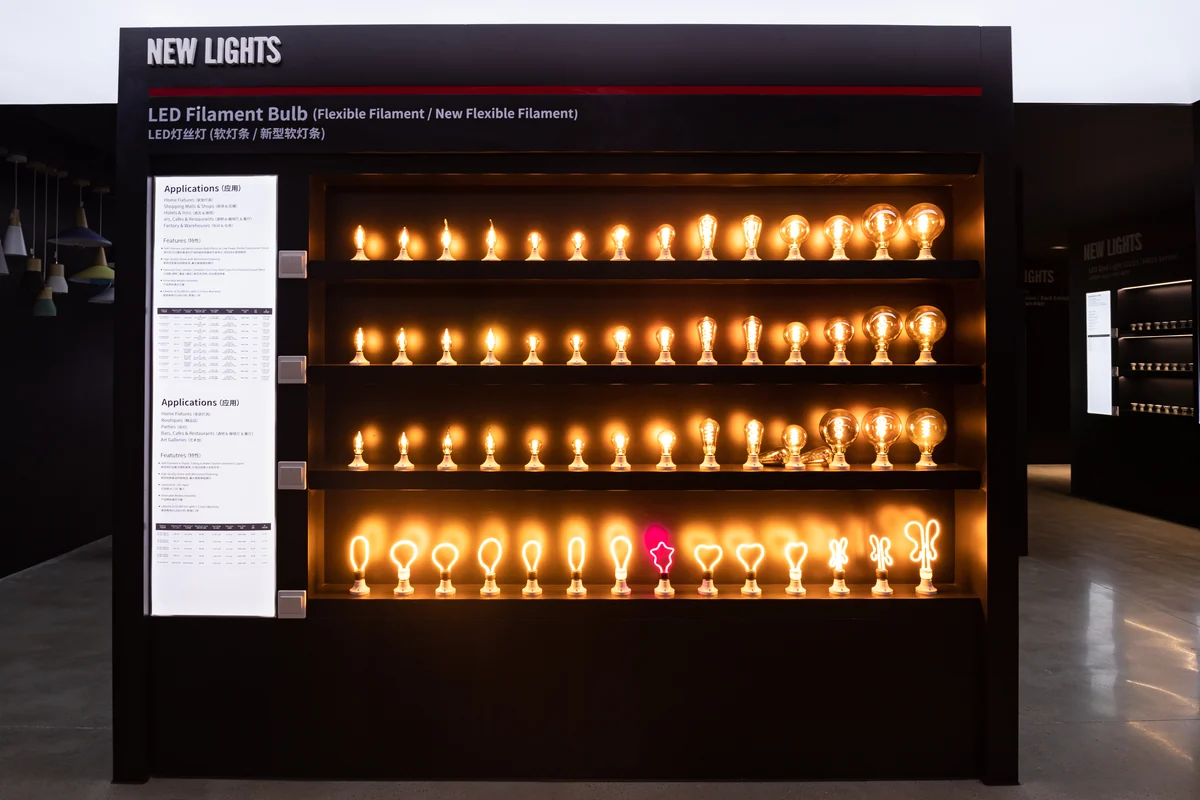
Clear, amber and frosted finishes do different jobs
Clear glass
Clear envelopes reveal the filament architecture and internal supports. They create the most literal exposed-bulb effect but can also expose high luminance directly to the eye.
Amber or tinted glass
A tint changes the switched-off appearance and may alter transmitted light. It can reinforce a warm visual palette, but the glass color does not prove an exact CCT or color-rendering performance. Read the model’s measured light data.
Frosted or opal glass
Diffusion reduces the visibility of individual filament structures and can soften the source. It may suit a room that needs the decorative bulb shape without a sharp exposed-filament image.
Choose the finish according to viewing distance, fixture openness and visual comfort—not from style photography alone.
Separate color appearance from color rendering
DOE distinguishes the color appearance of emitted light, commonly summarized by CCT, from how a source affects object colors, described through color fidelity and related metrics.
A lower CCT can contribute to a warm atmosphere, but it does not automatically mean colors will be rendered accurately. For hospitality, retail or residential finishes, verify both the desired light appearance and appropriate color-quality data.
Also coordinate with nearby sources. A filament pendant, downlights and under-cabinet lights can look inconsistent if their CCTs or spectra differ. A coherent room often matters more than selecting the warmest available bulb.
Control glare from exposed sources
The visual feature of a filament bulb—direct view of the emitting structure—can also create discomfort. Glare risk increases when the source is bright, close to the eye or placed against a dark background.
Control it through:
- appropriate lumen output;
- dimming with a verified compatible control;
- fixture height and viewing angle;
- partial shades, cages or glass diffusers;
- multiple lower-output sources instead of one intense source;
- separate task lighting so the decorative bulb does not carry the entire load.
Do not assume an amber envelope makes a bright source comfortable. Evaluate the installed view from seated and standing positions.
Match fixture material and detailing
The bulb reads together with the lampholder, canopy, cord, shade and surrounding finishes. Materials often used in vintage-inspired schemes include aged brass, bronze, blackened steel, enamel, timber, clear glass and textured fabric.
Consistency matters more than using every historical reference at once. For example:
- a simple clear ST bulb with a dark metal socket can support an industrial direction;
- a globe bulb with brushed brass can create a softer mid-century reference;
- a candle bulb in a traditional multi-arm fixture can preserve a familiar silhouette;
- a tinted bulb with raw timber may reinforce a rustic palette.
All examples are design directions, not product compatibility statements. The fixture must still accept the bulb’s base, voltage, dimensions, wattage and operating conditions.
Use scale and spacing deliberately
One large bulb can act as a focal point. A cluster creates rhythm but also increases combined output and visual density.
For a cluster or multi-lamp fitting, check:
- total connected load;
- spacing between envelopes;
- heat accumulation;
- consistent model and batch;
- dimmer capacity and compatibility;
- suspension height;
- replacement access;
- whether the combined brightness becomes uncomfortable.
Mock up the arrangement at actual height before approving a large project. Product shots rarely communicate scale accurately.
Build layers around the decorative bulb
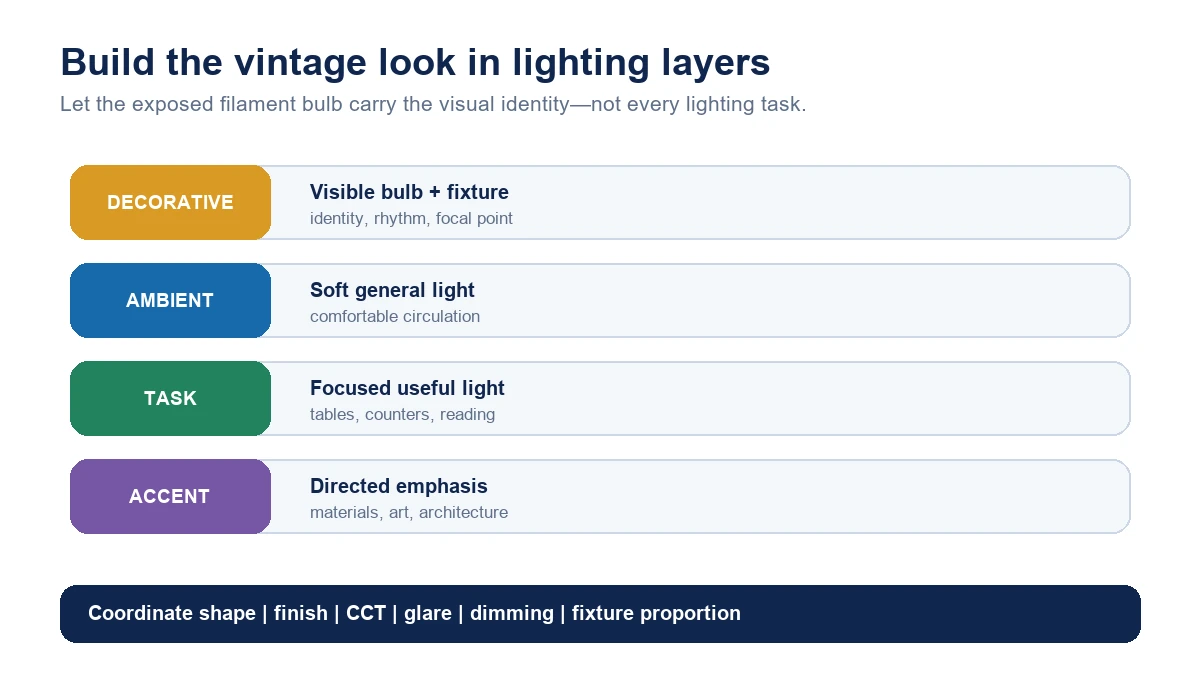
DOE residential lighting guidance describes ambient, task and accent lighting as separate functional layers. Adding a decorative layer is useful for vintage interiors because an exposed bulb may be visually important without being the best source for every task.
A practical room can combine:
- decorative pendants for identity and local atmosphere;
- concealed or diffused ambient light for comfortable circulation;
- task lighting for reading, dining service or work surfaces;
- accent light for artwork, texture or architecture;
- controls that create different scenes.
This approach reduces pressure to select an excessively bright exposed bulb. It also allows the vintage element to remain visible without compromising functional lighting.
Dimming requires a tested combination
Dimming can help shift a room from functional to atmospheric use, but the lamp must be explicitly dimmable and compatible with the exact control and connected load. DOE FEMP likewise advises buyers to check both dimming capability and compatibility with the dimming system.
Check:
- lamp’s dimmable marking;
- dimmer type and model;
- number of lamps per control;
- minimum stable level;
- flicker, buzzing, dropout and off-state glow;
- behavior across the required scene range.
Do not promise incandescent-like dimming or color change without model-level testing. Some products are designed to become warmer as they dim; others reduce output while keeping approximately the same color appearance.
Common design mistakes
Avoid these shortcuts:
- choosing the bulb before defining the fixture and room reference;
- treating “Edison style” as a complete technical specification;
- using a high-output clear bulb at eye level without glare review;
- mixing envelope shapes and CCTs without an intentional composition;
- expecting one decorative pendant to provide all task and ambient light;
- assuming every filament bulb is dimmable or enclosed-fixture suitable;
- selecting from a rendered image without checking dimensions and light data.
A selection checklist
Before approving a visible filament bulb, record:
- design reference and fixture type;
- envelope shape, dimensions and finish;
- base, voltage and fixture limits;
- filament arrangement and switched-off appearance;
- lumens and light distribution;
- CCT and color-quality evidence;
- glare-control method and viewing positions;
- dimming and control compatibility;
- open or enclosed fixture conditions;
- sample and batch-consistency requirements.
Browse the LED filament bulb family or the broader New Lights product range after defining the visual reference and fixture limits. For a project review, contact New Lights with fixture photos, socket, available dimensions, desired appearance, target output and dimmer model.
FAQ
Are LED filament bulbs genuinely vintage?
They are modern LED products that reference the visible-filament appearance of earlier lamps. “Vintage” describes the design language, not the product’s age or authenticity.
Does amber glass mean warm white light?
It can reinforce a warm appearance, but read the declared CCT and color data for the exact lamp. Glass color alone is not a measurement.
Are clear filament bulbs uncomfortable to look at?
They can be if output, viewing angle or contrast is poorly controlled. Use appropriate lumens, fixture shielding, height, dimming and separate task lighting.
Which bulb shape looks most vintage?
There is no universal answer. Match the envelope to the chosen historical or industrial reference, fixture proportion and room scale.
Can a filament pendant provide room lighting?
It may contribute, but verify the layout and task requirements. Many rooms benefit from separate ambient and task layers.
Are all LED filament bulbs dimmable?
No. Check the exact model and dimmer combination.
Do filament LED bulbs save energy?
Compare verified lumens and watts for the exact products and required lighting task. The visible filament form alone does not establish a savings percentage.
Editorial sources
- U.S. Department of Energy, “2022 SSL Manufacturing Status & Opportunities”: https://www.energy.gov/sites/default/files/2022-02/2022-ssl-manufacturing-status-opportunities_0.pdf
- U.S. Department of Energy, “LED Color Characteristics”: https://www1.eere.energy.gov/buildings/publications/pdfs/ssl/led-color-characteristics-factsheet.pdf
- U.S. Department of Energy, “Strategy Guideline: High Performance Residential Lighting”: https://www1.eere.energy.gov/buildings/publications/pdfs/building_america/strategy_guideline_high_perf_lighting.pdf
- U.S. Department of Energy FEMP, “Purchasing Energy-Efficient Light Bulbs”: https://www.energy.gov/cmei/femp/purchasing-energy-efficient-light-bulbs