

Choose an LED filament bulb by matching the fixture first: base, envelope shape, dimensions, supply, light output, color appearance, dimming and permitted operating conditions. The vintage appearance matters, but it cannot compensate for a bulb that does not fit or operate correctly.
An LED filament bulb uses small LED emitters arranged in linear strips to create the visual character of a traditional filament. Use the six-part checklist below as a quick filter, then complete the detailed review before ordering.
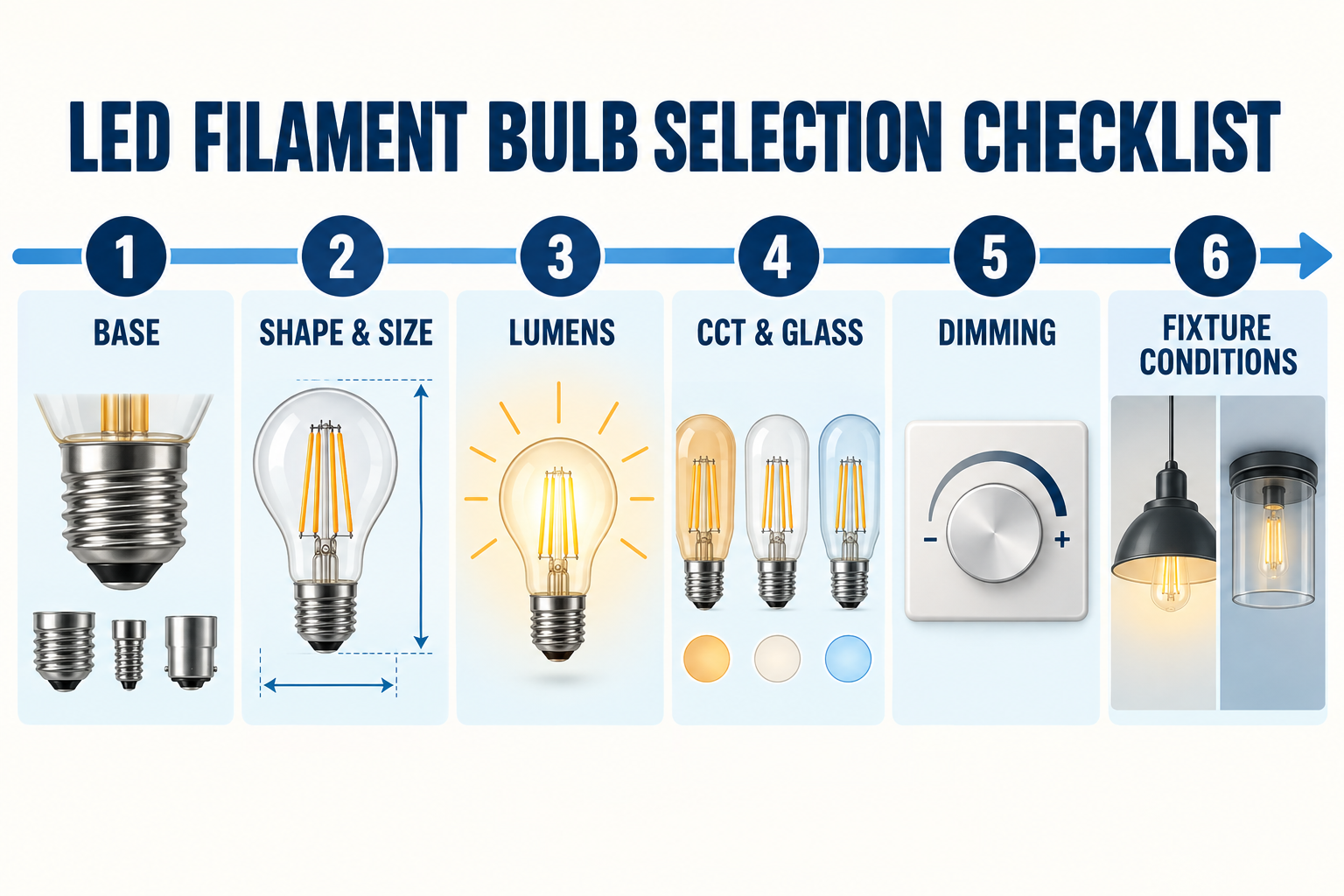
1. Record the fixture before removing the old lamp
Take a clear photo of the fixture, socket, old lamp and every marking you can read. Record:
- supply voltage and frequency;
- socket or base designation;
- fixture maximum lamp wattage;
- bulb shape and measured dimensions;
- lamp orientation;
- whether the lamp is exposed, shaded or enclosed;
- dimmer or control model;
- required quantity and whether several lamps appear together.
The fixture label and instructions are more reliable than a visual guess. Two bases may look similar in a photo but use different dimensions, electrical contacts or locking methods.
2. Match the base exactly
The base establishes the mechanical and electrical connection. Common families include Edison screw, bayonet and pin bases, with regional and size variants.
Use the exact designation from the lamp or fixture. Do not order from a description such as “small screw” or “standard base” when the project crosses markets. Also confirm whether the contact arrangement, voltage and socket construction are appropriate for the chosen lamp.
For replacement programs, store the approved base and product code in the maintenance record. This reduces substitutions based only on appearance.
3. Check shape and every critical dimension
Filament bulbs are available in familiar forms such as A-shape, globe, candle, tubular and decorative profiles. Shape codes help classification, but measured dimensions determine physical fit.
Check overall length, maximum diameter, neck profile and the distance from the base to the widest part. For chandeliers and multi-lamp fixtures, verify clearance between bulbs, shades and decorative components. A longer lamp can protrude below a shade; a wider globe may touch nearby arms.
If the bulb is visible, review whether its proportions suit the fixture. A technically compatible bulb can still look wrong in a shallow pendant or compact wall light. The vintage LED filament lighting guide explains how envelope, glass and fixture materials work together visually.
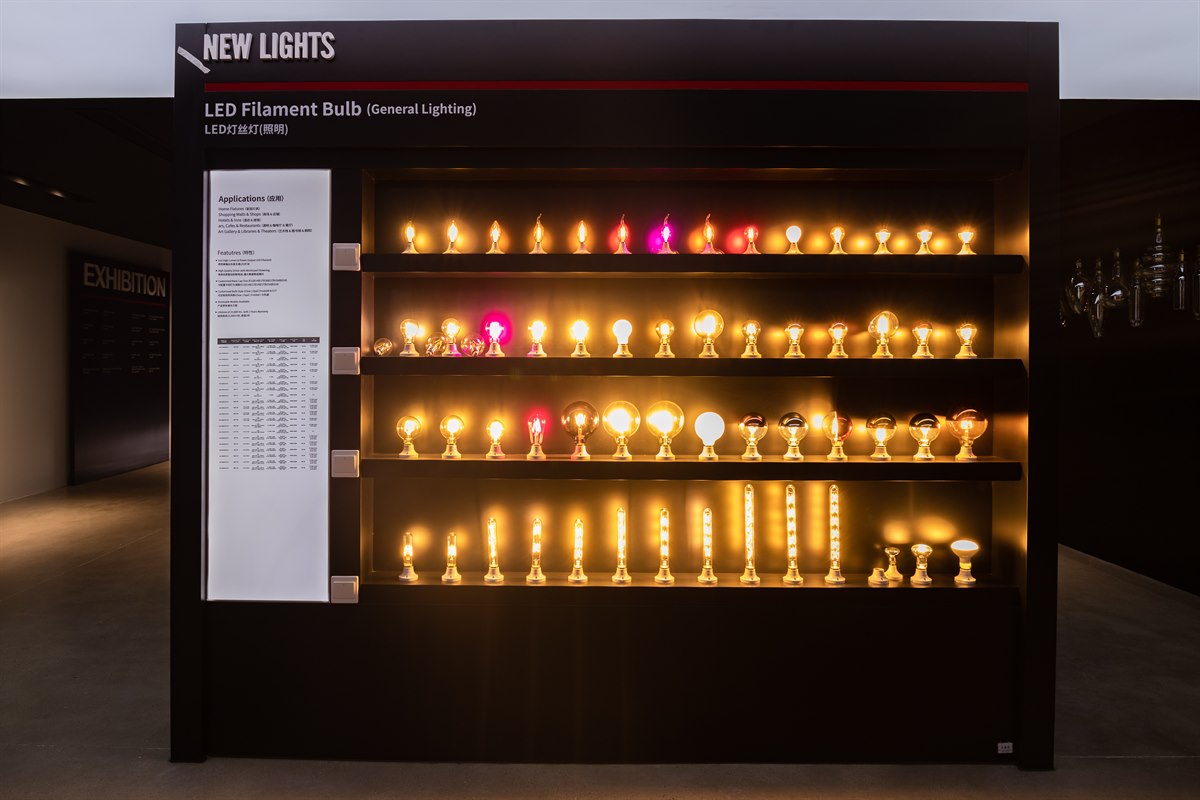
4. Choose brightness by lumens, not watts
Watts describe electrical input, not brightness. The U.S. Federal Trade Commission advises shoppers to use lumens when comparing bulb brightness.
Start with the useful light required from the fixture. If replacing a lamp, use the old lamp’s verified lumen output or evaluate the room instead of relying only on an incandescent-watt equivalent printed by a seller.
Then compare input watts to understand energy use. Two LED bulbs can draw similar power but produce different lumen output or distribution, so neither value should be viewed alone.
The U.S. Lighting Facts label can help compare brightness, estimated energy cost, expected life, light appearance and energy used. For an international project, use the applicable market label and product documents.
5. Separate color appearance from glass color
Correlated color temperature, or CCT, describes whether white light appears warmer or cooler. The glass envelope may be clear, frosted, tinted or amber.
Those are related visual choices but not interchangeable specifications. Amber glass can change the unlit appearance and emitted spectrum, but it does not guarantee one standardized CCT. Compare the exact model’s CCT and a representative illuminated sample.
Review color rendering where accurate object, food, fabric or finish appearance matters. CRI is one common metric, but project requirements may need additional color information. Do not infer color quality from warm appearance alone.
When multiple exposed bulbs appear in one fixture, define acceptable color consistency. Small differences can become obvious when lamps are side by side.
6. Review light distribution and filament arrangement
The U.S. Department of Energy describes filament-style LED lamps as using small emitters arranged in linear strips to mimic an incandescent filament. The number, length, orientation and placement of those strips can vary by product.
That arrangement, together with the envelope, base shadow, supports and internal electronics, affects distribution. A filament appearance does not mean perfectly uniform or fully omnidirectional output.
For exposed decorative fixtures, review the bulb from normal viewing angles while both on and off. For shaded fixtures, check whether the distribution lights the shade and room as intended. A sample or photometric file is more useful than a front-facing product image.
7. Verify dimming as a system
A lamp must be explicitly identified as dimmable before it is used on a dimming circuit. That still does not guarantee compatibility with every dimmer. The detailed filament LED dimming compatibility guide covers the checks in more depth.
ENERGY STAR advises checking both the bulb’s dimmable marking and the manufacturer’s list of compatible dimmers. For a project, record:
- dimmer manufacturer and model;
- number of lamps per circuit;
- supply conditions;
- required dimming range;
- acceptable flicker, noise and startup behavior;
- whether lamps must start from a low setting;
- whether multiple fixtures must dim together.
Test the actual lamp and control combination at minimum, mid-range and full output. Watch for dropout, delayed start, shimmer, audible noise and inconsistent behavior across multiple lamps.
8. Confirm enclosed-fixture and orientation suitability
LED lamps contain electronic and light-emitting components that generate heat. Thermal conditions change when a lamp is installed in a closed globe, tight shade or fixture with limited air movement.
Do not assume that an LED filament bulb is suitable for an enclosed fixture because its outer bulb resembles an incandescent lamp. Check the exact model’s markings and instructions. Also verify any restrictions on base-up, base-down or horizontal operation. The broader fixture compatibility guide explains why a matching base is only one part of the decision.
ENERGY STAR notes that LED products need thermal management and typically experience gradual lumen depreciation rather than a single incandescent-style filament break. Model-level lifetime depends on test evidence and the permitted operating environment.
9. Check voltage, frequency and market evidence
Base compatibility does not confirm electrical compatibility. Verify rated voltage, frequency, power, power factor where required, and any surge or control requirements relevant to the project.
For distribution or OEM procurement, request documents that cover the exact model and destination market. The evidence package may include:
- datasheet and dimensional drawing;
- package and lamp markings;
- applicable test or certification records;
- model-to-document scope;
- dimmer compatibility information;
- lumen, color and lifetime test basis;
- approved-component and change-control records;
- warranty terms and operating exclusions.
A certificate for a different bulb shape or electrical configuration should not be treated as evidence for the ordered model.
Build a clear purchase specification
Use a short schedule for each required lamp:
| Field | What to specify |
|---|---|
| Fixture | Type, enclosure and lamp orientation |
| Base | Exact designation |
| Envelope | Shape, finish, maximum diameter and length |
| Electrical | Voltage, frequency and input limits |
| Light output | Required lumens and distribution role |
| Color | CCT, color-rendering requirement and consistency |
| Control | Dimmable or non-dimmable, with control model |
| Environment | Permitted installation condition and orientation |
| Documentation | Destination-market and model-level requirements |
This schedule separates measurable requirements from decorative preference. It also makes sample review and later replacement easier.
Review a sample in the real fixture
For visible lamps, photographs rarely show the complete effect. Install a representative sample and review:
- physical fit and clearance;
- unlit glass and filament appearance;
- brightness and distribution;
- shade illumination and unwanted shadows;
- color consistency among multiple lamps;
- dimming behavior;
- visible flicker or noise;
- thermal and use restrictions in the instructions.
Approve the exact model and configuration, not merely a shape family. If a supplier later changes the LED strip, driver, glass, phosphor or internal support, review whether the approved appearance and performance are affected.
To compare model-level options, contact New Lights with a fixture photo, old-lamp markings, dimensions, voltage, dimmer and target appearance.
Frequently asked questions
Are LED filament bulbs brighter than regular LED bulbs?
The construction name does not determine brightness. Compare lumens and the delivered distribution of the exact bulbs.
What wattage LED filament bulb should replace my old lamp?
Match the required lumens and fixture conditions first, then compare input watts. A watt-equivalent label is only a reference and should not replace the product data.
Are all LED filament bulbs dimmable?
No. The lamp must be marked dimmable, and compatibility with the exact dimmer and circuit load must be verified.
Can I use an LED filament bulb in an enclosed fixture?
Only when the exact model is approved for that fixture condition and orientation. Check its markings and instructions.
Does amber glass always mean extra-warm light?
No. Glass appearance alone does not define CCT or color quality. Use the model data and an illuminated sample.
Do filament bulbs shine in every direction?
Not perfectly by definition. Filament arrangement, supports, base, envelope and internal components influence distribution.
Which bulb shape is best for a chandelier?
Choose a shape that fits the socket, clearance and visual proportions, then verify lumens, color, distribution, dimming and fixture suitability.
How should a buyer compare lifetime claims?
Check the test basis, operating conditions, rated lumen-maintenance point, warranty and thermal restrictions for the exact model. Compare claims only when those conditions are equivalent.
Editorial sources
- U.S. Federal Trade Commission, “Shopping for Light Bulbs”: https://consumer.ftc.gov/articles/shopping-light-bulbs
- ENERGY STAR, “DIY Lighting Guide”: https://www.energystar.gov/sites/default/files/ES_DIY-Lighting-Printable3_10-2015.pdf
- U.S. Department of Energy, “Adoption of Light-Emitting Diodes in Common Lighting Applications”: https://www.energy.gov/sites/default/files/2020/09/f78/ssl-led-adoption-aug2020.pdf
- ENERGY STAR, “Learn About LED Lighting”: https://www.energystar.gov/products/learn-about-led-lighting