

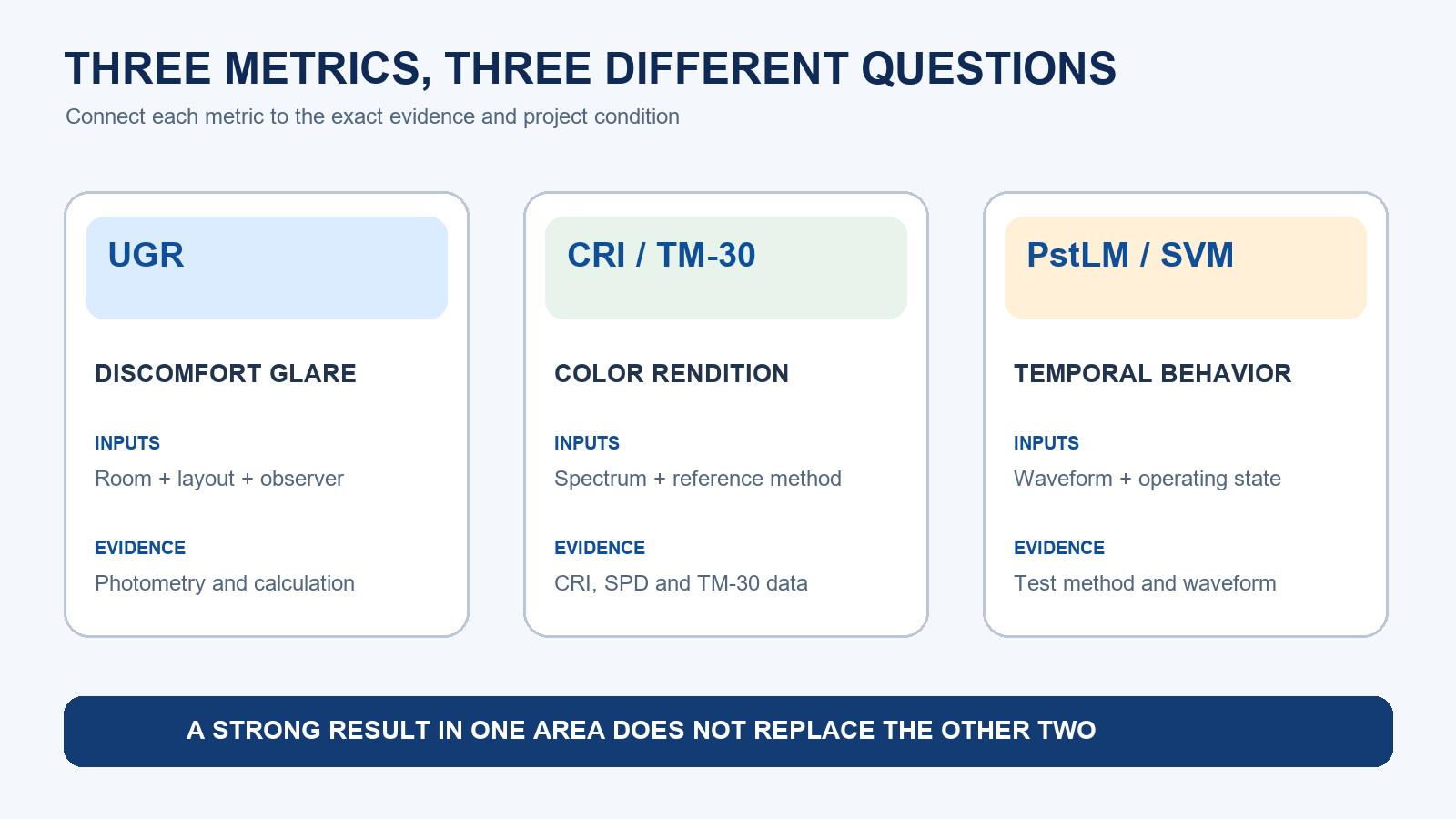
UGR, CRI and “flicker-free” often appear together in commercial-lighting specifications, but they answer three different questions. UGR addresses discomfort glare in a defined room and viewing condition. CRI and TM-30 describe aspects of color rendition. Temporal light modulation metrics describe how light output changes over time.
No single value represents the overall quality of a luminaire. A useful review connects each metric to its method, the exact product configuration and the intended application. Buyers planning an office, store or public space can start with the commercial and retail lighting solution and then use this guide to build the technical evidence list.
| Metric family | Main question | Evidence to request | Common mistake |
|---|---|---|---|
| UGR | Will the installed arrangement create discomfort glare for defined observers? | Photometric file, UGR table and project calculation | Treating one catalogue value as universal |
| CRI and TM-30 | How will object colors shift relative to a reference? | CCT, CRI data, spectrum and TM-30 outputs where relevant | Using CRI as a complete color-quality score |
| PstLM and SVM | How may temporal variation become visible? | Waveform, test method, supply, driver and dimming state | Accepting “flicker-free” without a metric or condition |
What UGR Evaluates
Unified Glare Rating is a method for evaluating discomfort glare from luminaires in indoor environments. Discomfort glare can make a space unpleasant even when a person can still see the task. The CIE method uses luminaire luminance, apparent source size, position in the field of view and background luminance.
Those inputs make UGR an installation-dependent result. CIE 190:2010 describes tables for preset room proportions and luminaire arrays at defined spacing-to-height conditions. A manufacturer’s UGR table is useful input for design, but the room calculation remains the step that connects the luminaire to the project.
Why “UGR Below 19” Needs Context
When a product page or datasheet states UGR below a threshold, ask which conditions produced the number:
- Room dimensions and surface reflectances.
- Luminaire spacing and mounting height.
- Observer position and viewing direction.
- Output setting and optical configuration.
- Calculation method and photometric file version.
Changing the layout, output, background or line of sight can change the result. Even products designed around glare-control optics, such as a UGR<16 LED backlit panel, still need to be evaluated as part of the actual room arrangement.
Highly non-uniform luminous surfaces add another consideration. Small bright regions can look different from a uniformly luminous area with the same average value. Where occupants directly view the source, combine the calculation with a representative mock-up and observations from realistic seating or working positions.
Practical Ways to Manage Discomfort Glare
Glare control is a design process rather than a label. Options include keeping bright surfaces outside critical sight lines, increasing the apparent emitting area, using suitable optics or shielding, changing mounting and spacing, and balancing task and background illumination.
Reducing output alone may also reduce task illuminance. Review glare, distribution and required light levels together. For screen-based work, include the normal monitor positions and seating directions instead of calculating an empty room with no reference to how people use it.
What CRI Describes
The General Color Rendering Index, commonly reported as CRI or CIE Ra, compares the appearance of selected color samples under a test source with their appearance under a reference source. It is primarily a color-fidelity measure.
CRI remains familiar and widely available, but an average score can hide different shifts among individual colors. Two sources with the same CRI may present red, blue, skin-tone or material colors differently. The number also does not directly describe preference, vividness or whether the appearance suits a particular brand environment.
For general circulation areas, a stated CRI requirement may be sufficient when color discrimination is not critical. Retail merchandise, food, textiles, artwork, printing, healthcare observation and quality-control tasks often justify a closer look at spectrum and specific color behavior.
How TM-30 Adds Detail
ANSI/IES TM-30 is a system of related measures and graphics for evaluating color rendition. Its outputs include fidelity, gamut and hue-specific information based on a larger sample set than the traditional general CRI calculation.
The additional detail helps a reviewer match data to design intent. A museum may prioritize fidelity. A retailer may want an intentional balance of fidelity and saturation. A quality-inspection task may depend on distinctions in a particular hue region. There is no universal TM-30 combination for every space.
Start by stating the visual objective, then select the measures that address it. Avoid converting a familiar CRI threshold mechanically into an assumed TM-30 threshold. When materials are commercially or operationally important, use the exact proposed source in a mock-up with the actual finishes or products.
What Flicker Means in LED Lighting
LED output can vary over time because the driver converts and regulates electrical power. The supply, driver loading, control protocol, dimmer and operating level can all influence the waveform. The broader technical term is temporal light modulation, or TLM.
DOE identifies three established visual responses: direct flicker, the stroboscopic effect and the phantom-array effect. Direct flicker is perceived while the observer and scene are relatively stationary. A stroboscopic effect appears with moving objects. A phantom array can appear during rapid eye movement. These effects involve different conditions and are not represented well by one vague adjective.
PstLM is used for lower-frequency direct-flicker evaluation, while SVM addresses stroboscopic visibility over another frequency range. Percent flicker and flicker index can describe waveform characteristics but cannot represent every visual response or application. For a broader electrical review, see the LED flicker, power factor and THD buyer checklist.
Why “Flicker-Free” Is Incomplete
Ask the supplier to define the claim:
- Which metric and threshold were used?
- Which measurement method and instrument were used?
- At which supply voltage and frequency?
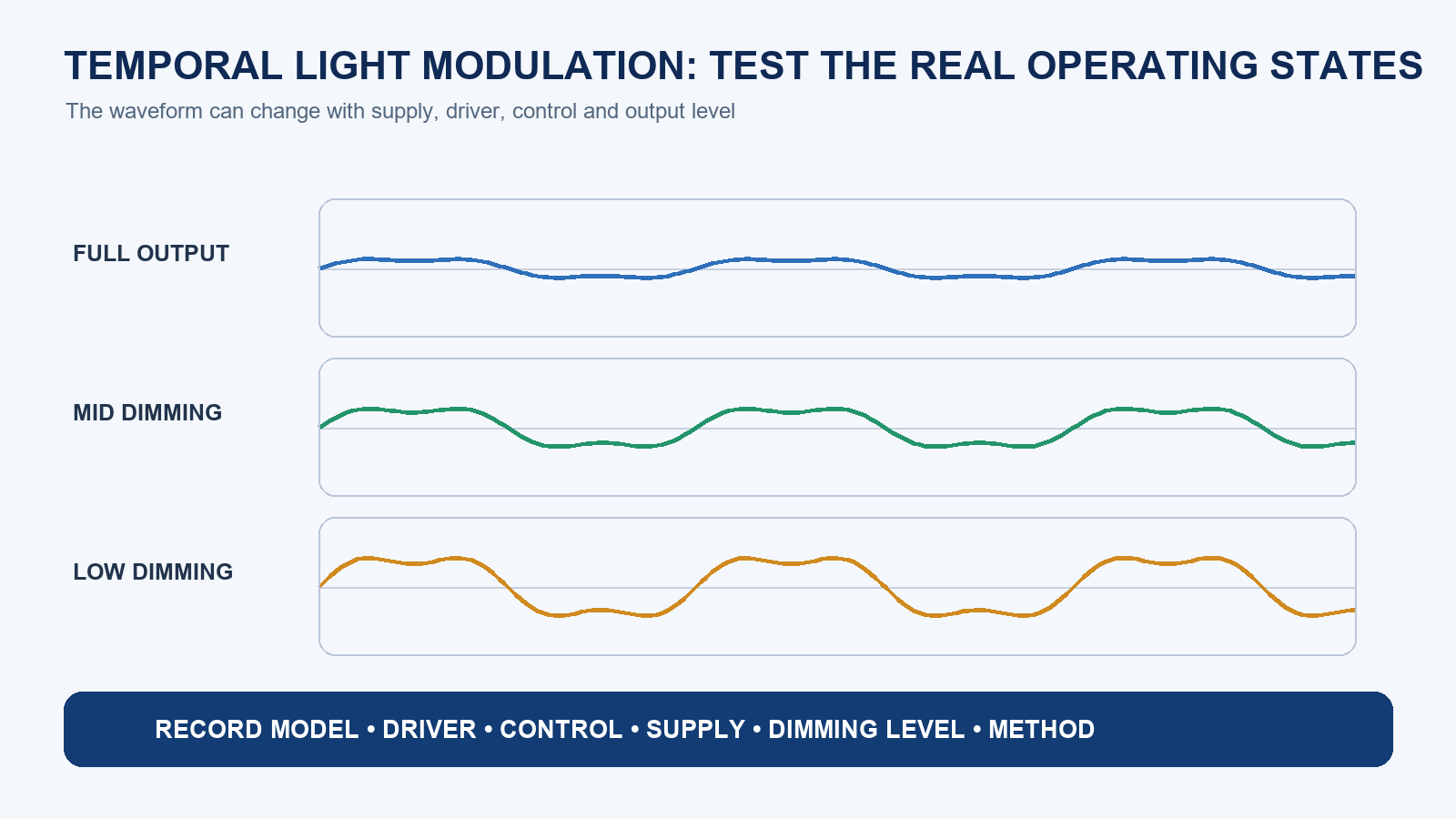
- At full output, minimum output or across the dimming range?
- With which driver, dimmer, control and firmware?
- Was the exact model and configuration tested?
- Is the waveform or sufficient test output available?
A system may behave differently at low dimming levels than at full output. Changing a driver or control can also change temporal behavior. Evidence should cover the operating states that the project will actually use.
A phone camera can help screen for bands or pulsing, but rolling shutter, frame rate and exposure settings affect what appears on screen. Use the observation to trigger a measured investigation, not as the final acceptance test.
Where the Three Issues Matter
| Application | UGR focus | Color focus | TLM focus |
|---|---|---|---|
| Offices and education | Screen views, seating directions and long occupancy | Faces, paper, finishes and task materials | Daylight and dimming states |
| Retail and hospitality | Display hierarchy and direct source views | Merchandise, food, textiles and brand finishes | Scene changes, cameras and low-level dimming |
| Healthcare and care spaces | Patient and staff viewing positions | Observation and color discrimination | Long occupancy and control states |
| Industrial and workshops | High-output sources, shadows and task visibility | Inspection colors and markings | Moving machinery and rotating parts |
| Video and machine vision | Human comfort remains relevant | Camera-dependent color response | Banding and exposure stability |
For offices and education, direct views of luminaires and screens make room-based glare analysis especially important. Dimming and daylight controls should be reviewed across their real operating range. The selected color data should suit faces, paper and the materials used in the space.
Retail and hospitality projects often need more than a general CRI number because color appearance contributes to product presentation and atmosphere. Review the intended finishes under the proposed light and include camera use where customers or staff regularly record video.
In industrial areas, moving machinery increases the relevance of stroboscopic effects. Safety assessment still covers the complete workplace: illuminance, shadows, contrast, glare, controls and procedures. One SVM value is not a substitute for that broader review.
Evidence Checklist for Buyers
For glare, request the exact photometric file, UGR table with stated conditions, luminous dimensions, optic identity and a calculation using the real room inputs. A representative mock-up is valuable when direct views, screens or non-uniform sources are important.
For color, request CCT and chromaticity information, CRI data, spectral power distribution and TM-30 outputs when the application needs added detail. Also review color consistency and how the approved configuration will be controlled through procurement.
For TLM, request the test method, metric, result and waveform where available. Record the supply, driver, control, firmware and output state. Full-output data alone is insufficient when the installation will dim or change scenes.
Evidence must map to the exact model, driver, optic, color setting and control configuration. Keep that mapping in the submittal so substitutions can be checked against the approved basis. This model-level discipline also supports the wider decisions in commercial lighting priorities for buyers.
A Better Specification Workflow
- Define the room, users, visual tasks, materials and camera requirements.
- State glare, color and TLM objectives separately.
- Identify the standards and project requirements that apply in the destination market.
- Request evidence for the exact luminaire, driver, optic and control configuration.
- Calculate the real layout rather than relying on catalogue shorthand.
- Review samples with actual materials, controls and important viewing positions.
- Commission the installed system at full output and every important control state.
- Preserve reports, settings and approved configurations for substitution and change control.
If the project is comparing panel-light configurations, the UGR<13 LED backlit grid panel provides another product route to discuss at model level. Its project suitability still depends on room calculation, color requirements, driver configuration and the applicable test evidence.
Frequently Asked Questions
Does a luminaire have one fixed UGR value?
No. UGR depends on the luminaire, room proportions, arrangement, background and observer conditions. Product tables support calculations under stated assumptions; the designed installation supplies the project result.
Is CRI 90 always better than CRI 80?
A higher value generally indicates higher average fidelity under the CRI method, but suitability depends on the application and the behavior of important colors. Review spectrum or TM-30 information when the visual objective needs more detail.
Does “flicker-free” mean zero temporal modulation?
Not necessarily. The phrase needs a metric, threshold, method and operating state. Request measured information for the exact driver and control configuration.
Are PstLM and SVM the same metric?
No. They address different temporal visual effects and frequency ranges. Use the metrics and limits required for the product, market and application.
Can a phone camera test LED flicker?
It can reveal possible artifacts, but camera settings can create or hide bands. A calibrated measurement method is needed for a specification or acceptance decision.
What should I send for a lighting-metric review?
Provide the room and layout, observer and task positions, luminaire model and optic, color intent, controls, dimming states, supply and applicable project requirements. Buyers can contact New Lights with those inputs for a model-level discussion.
Editorial Sources
- CIE 190:2010 — Calculation and Presentation of United Glare Rating Tables for Indoor Lighting Luminaires
- U.S. Department of Energy — TM-30 Frequently Asked Questions
- U.S. Department of Energy — Tutorial: Background and Guidance for Using ANSI/IES TM-30
- U.S. Department of Energy — Flicker Research
- Illuminating Engineering Society — ANSI/IES LM-90-20