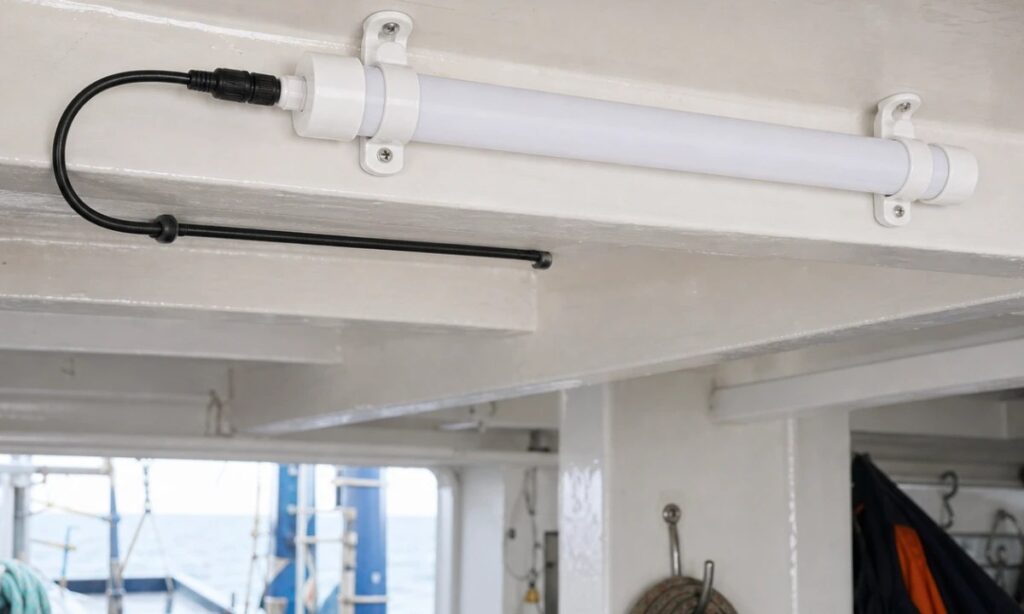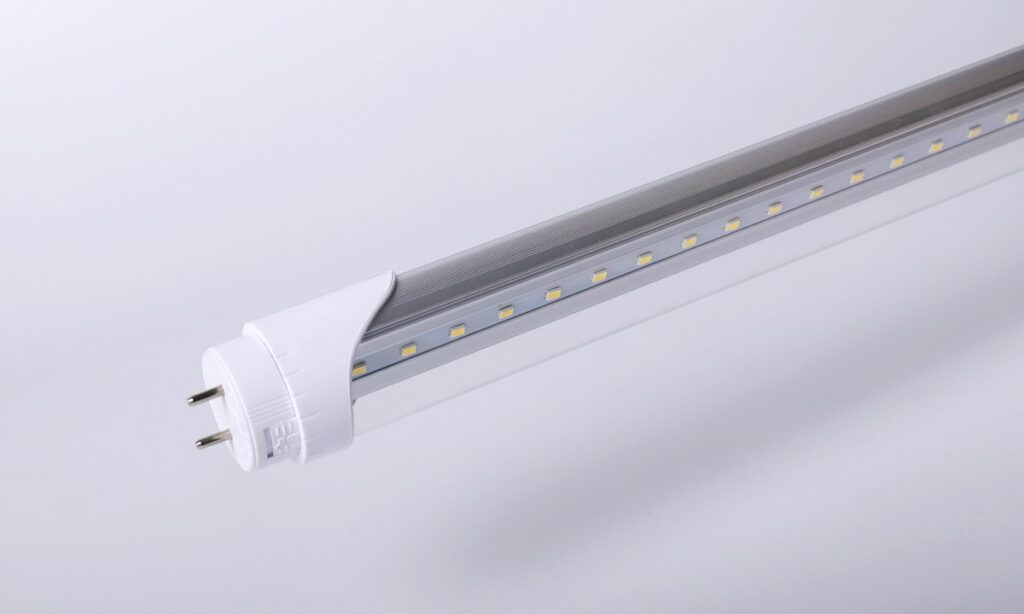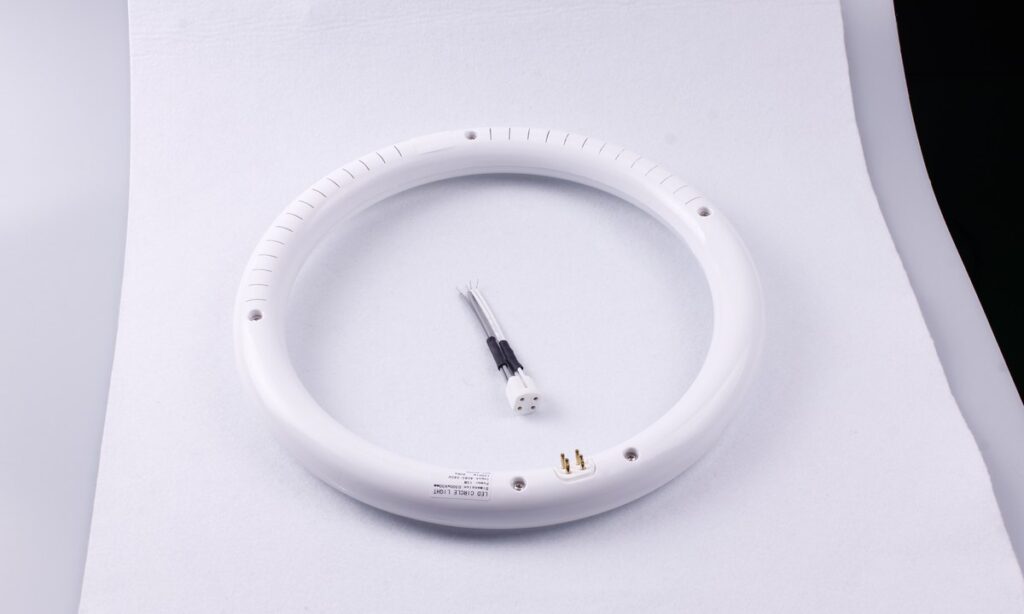


“Type of grow light” can mean several different things. LED, high-pressure sodium and fluorescent describe source technologies or systems. Bar, panel, bulb, toplight and interlight describe physical form or placement. Full-spectrum and red-blue describe spectral approaches. Supplemental and sole-source describe how the light is used.
Mixing these layers makes comparison difficult. A better selection process identifies the growing system first, then chooses a source technology, form factor, spectrum, distribution and control strategy supported by exact product data. Readers who need the measurement basics first can begin with grow-light fundamentals; spectrum is treated separately in the guide to full-spectrum and red-blue grow lights.
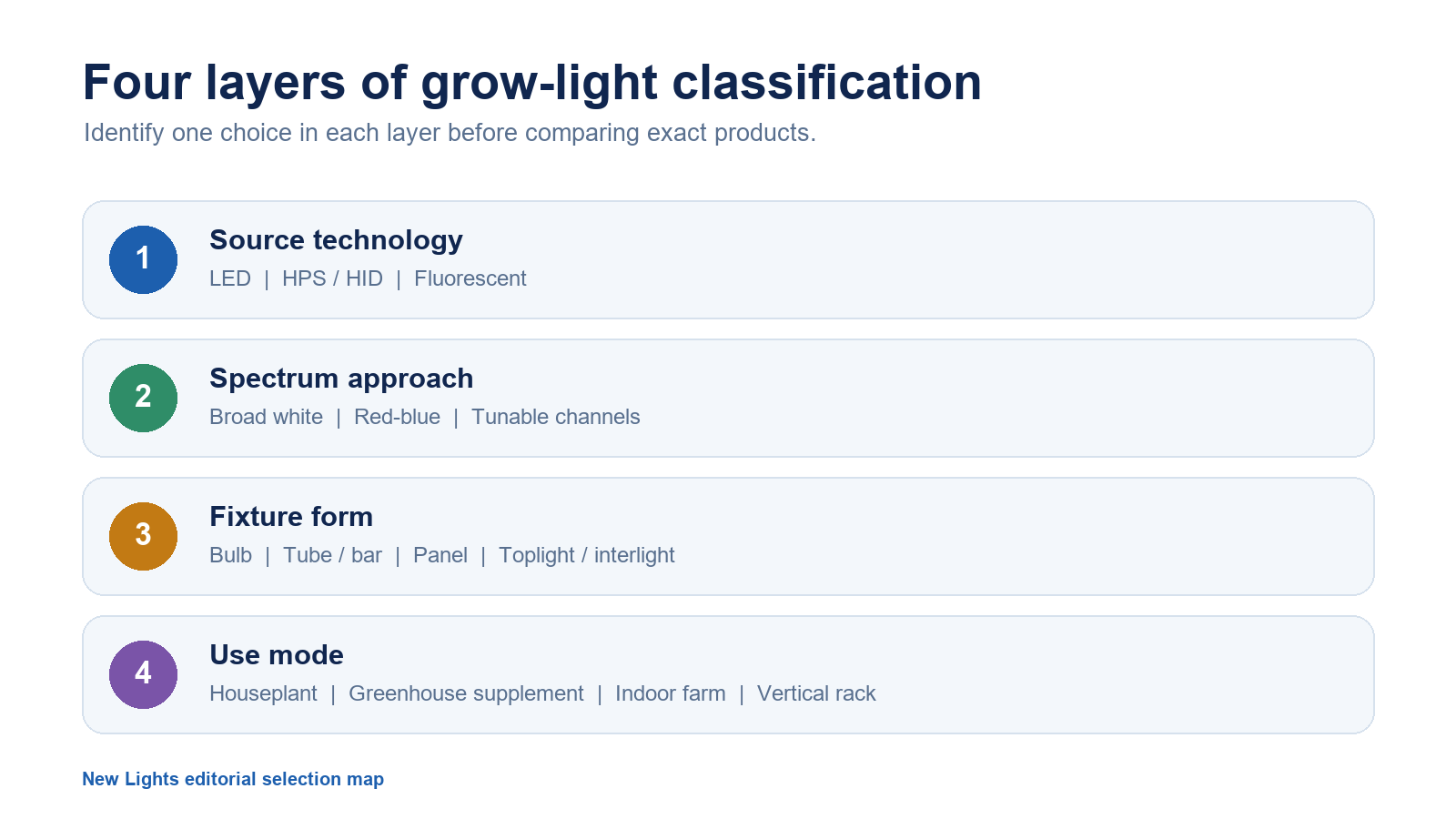
The Four Layers of Grow-Light Classification
Use this simple taxonomy:
- Source technology: LED, HPS/HID, fluorescent and legacy incandescent systems.
- Spectrum option: broad white, red-blue combinations, added far-red or UV, or tunable channels.
- Fixture form: bulb, tube, bar, panel, board, toplight or interlight.
- Use mode: houseplant supplementation, propagation, greenhouse supplemental lighting, non-stacked indoor production or vertical racks.
A product can occupy one position in every layer. For example, an LED bar may use a broad white spectrum as the sole source on a vertical rack. An HPS toplight may supplement sunlight in a greenhouse. “Full spectrum” alone does not tell you the fixture shape, photon output or application.
| Classification layer | What it describes | Questions to answer |
|---|---|---|
| Source technology | How light is generated and powered | LED, HPS/HID or fluorescent? |
| Spectrum approach | Which wavelength bands are delivered | Fixed broad white, red-blue or tunable? |
| Fixture form | Physical shape and placement | Bulb, tube, bar, panel, toplight or interlight? |
| Use mode | Role of electric light in production | Supplemental or sole-source; single level or stacked? |
LED Grow Lights
LED horticultural fixtures use solid-state light-emitting devices and electronic drivers. Their design flexibility allows manufacturers to choose spectral components, optics, form factors and controls for different growing systems.
Potential strengths include:
- Multiple spectrum and tuning options.
- Instant switching and dimming with compatible drivers.
- Compact bars and low-profile forms for racks.
- Directional photon distribution.
- Ability to separate drivers from the emitting fixture in some systems.
- Integration with sensors and controls.
LED products vary widely in photon efficacy, spectrum, PPFD uniformity, driver quality, thermal design, environmental suitability and serviceability. Compare the exact model and operating setting.
LED fixtures still release heat. They may direct less radiant heat toward the crop than some legacy technologies, but electrical energy not converted to useful radiation ultimately becomes heat in the facility. Rack design must account for fixtures, drivers, airflow and cooling loads.
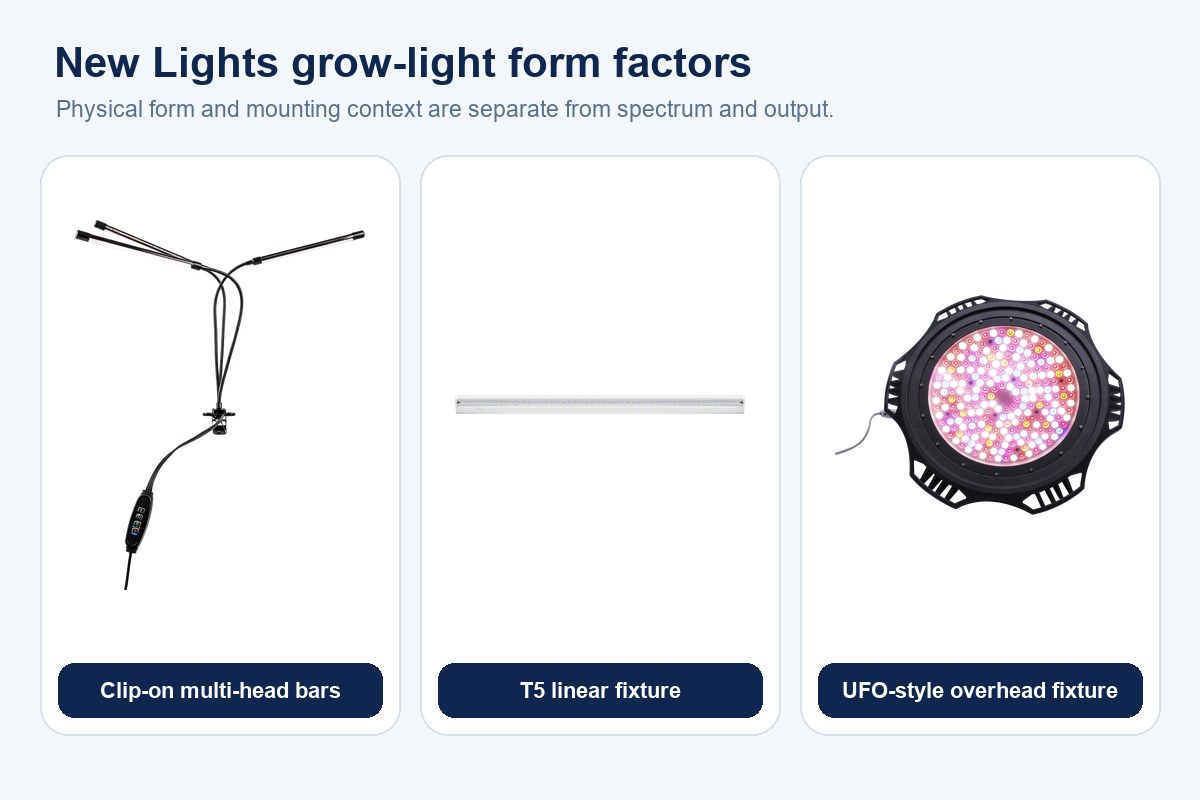
The New Lights horticultural-lighting range includes several LED form factors. Product-family pages are useful for identifying shapes and mounting concepts; system selection still requires exact model data and a project-specific layout.
High-Pressure Sodium and Other HID Systems
High-pressure sodium, or HPS, is a high-intensity discharge technology with a long history in greenhouse supplemental lighting. Metal halide and ceramic metal halide are other HID-related options found in some horticultural contexts.
Potential HPS strengths include:
- Established use in large greenhouse installations.
- High-output fixtures suited to substantial mounting heights.
- Existing infrastructure and maintenance knowledge at some facilities.
- A familiar economic baseline for retrofit analysis.
Constraints can include fixture bulk, warm-up or restrike behavior, limited control flexibility compared with many LED systems, lamp replacement and radiant heat near the crop. These characteristics vary by system generation.
USDA Agricultural Research Service has compared HPS and LED supplemental lighting under controlled greenhouse conditions. The studies show why a universal winner is inappropriate: crop response, spectrum, fixture performance, capital cost and operating cost all influence the decision. Results from one crop set, PPFD and treatment cannot be transferred to every greenhouse.
When evaluating an existing HPS system, measure its current canopy delivery and energy use. Compare the LED alternative at the system level, including layout, cooling or heating interactions, controls, installation and required production outcomes.
Fluorescent Grow Lights
Linear fluorescent tubes and compact fluorescent lamps have been used for houseplants, propagation and small growing areas. Their elongated form can provide useful coverage over shelves, and some systems can operate relatively close to plants when installed as intended.
Potential strengths include:
- Familiar equipment and replacement practices.
- Broad linear distribution.
- Suitability for some low- to moderate-intensity propagation or household applications.
- Lower initial complexity where compatible fixtures already exist.
Constraints can include lower photon efficacy than current high-performing LED products, lamp and ballast maintenance, limited control options and fixture depth. Performance varies by lamp, ballast, reflector and operating temperature.
Do not apply old watt-per-square-foot rules to a modern comparison. Use measured or documented photon data at the crop plane. If retrofitting a fluorescent fixture with LED tubes, treat the result as a new system and verify distribution, compatibility, wiring architecture and safety.
Incandescent and Halogen: Mainly a Legacy Reference
Incandescent and halogen sources convert a large share of input energy into heat and are generally poor choices as primary grow-light systems. They may appear in older household advice or specialty experimental contexts, but their visible warmth should not be confused with an efficient horticultural spectrum.
If a legacy installation uses these lamps, compare the complete replacement by plant delivery and environment. Do not place a hot source close to leaves or assume that adding red-looking light improves the growing system.
| Technology or system | Useful starting context | Main comparison points |
|---|---|---|
| LED | New builds, controls-led projects, close-clearance racks and many retrofit studies | Spectrum, PPF, PPFD distribution, photon efficacy, driver location, dimming and thermal design |
| HPS/HID | Existing greenhouse infrastructure and high-output overhead layouts | Current canopy delivery, lamp age, radiant heat, warm-up behavior, controls and maintenance |
| Fluorescent | Existing shelf, propagation and modest-intensity systems | Lamp and ballast condition, distribution, clearance, maintenance and LED retrofit safety |
| Incandescent/halogen | Legacy reference rather than a normal primary grow-light choice | Heat near plants, poor system efficiency and replacement practicality |
Fixture Form 1: Grow-Light Bulbs
Screw-base or pin-base grow bulbs can be convenient for small household setups and existing portable fixtures. They work best when the socket, reflector, orientation and distance support the intended distribution.
The bulb format does not guarantee broad coverage. A single lamp may create a strong center and weak perimeter. Check the PPFD map or measure the actual area. Verify base, voltage, fixture rating, enclosure limits and mounting stability.
Bulbs are generally easier to replace than integrated fixtures, but the surrounding fixture can limit thermal performance or waste photons.
For compact installations, compare a bulb or clip-on product within the home grow-light category and evaluate the actual illuminated area, mounting stability and distance to the canopy.
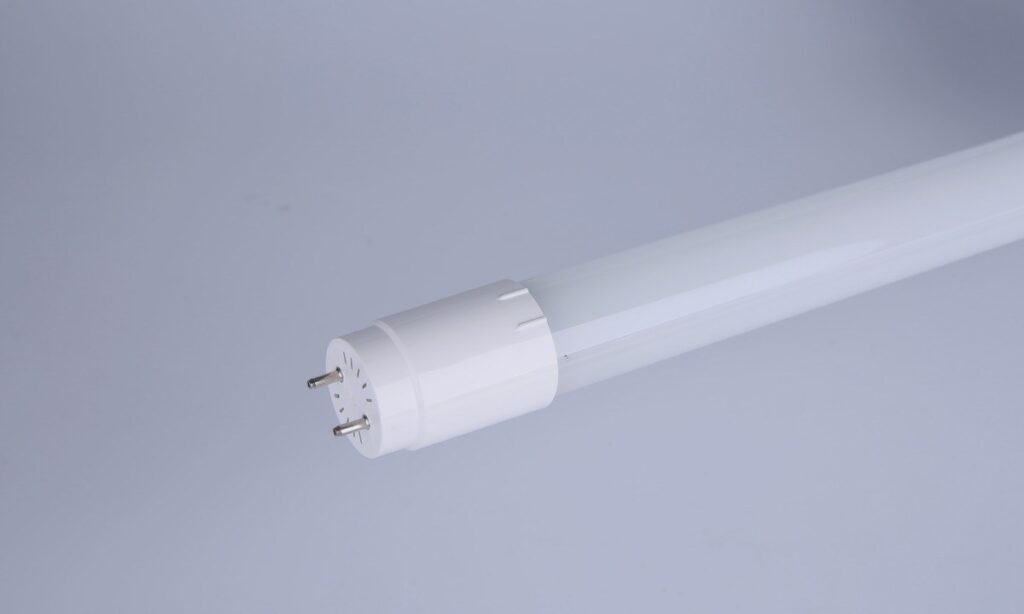
Fixture Form 2: Tubes and Linear Bars
Tubes and rigid bars distribute emitting points along a line. They are common over propagation shelves, benches and multi-level racks.
Potential benefits include flexible spacing, shallow profiles and the ability to build coverage from multiple parallel units. The design must address dark gaps, edge performance, driver location, linking limits and cable management.
A “bar” can range from a low-output shelf light to a high-output horticultural luminaire. Compare dimensions, PPF, PPFD maps, mounting heights and thermal conditions rather than relying on the name.
Fixture Form 3: Panels and Boards
Panel- or board-style products concentrate many LEDs in a broad plane. They can provide a large emitting area and compact overhead installation.
Evaluate source visibility, uniformity and heat dissipation. A dense board can create high center PPFD or visible points if the distribution and mounting height are not matched to the area. Integrated drivers simplify some installations but may add heat or complicate service.
The panel outline is not proof of even coverage. Review a grid across the intended canopy.
Fixture Form 4: Greenhouse Toplights
Toplights are mounted above the crop and deliver supplemental light over greenhouse bays or benches. They may use HPS or LED technology.
The system must coexist with sunlight and greenhouse structure. Fixture size and position can create daylight shading. Distribution, mounting height, truss loading, wiring, controls and maintenance access all matter.
For retrofit projects, compare not just individual fixture output but the new layout’s canopy distribution and natural-light obstruction. Control logic may respond to measured sunlight or accumulated DLI.
Fixture Form 5: Interlighting and Side Lighting
Interlights position luminaires within or beside a tall crop canopy to deliver photons to lower leaves that overhead light may not reach effectively. This is a placement strategy, not a single source technology.
The equipment must fit between crop rows, tolerate the environment and avoid obstructing workers or crop management. Distribution, surface temperature, water exposure, cable routing and plant contact require close review.
Interlighting should be justified by crop architecture and measured delivery. Adding fixtures inside a canopy does not automatically increase useful yield enough to cover energy and maintenance cost.
Fixture Form 6: Multi-Level Rack Systems
Vertical farms commonly use low-profile bars or panels under each shelf. Clearance, uniformity, driver heat, airflow and service access are critical because multiple layers concentrate electrical and thermal loads.
University of Missouri Extension notes that bulky, high-radiant-heat systems can be unsuitable where plants are close to the source. LEDs and some fluorescent systems may fit these geometries, but exact distance and thermal limits remain product- and crop-specific.
Plan the full rack: crop height, fixture depth, mounting hardware, irrigation, airflow, driver position, cable routing and cleaning. Evaluate PPFD at every level, not just one prototype shelf.
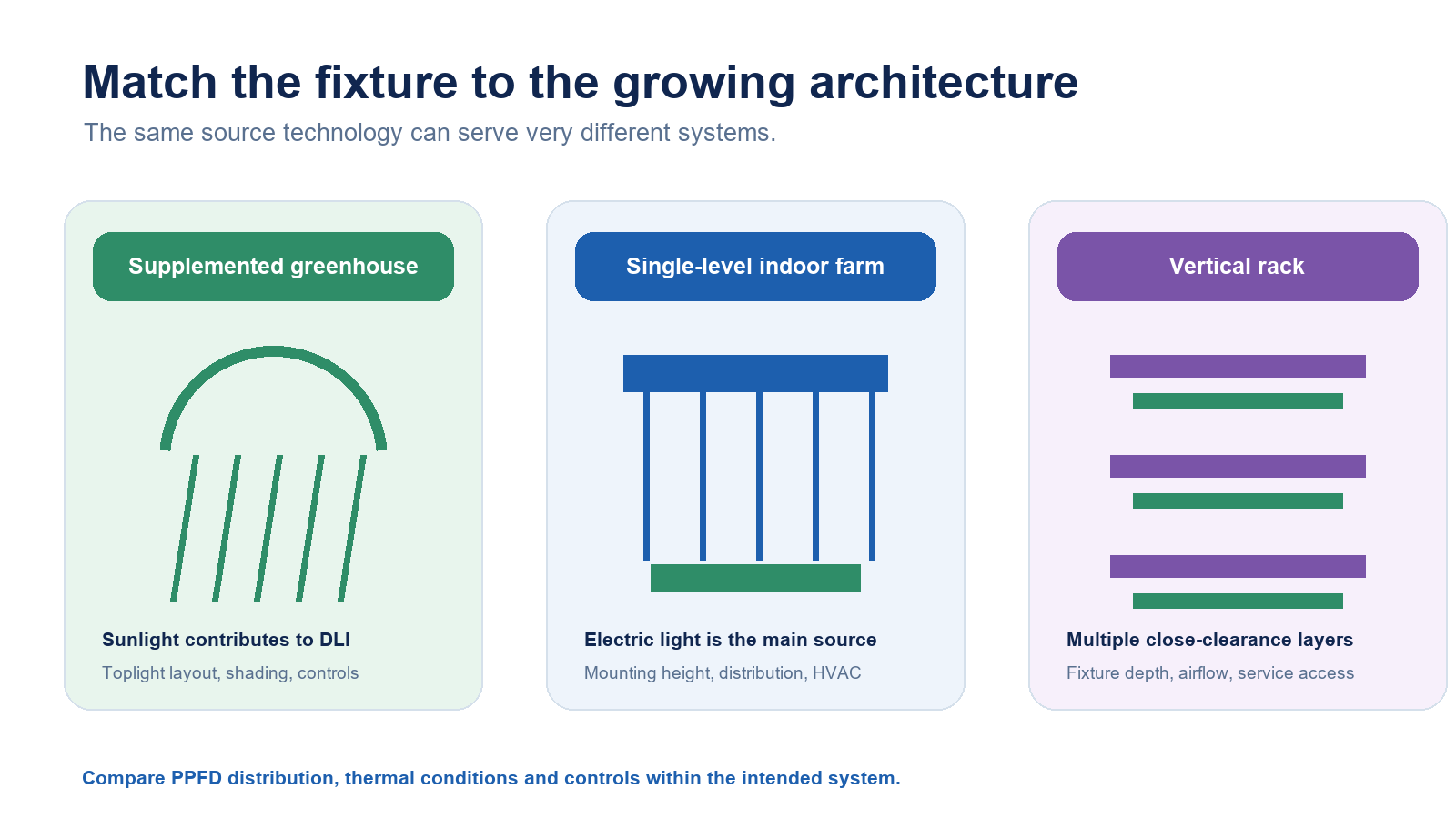
The U.S. Department of Energy uses these three broad architectures—supplemented greenhouses, single-level sole-source indoor farms and vertical farms—when analyzing horticultural-lighting energy opportunities. The categories are useful because each creates a different relationship among natural light, fixture clearance, electrical load and environmental control.
How to Choose Among the Types
Step 1: Define the Growing System
State whether sunlight is present, whether the lights are supplemental or sole-source, how many layers are used, and how the crop area changes over time.
Step 2: Define Crop and Stage
Obtain crop-specific evidence for spectrum, PPFD, DLI and photoperiod. Avoid choosing a technology before understanding the biological task.
Step 3: Set Physical and Environmental Limits
Measure area, clearance, mounting, water exposure, ambient temperature and airflow. Identify where drivers, controls and cables can be installed and serviced.
Step 4: Compare Exact Photon Data
Request spectrum, PPF, PPFD maps at relevant heights, input power and photon efficacy for the exact model and setting. Check edge and corner delivery, not only the center.
Shortlisting a higher-output form factor is easier within the professional grow-light category, but a product photo or wattage alone cannot replace a PPFD map at the planned height.
Step 5: Compare Controls and Operations
Review dimming, scheduling, sensors, protocols, startup, failure behavior and integration with environmental systems. Include cleaning, lamp or component replacement and calibration.
Step 6: Model Economics
Compare product, installation, energy, HVAC interaction, maintenance, downtime and expected production value. Use current models and stated assumptions. Historical LED-versus-HPS cost studies are context, not current quotations.
Step 7: Pilot and Measure
Run a representative area with the intended crop and environment. Record photon delivery, energy, temperature and crop outcomes. Expand only after the evidence supports the system.
If measured delivery or plant response differs from the design, use the indoor grow-light troubleshooting guide to separate distribution, distance, schedule, environment and equipment causes before changing the fixture type.
Frequently Asked Questions
Are LED grow lights always better than HPS?
No. LED systems offer flexibility and can perform very well, but the decision depends on current exact products, greenhouse or indoor context, crop goals, infrastructure and lifecycle economics.
Are fluorescent grow lights obsolete?
Not in every small or existing application, but they should be compared with current LED options using canopy photon delivery, energy, maintenance, heat, controls and installed cost.
Is “full spectrum” a type of grow light?
It is a spectral description, not a complete hardware category. A bulb, bar, panel or toplight may all be marketed with broad-spectrum output, and their spectra and performance can differ.
Are grow-light bars better than panels?
Neither form is universally better. Bars can support flexible spacing; panels can offer a broad emitting area. Compare the real PPFD distribution, clearance, heat and service plan.
Which type is best for a greenhouse?
Choose using sunlight contribution, crop and stage, mounting structure, shading, heat, controls, current HPS infrastructure, exact product evidence and lifecycle cost.
What information is needed for a format comparison?
Provide the crop and stage, greenhouse or indoor layout, sunlight contribution, growing area, clearance, environmental conditions, target photon metrics, controls and budget assumptions. Buyers can contact New Lights with these inputs for a model-level comparison.
Editorial Sources
- University of Missouri Extension, “Controlled Environment Agriculture: Understanding Grow Lights”: https://extension.missouri.edu/publications/g6987
- USDA Agricultural Research Service, “Comparison of Supplemental Lighting Provided by High-pressure Sodium Lamps or Light-emitting Diodes for the Production of Bedding Plants in Commercial Greenhouses”: https://www.ars.usda.gov/ARSUserFiles/50820500/GPRG/2019PublicationsandSummaries/2019_Comparison%20of%20Supplemental%20Lighting%20Provided%20by%20High-pressure%20Sodium%20Lamps%20or%20Light-emitting.pdf
- USDA Agricultural Research Service, publication record for crop-dependent HPS and LED comparison: https://www.ars.usda.gov/research/publications/publication/?seqNo115=370992
- U.S. Department of Energy, “Better Lighting for Agriculture”: https://www.energy.gov/cmei/ssl/better-lighting-agriculture