

Yes, LED street lights can reduce electricity use, but there is no universal savings percentage. The result depends on what the project replaces, the actual input power of both systems, operating hours, dimming schedules, controls, lighting requirements, metering, and utility billing.
The defensible question is not “How much does LED save?” It is “How much energy does this approved roadway-lighting system use compared with a verified baseline while delivering the required lighting performance?”
Build an Accurate Baseline
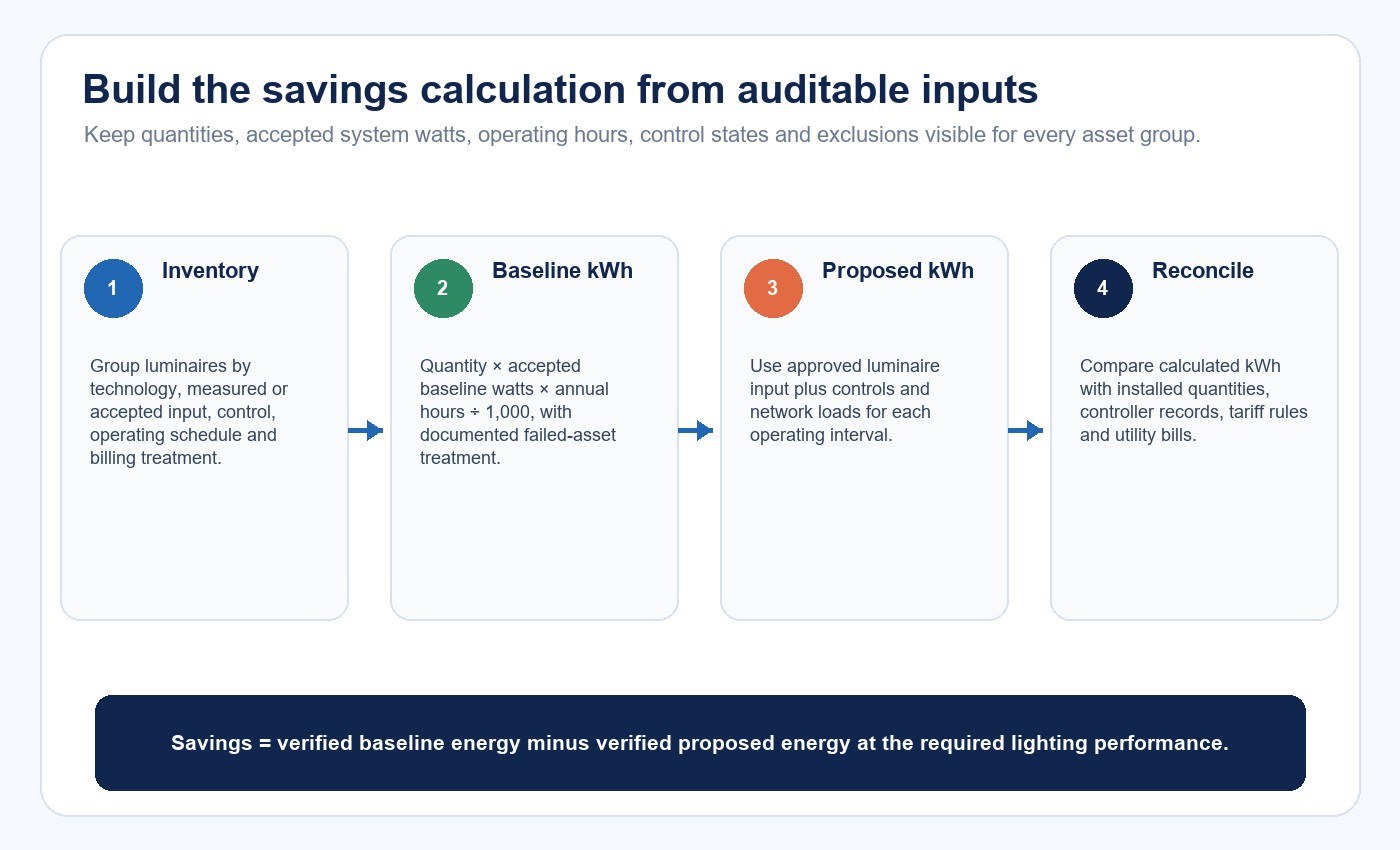
Start with an asset inventory. Record each luminaire’s location, technology, nominal lamp wattage, ballast or driver losses, measured input where available, mounting, control, operating schedule, failure status, and billing category. Separate asset groups that have different wattages or hours.
Do not assume the nameplate lamp wattage equals system input. Legacy discharge systems can include ballast losses, and utility bills may use fixed tariff wattages rather than meters. Confirm how the owner is charged and how the billing inventory will be updated.
Exclude failed lamps only with a documented rule. Comparing a fully operating LED system with a baseline containing many dark fixtures can understate baseline service or distort energy and lighting comparisons.
| Baseline field | Why it changes the result | Preferred evidence |
|---|---|---|
| Quantity by fixture type | Different groups may have different loads and schedules | Geocoded asset inventory and field sample |
| System input power | Lamp wattage can omit ballast, driver or control losses | Circuit or representative fixture measurement |
| Annual operating hours | Dawn-to-dusk hours vary by location and control behavior | Controller history, timer settings or documented schedule |
| Failed or disconnected units | Dark assets distort both service and energy baselines | Condition survey with an agreed treatment rule |
| Billing method | Metered kWh and tariff-wattage billing reconcile differently | Utility tariff and current billing inventory |
Use a Transparent Energy Formula
For a constant schedule, annual energy is:
Annual kWh = Quantity × Input watts × Annual operating hours ÷ 1,000
Calculate baseline and proposed energy separately. Annual energy savings equal baseline kWh minus proposed kWh. Percentage savings equal that difference divided by baseline kWh.
Consider 1,000 existing systems measured at 180 W and operating 4,100 hours. The baseline is 738,000 kWh per year. A 95 W proposed system on the same schedule uses 389,500 kWh, so the engineering estimate is 348,500 kWh, or about 47%, before controls.
| Calculation line | Baseline | Proposed | Difference |
|---|---|---|---|
| Quantity | 1,000 | 1,000 | 0 |
| Accepted input power | 180 W | 95 W | 85 W per luminaire |
| Annual operating hours | 4,100 | 4,100 | 0 |
| Annual energy | 738,000 kWh | 389,500 kWh | 348,500 kWh |
The percentage changes immediately if the measured baseline load, approved LED load, operating hours or installed quantity changes. Keep the calculation sheet tied to the asset groups rather than applying one percentage to the entire estate.
Keep quantity, watts, hours, losses, and exclusions visible so reviewers can reproduce the result.
Add Controls as a Time Schedule
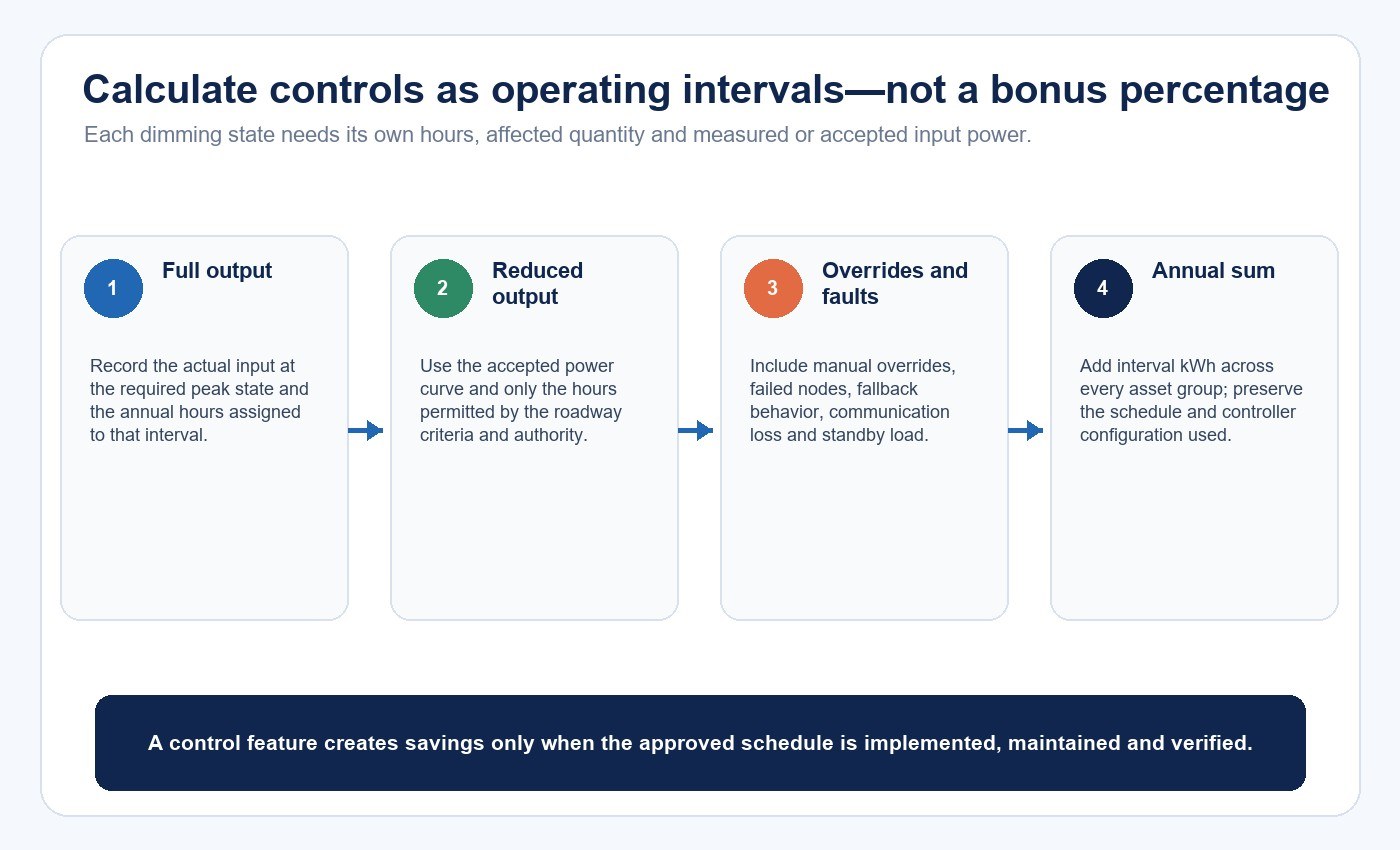
Do not add a generic “control savings” percentage. Divide the night into operating intervals and calculate each interval using the commanded power level, actual luminaire input at that level, number of affected assets, and hours.
A schedule may use full output during traffic peaks, reduced output overnight, and a defined response to events or failures. Confirm whether the lighting criteria and authority permit each state. Account for controller and network standby power where material.
DOE’s model specification work recognizes that networked outdoor controls can reduce energy and maintenance costs, while DOE research also notes questions about measurement accuracy, functionality, and maintenance. Validate the actual system rather than relying on a feature list.
Preserve Required Lighting Performance
Energy savings are not valid if the proposed layout fails the project’s lighting requirements. Compare maintained illuminance or luminance, uniformity, glare, veiling luminance, vertical illumination, color, obtrusive light, and other applicable criteria using the approved roadway design method.
Request model-specific photometric files and calculate the real pole spacing, mounting height, arm, tilt, road width, surfaces, geometry, and maintenance factor. A lower wattage can be appropriate when optics direct light more effectively, but wattage alone cannot prove equivalence.
Measure a representative baseline and pilot using an agreed grid and calibrated instruments. DOE’s lighting measurement protocol emphasizes comparable operating conditions, power measurements, and light-level measurements.
The outdoor lighting installation checklist helps carry the approved design into mounting, wiring, aiming and commissioning without losing the assumptions used in the savings model.
Compare Luminaire and System Efficacy
DOE FEMP describes luminaire efficacy as light output divided by electrical input. It is a useful product metric, but project energy depends on useful distribution, installed power, controls, and hours.
Two luminaires with the same lm/W can create different roadway results because their intensity distributions differ. Conversely, a product with lower headline efficacy may require fewer watts in a specific layout if its optics match the task better. Compare the approved layouts at equal performance.
Confirm whether quoted power includes all drivers, controls, photocells, sensors, and communication devices used in the project boundary.
Reconcile Tariffs and Bills
Energy savings and bill savings can differ. A tariff may include energy charges, fixed monthly charges, maintenance charges, pole charges, demand, taxes, and estimated wattage tables. Some utility-owned systems are not billed from direct meter readings.
Obtain the current tariff and asset-billing file. Ask how new wattages, dimming schedules, outages, controls, and ownership changes will be recognized. A technically efficient retrofit may not deliver the forecast cash saving until billing records and rates are updated.
Model low, expected, and high electricity-price scenarios. Keep tax and escalation assumptions separate from measured energy reduction.
Include Maintenance Without Inventing Lifetime
LED systems can change maintenance patterns, but a long rated life is not a guaranteed field replacement interval. Review driver, LED module, surge protection, connector, control node, seal, finish, and environmental evidence for the exact model.
Build the maintenance baseline from actual work orders, failures, relamping cycles, crew time, lifts, traffic control, spares, and disposal. For the proposed system, state failure-rate and replacement assumptions as assumptions unless field or warranty data support them.
Read warranty scope, ambient limits, switching, surge, controls, exclusions, labor, freight, remedy, and claim process. A replacement part warranty may not cover site labor or traffic management.
Run a Representative Pilot
Choose pilot locations that represent major road geometries, pole spacing, mounting heights, electrical conditions, traffic, ambient temperatures, and communication environments. Avoid selecting only the easiest block.
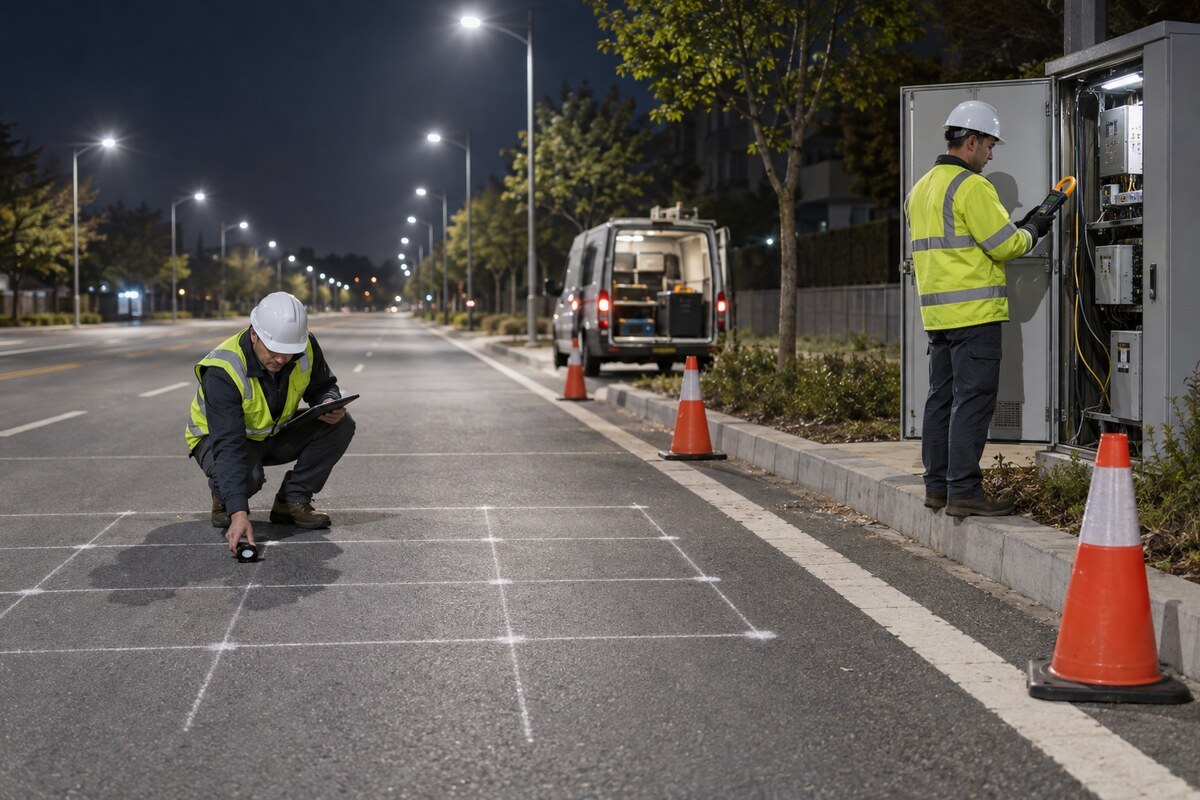
Before installation, record baseline power, light levels, asset condition, controls, billing data, and public or operational issues. After installation, verify product model, settings, input power, distribution, dimming, network reporting, faults, and lighting criteria.
Operate the pilot long enough to observe control schedules, weather, communications, maintenance workflow, and stakeholder response. Document changes before scaling the calculation to the full inventory.
Create a Measurement and Verification Plan
Define which values will be measured, stipulated, calculated, or taken from bills. State instruments, sample size, circuits, measurement dates, operating conditions, quality checks, data ownership, and correction methods.
Post-installation verification should reconcile installed quantities, actual wattages, control schedules, exceptions, failed nodes, manual overrides, and tariff records. Connected controllers may report energy, but compare their accuracy and aggregation rules with the accepted measurement method.
DOE explains that M&V effort should be proportional to project value and risk. A simple retrofit may need limited sampling; a large performance contract or complex control system may justify stronger verification.
| Evidence point | Baseline | After installation | Acceptance question |
|---|---|---|---|
| Asset count | Audited quantity and condition | Installed model and quantity | Were every addition, omission and exception reconciled? |
| Input power | Representative fixture or circuit measurement | Same boundary and comparable operating state | Does the measured load match the calculation inputs? |
| Operating schedule | Existing controls and annual hours | Programmed schedule, overrides and failure state | Is the expected dimming profile actually operating? |
| Lighting performance | Agreed measurement grid and conditions | Same grid and comparable conditions | Does the approved design remain satisfied? |
| Billing | Tariff and utility asset file | Updated wattages, ownership and fees | Has the financial model been reconciled to the bill? |
Calculate Financial Results Separately
Energy savings are only one cash-flow input. Include equipment, design, survey, installation, rewiring, controls, network fees, commissioning, traffic management, disposal, financing, incentives, maintenance, spares, and billing changes.
Calculate simple payback, net present value, and lifecycle cost with stated analysis period, discount rate, escalation, residual value, and replacement assumptions. DOE provides a Street and Parking Facility Lighting Retrofit Financial Analysis Tool for this type of structured analysis.
Run sensitivity cases for electricity price, operating hours, control schedule, installation cost, maintenance, failures, and network fees. A single payback number hides uncertainty.
Treat Off-Grid Solar Street Lights as a Different Energy Boundary
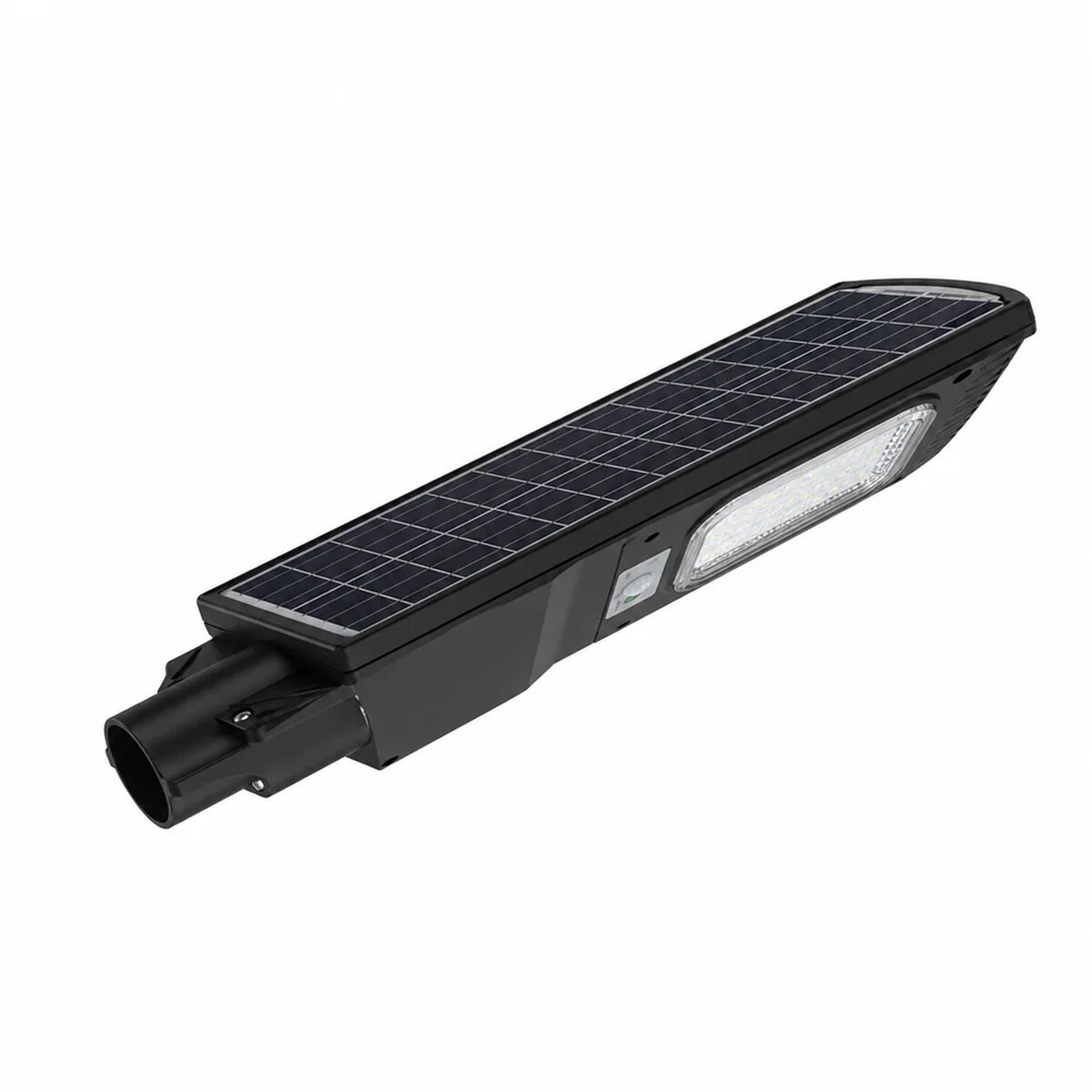
An all-in-one solar street light does not draw normal operating energy from the same grid circuit as a conventional street-light retrofit. Its system boundary includes the solar panel, battery, charge controller, LED load, nightly operating profile, seasonal solar resource and autonomy requirement. The grid-kWh formula above therefore cannot be reused as its complete sizing or economic model.
The New Lights all-in-one solar street-light series is relevant where an off-grid access road or site route is being considered. Compare that route through a separate solar and battery energy balance, civil works, maintenance access and required lighting-performance review. The broader outdoor, garden and solar lighting solution helps distinguish grid-connected retrofit, area lighting and off-grid solar applications before product selection.
Build the Procurement Evidence Package
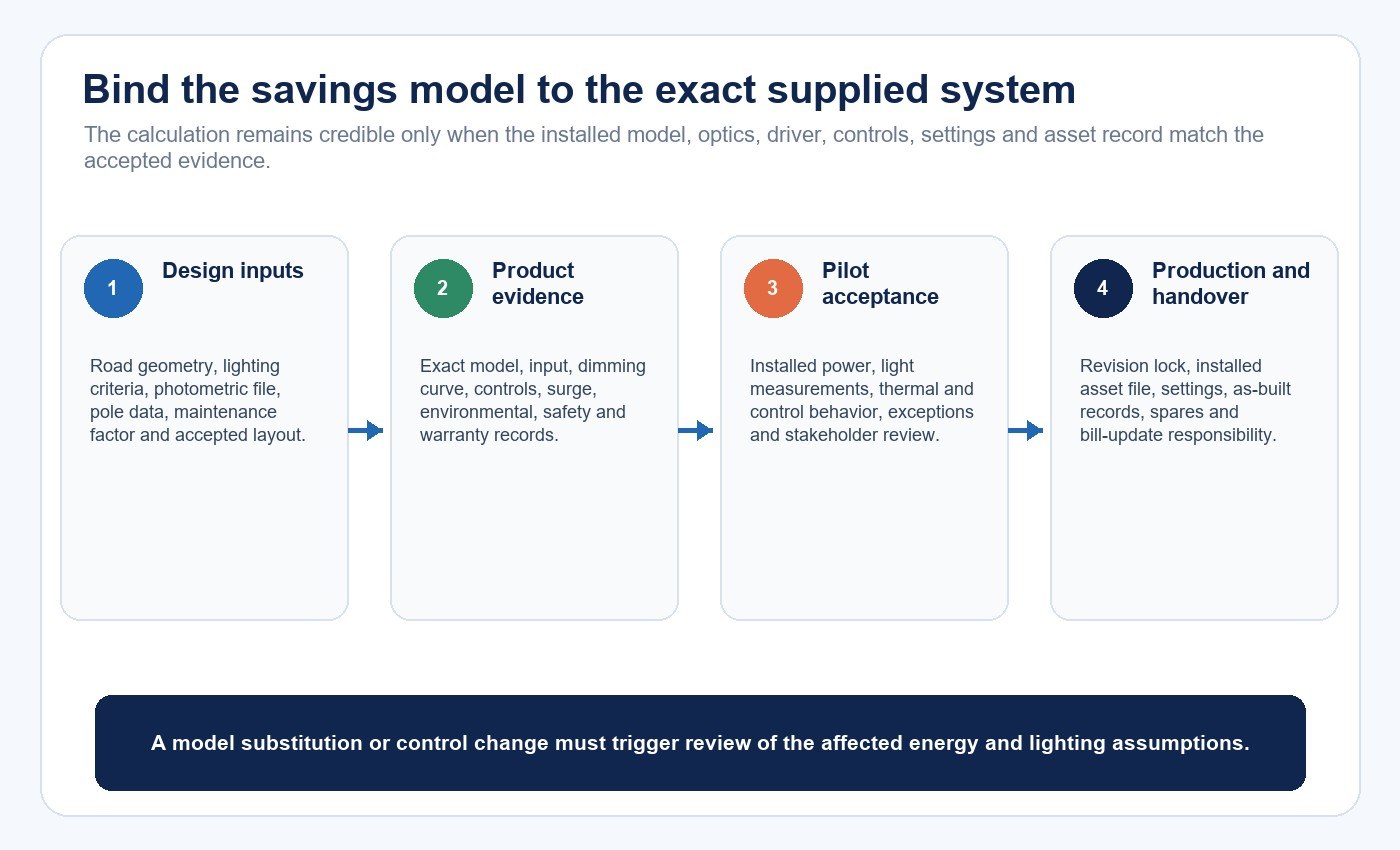
The buyer should provide inventory, baseline method, roadway criteria, pole geometry, electrical conditions, environment, controls, tariff, ownership, pilot and M&V requirements. Suppliers should return model-bound evidence.
Request exact input power, photometric files and reports, dimming power curve, control interoperability, surge and power-quality evidence, environmental ratings, safety certifications, thermal and lifetime reports, warranty, installation instructions, spare-parts strategy, and change-control process.
Use the LED lighting sample evaluation checklist to bind each sample to its model, driver, controls, settings and test purpose. The New Lights factory and manufacturing page provides context for production evidence and change-control discussions.
To evaluate a specific street-light conversion, contact New Lights with the asset inventory, baseline energy, pole and road geometry, required lighting criteria, control schedule, tariff, and evidence list. Calculate the final savings range after the proposed models and layouts have been accepted.
Frequently Asked Questions
What percentage of electricity do LED street lights save?
There is no universal percentage. Calculate the difference between verified baseline and proposed system energy using project-specific watts, quantities, hours, controls, and losses.
Is lower wattage enough to prove savings?
It can show lower connected load, but the proposed system must also meet approved roadway-lighting criteria and the operating and billing assumptions must be valid.
Do smart controls always add savings?
Only when permitted dimming schedules are implemented and maintained. Use actual input at each state, operating hours, standby power, overrides, and failure behavior.
Why might the utility bill fall less than calculated energy?
Fixed charges, maintenance fees, estimated tariff wattages, asset-record delays, network fees, taxes, or different operating assumptions can separate bill savings from kWh savings.
Should maintenance savings be counted?
Yes, but use actual baseline records and transparent proposed assumptions. Do not convert rated life or warranty duration directly into a guaranteed field failure rate.
How should savings be verified after installation?
Reconcile installed assets, measured or accepted input power, controls, hours, lighting measurements, controller data and utility bills under a documented M&V plan.
Editorial Sources
- U.S. Department of Energy FEMP, “Purchasing Energy-Efficient Exterior Lighting”: https://www.energy.gov/cmei/femp/purchasing-energy-efficient-exterior-lighting
- U.S. Department of Energy, “Standard Measurement and Verification Plan for Lighting Retrofit Projects”: https://betterbuildingssolutioncenter.energy.gov/sites/default/files/attachments/lighting_measurement_evaluation_protocol.pdf
- U.S. Department of Energy, “Retrofit Financial Analysis Tool”: https://www.energy.gov/cmei/ssl/retrofit-financial-analysis-tool
- U.S. Department of Energy, “Connected Streetlighting Systems”: https://www.energy.gov/cmei/ssl/connected-streetlighting-systems