

Connected retail lighting is adaptable only when a layout change preserves four things at the same time: mechanical safety, electrical capacity, optical performance, and control behavior. Movable luminaires or wireless controls make change possible, but neither one makes the completed system automatically reconfigurable.
The practical approach is to define the store changes first, map every affected interface, test the new arrangement, and retain an updated configuration record. This guide turns that process into a repeatable decision rather than treating “modular” or “connected” as a blanket product feature.
Start With a Real Store Change
Begin with a change the store actually expects: a seasonal window reset, relocated gondolas, a new checkout position, a wall converted to shelving, a pop-up display, or a tenant handover. Draw the current and proposed display positions and mark the surfaces that must receive general, vertical, and accent light.
For each scenario, identify the allowed downtime, who may move equipment, whether electrical work is involved, which scenes or zones must change, and what evidence will close the work. This separates routine scene recall from a physical reconfiguration that needs a qualified installer and recommissioning.
The retail lighting zones, optics and controls guide helps establish the original zone and display-lighting brief before a change is assessed.
| Store change | Lighting impact | Control impact | Closeout evidence |
|---|---|---|---|
| Move a display table | Re-aim beams and check target coverage | Reassign the affected luminaires if the zone changes | Updated aiming plan and measured result |
| Convert a wall to shelving | Review vertical light, glare and shadows | Adjust scene levels or sensor response | Before-and-after readings and scene record |
| Add a promotional island | Confirm spare mounting and electrical capacity | Add a temporary group with an expiry date | Load check, group test and removal plan |
| Tenant or brand reset | Rebuild the task hierarchy and appearance criteria | Review permissions, schedules and data ownership | Approved layout, configuration export and handover |
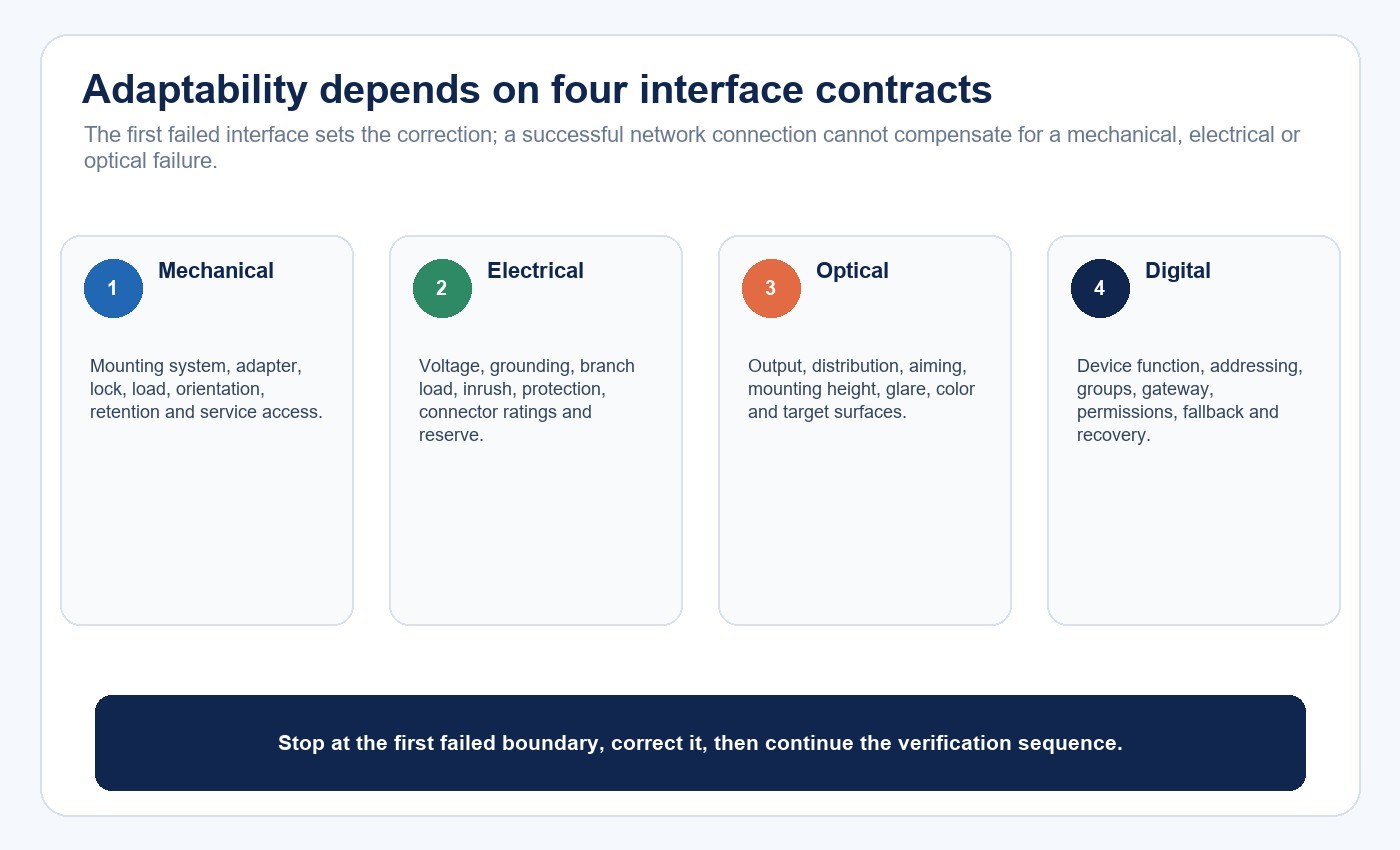
Treat Modularity as Four Interface Contracts
A system is only as adaptable as its most restrictive interface. A rail may accept another luminaire mechanically while the circuit has no spare capacity. A control platform may discover a device while lacking the function needed for a scene. A movable spotlight may still miss its new target or create glare.
| Interface | What must remain compatible | Common failure after a change | Acceptance question |
|---|---|---|---|
| Mechanical | Track or support, adapter, lock, load, orientation and access | Loose engagement, unsupported weight or blocked service access | Is the exact module approved for this mounting position? |
| Electrical | Voltage, polarity, grounding, branch load, inrush and protection | Overload, nuisance trip, wrong connection or inadequate spare capacity | Does the revised load schedule remain within every limit? |
| Optical | Output, distribution, aiming, mounting height, glare and color | Dark merchandise, spill, reflections or inconsistent appearance | Does the new layout meet the task at the actual surfaces? |
| Digital | Protocol, device function, addressing, zones, gateway, permissions and fallback | Missing commands, orphaned devices, broken scenes or cloud dependence | Can every required workflow be commissioned and tested? |
The first bottleneck determines the next action. If the mounting interface fails, stop before control programming. If the circuit cannot support the change, moving a fixture in software solves nothing. If the photometric result fails, a successful network connection is irrelevant.
Lock the Mechanical and Electrical Boundary First
Record the permitted luminaire families, adapters, suspension or track components, connector orientation, support spacing, maximum loads, required tools, and inspection criteria. “Fits the rail” is not sufficient if the locking method, grounding path, retention, or service clearance differs.
Build a current load schedule for every circuit, track, power supply, and control device. Include normal operating load, inrush where relevant, sensors, gateways, emergency functions, and reserved capacity. Do not estimate allowable quantity by dividing circuit watts by one luminaire’s rated power; protection, conductor limits, connector ratings, inrush, voltage drop, driver behavior, and manufacturer instructions can become the controlling constraint first.
Label the physical and electrical boundary in the as-built record. The person approving a future change should be able to identify the correct hardware and remaining capacity without reconstructing the original design.
Recalculate the Optical Result
Movability is valuable only when the revised arrangement still supports the merchandise and circulation task. Check horizontal and vertical illuminance, beam placement, uniformity, glare, reflections, color appearance, mounting height, obstructions, and the relationship between luminance and the shopper’s viewing direction.
Dimming cannot redirect a beam that misses its target. A scene can reduce excess light, but it cannot repair a dark wall, a harsh reflection, or a narrow beam placed too far from the display. Use photometric files for the exact luminaire and optic, then measure representative points after the move.
The UGR, CRI and flicker guide explains why glare, color rendering, and temporal light modulation remain separate checks. The wider Commercial & Retail Lighting Solutions page provides application context for sales floors, displays, counters, and public areas.
Define Control Behavior as Testable Sequences
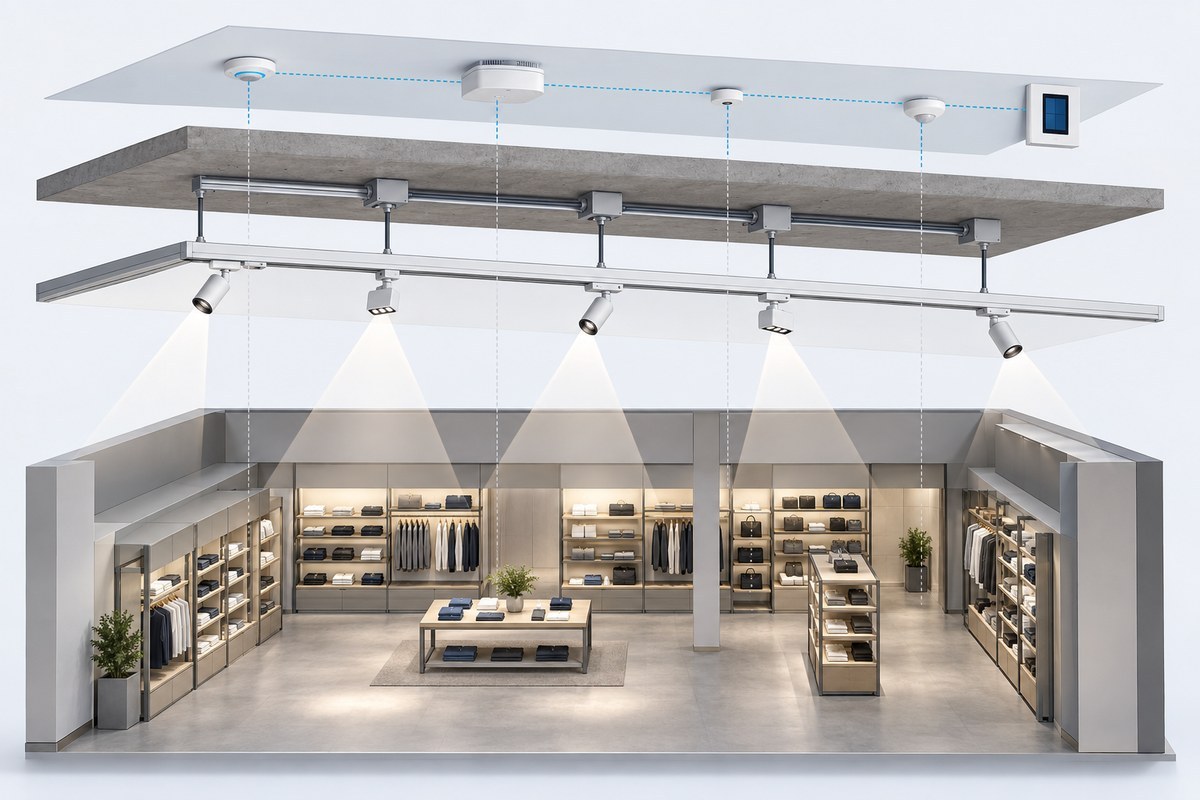
The commercial connected-lighting specification guide covers the broader architecture. For a reconfiguration, narrow that architecture into observable sequences: occupied, unoccupied, daylight response, after-hours, manual override, emergency state, communication loss, power restoration, and administrator handover.
Map zones to store functions instead of treating them as permanent room names. A zone hierarchy tied rigidly to yesterday’s fixtures or shelving can make a physically flexible installation expensive to change. Keep a device inventory that links each device identity to its physical location, electrical circuit, control group, firmware version, and approved function.
Wireless does not remove commissioning. Devices still require onboarding, addressing or identification, grouping, sensor setup, permissions, scene testing, and failure-state verification. Decide which functions must continue locally if the gateway, internet connection, cloud service, or administrator account is unavailable.
Verify Interoperability at the Function Level
The U.S. Department of Energy reports that commercial connected-lighting interoperability standards and specifications have historically had limited adoption, and its API research identifies integration challenges and tradeoffs. A shared protocol name therefore starts the review; it does not finish it.
Compare exact devices, versions, profiles, commands, data objects, commissioning tools, gateways, and update policies. Test every function that matters: on/off, dimming, scenes, sensor events, schedules, status, energy data, faults, timestamps, overrides, and recovery. A demo that switches one light does not prove the rest of the workflow.
Certification can strengthen evidence when it applies to the exact product. The DALI Alliance, for example, states that DALI-2 certification uses testing with independent verification and lists certified products in its database. The project still needs to confirm the specific part number and the required device functions rather than relying on a logo or family-level claim.
Include Data and Cybersecurity in the Change Plan
List the data created or used by luminaires, sensors, gateways, applications, and cloud services. Define ownership, administrator control, storage, export, retention, deletion, remote access, and the process for transferring the system to a new operator.
NIST guidance treats IoT security as a lifecycle and system-risk problem. For connected lighting, the requirement may include device identity, access control, secure onboarding, software update, vulnerability handling, logging, configuration backup, network segmentation, recovery, and end-of-support communication. The appropriate controls depend on the architecture and the store’s risk requirements.
Do not let essential lighting operation depend on an untested remote service. Record the required local behavior during communication loss, gateway failure, expired credentials, cloud outage, and product end of support. Test those states during acceptance rather than waiting for an incident.
Work Through One Reconfiguration Example
Consider a fashion store moving a featured collection from a perimeter wall to a central island. The change affects more than fixture position.
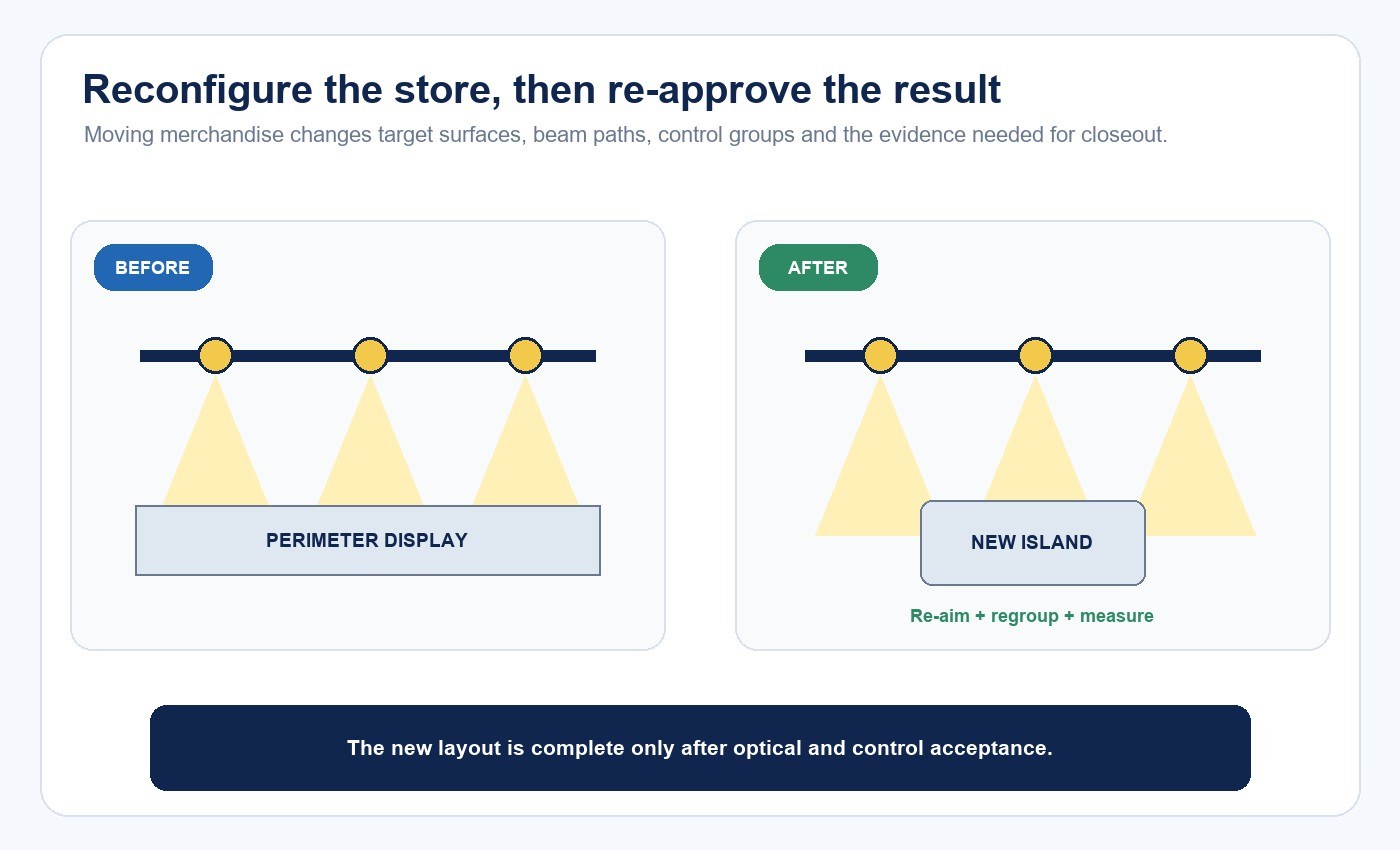
| Step | Decision | Verification |
|---|---|---|
| 1. Redefine the task | Set target surfaces, appearance priorities and operating scenes | Approved display and lighting brief |
| 2. Check the platform | Confirm available mounting positions, compatible modules and safe access | Hardware list and visual inspection |
| 3. Check power | Update connected load, circuit allocation and reserved capacity | Revised load schedule and protective-device review |
| 4. Re-aim or relocate | Place luminaires for the new island without creating spill or glare | Calculation or mockup plus field measurements |
| 5. Update controls | Reassign devices, scenes, schedules and sensor response | Functional test for each required sequence |
| 6. Close out | Export settings and update location, circuit and device records | Signed test record and configuration backup |
If the existing luminaires cannot provide the required distribution from available mounting positions, the correct outcome may be a different optic or product type rather than more dimming. If the network cannot accept the revised grouping without a proprietary service visit, that limitation belongs in the lifecycle decision.
Use Product Evidence for the Role It Actually Proves
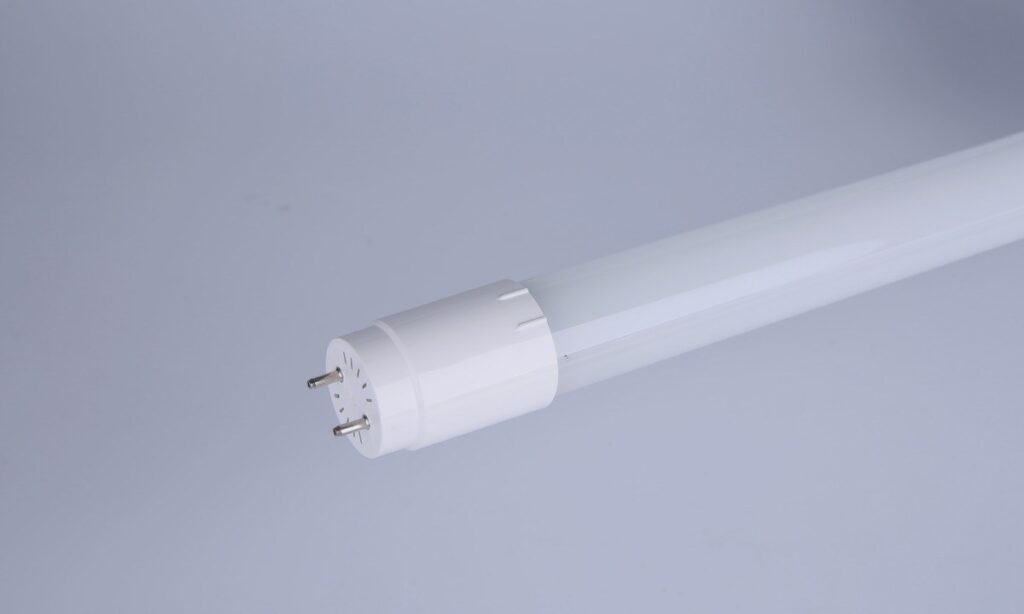
The New Lights Connectable Suspended LED Shop Light is a real linear product family for continuous dry-indoor runs. It illustrates a mechanical and electrical linking route; controls, sensors, gateways, protocols, and network behavior remain separate system decisions.
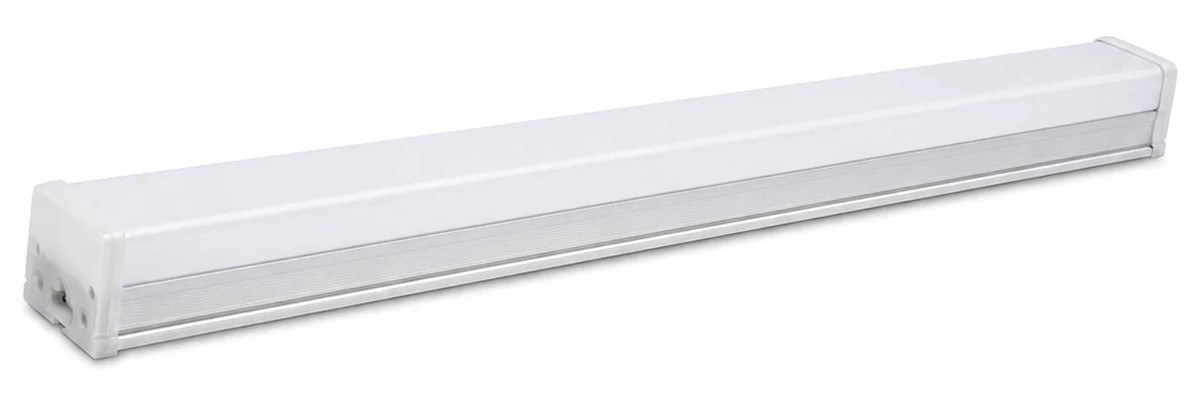
For a project review, bind every product claim to the exact model, driver, accessory, control option, photometric file, and certificate. New Lights’ factory and manufacturing capabilities can support sampling, documentation, and controlled product changes, while the final system architecture still needs project-specific electrical, controls, IT, and commissioning decisions.
Commission, Recommission and Keep the Record Usable
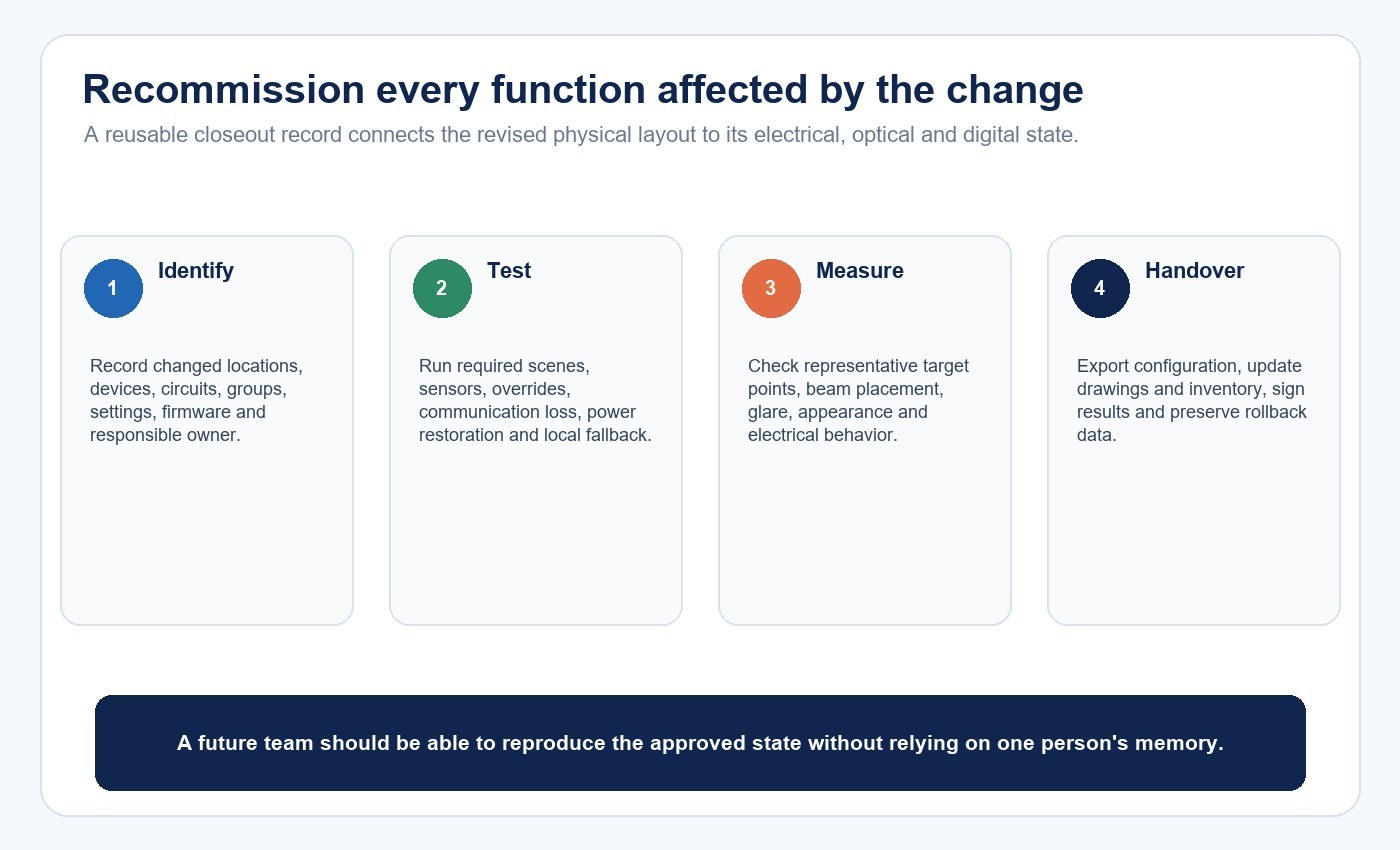
Commission the complete system at first handover, then recommission the functions affected by each later change. The acceptance record should identify who tested, which configuration and software versions were present, what instruments or test methods were used, and what result was accepted.
| Acceptance area | Minimum record | Failure signal |
|---|---|---|
| Physical installation | Module identity, position, lock and support condition | Wrong adapter, incomplete engagement or inaccessible service point |
| Electrical system | Circuit, load, protection, grounding and startup behavior | Overload, nuisance trip, unstable start or mismatched labels |
| Lighting result | Target points, scene, output, distribution and visual review | Missed target, glare, uneven appearance or inconsistent color |
| Controls | Device identity, group, sequence, override and restoration | Orphaned device, wrong scene, delayed response or failed recovery |
| Data and security | Administrator, backup, access, update and offline state | Unknown ownership, no export, unsupported account or unsafe default |
Retain the reflected ceiling plan, device inventory, circuit schedule, zone and scene definitions, sensor settings, gateway and network diagram, firmware list, credentials ownership, configuration export, test results, licenses, support contacts, spare-parts plan, and end-of-support terms. A future team should be able to reproduce the approved state without depending on one person’s memory.
Build the RFQ Around Change Scenarios
Give suppliers and integrators the existing layout, proposed change scenarios, ceiling and electrical information, optical criteria, control sequences, IT policy, data requirements, commissioning method, documentation format, support period, and expected frequency of reconfiguration.
Ask the response to identify exact modules, adapters, loads, photometrics, protocols, certified functions, gateways, APIs, software dependencies, offline behavior, security capabilities, licenses, update commitments, and replacement strategy. Compare the whole change workflow, not only fixture price or the presence of an app.
To review a retail-lighting reconfiguration, contact New Lights with the current and proposed layouts, target surfaces, ceiling and circuit plans, product shortlist, control sequences, and evidence requirements.
Frequently Asked Questions
Is modular lighting the same as connected lighting?
No. Modular lighting describes replaceable or movable physical components. Connected lighting describes communication and control. A project may use either one without the other, or combine both under a defined interface plan.
Can store staff move connected luminaires themselves?
Only when the approved hardware, electrical design, site rules, and work instructions allow it. Scene selection may be an operational task, while moving powered modules or changing circuits may require qualified personnel.
Do products using the same protocol always interoperate?
No. Device functions, profiles, data objects, versions, commissioning tools, and gateways can differ. Verify the exact product and test every required workflow.
Does wireless control eliminate recommissioning?
No. A changed layout may require device identification, regrouping, sensor adjustment, scene updates, permission checks, and failure-state testing even when no control cable moves.
What should continue when the cloud is unavailable?
Define the required local outcome for switching, dimming, schedules, sensors, overrides, emergency behavior, and restoration. Then test those functions with the external service unavailable.
When is a retail-lighting change complete?
It is complete when the installation is safe, the measured lighting result meets the revised task, every required control sequence works, failure states are acceptable, and the as-built configuration and ownership records are updated.
Editorial Sources
- U.S. Department of Energy, “Connected Lighting Systems”: https://www.energy.gov/cmei/ssl/connected-lighting-systems
- U.S. Department of Energy, “Interoperability”: https://www.energy.gov/cmei/ssl/interoperability
- U.S. Department of Energy, “Connected Lighting System Interoperability Study Part 1: Application Programming Interfaces”: https://www.energy.gov/sites/prod/files/2018/12/f58/cls_interoperability-pt1api_oct2017.pdf
- Digital Illumination Interface Alliance, “DALI Certification Programs”: https://www.dali-alliance.org/certification
- National Institute of Standards and Technology, “IoT Device Cybersecurity Guidance for the Federal Government: Establishing IoT Device Cybersecurity Requirements”: https://csrc.nist.gov/pubs/sp/800/213/final
- National Institute of Standards and Technology, “Trusted Internet of Things Device Network-Layer Onboarding and Lifecycle Management”: https://csrc.nist.gov/pubs/sp/1800/36/final