

Copper-wire decorative LED bulbs are best used as visible accent objects, not assumed replacements for general-lighting lamps. Choose the envelope and internal light-point pattern for the intended sightline, then verify the exact base, voltage, control mode, fixture clearance and installation conditions. Approve the lit and unlit appearance with a full-scale sample before ordering production quantities.
The copper-colored internal wire is part of the visual construction. It does not define lumen output, color quality, dimming, service life or electrical suitability. Those decisions remain model- and installation-specific.
Decide What the Bulb Must Contribute
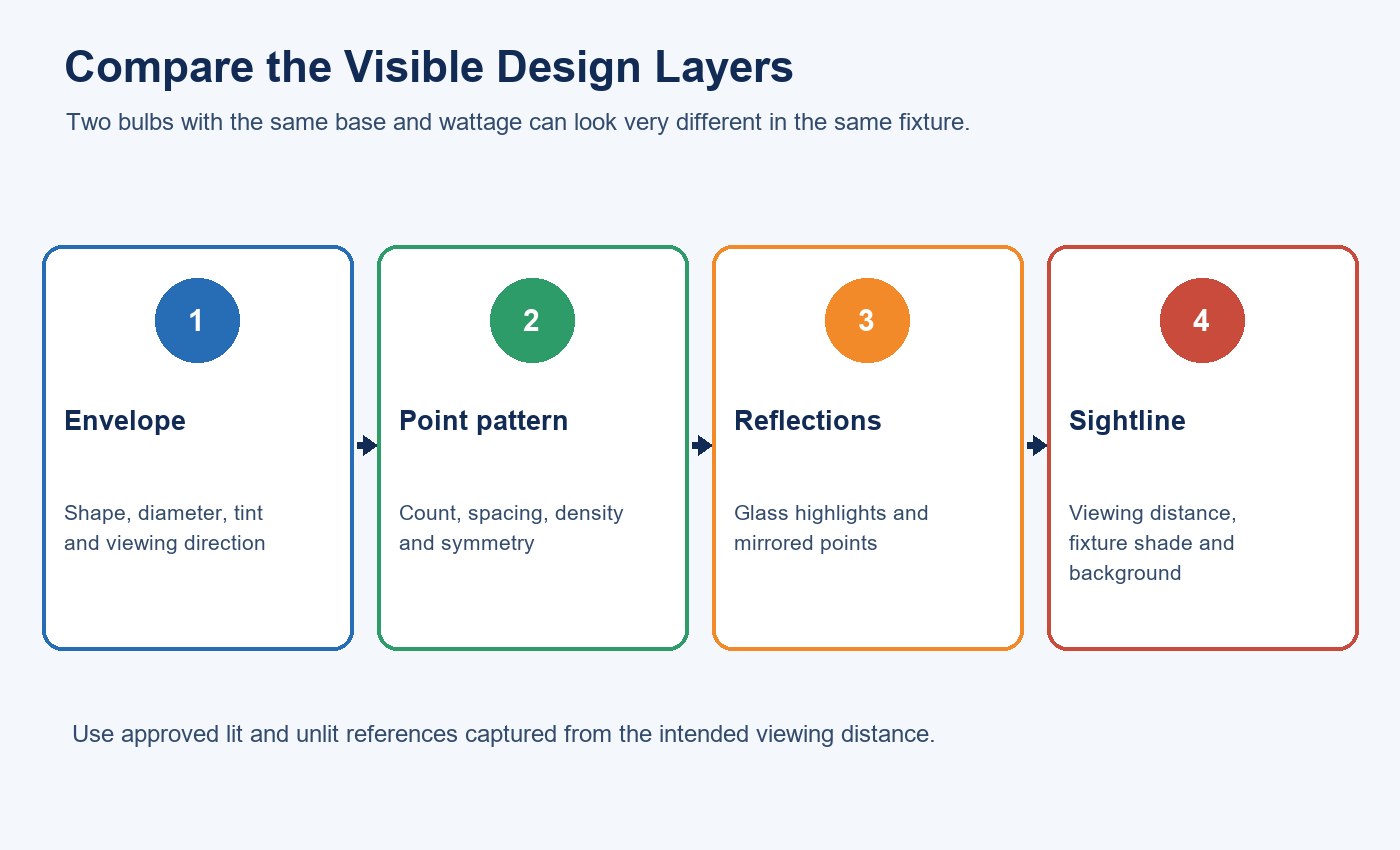
Start with the scene rather than the catalogue. Is the bulb a focal object above a bar, a warm table-lamp detail, a retail display accent or a background layer behind other task lighting? Record whether people see the lamp directly, through a shade or as a reflection.
If the project also needs useful illuminance on a counter or table, specify that layer separately. A low-power decorative lamp can create strong sparkle while contributing little workplane light. The decorative lighting concept-to-specification guide helps separate appearance, ambient, task and accent requirements before product details are fixed.
| Design question | What to define | Why it changes the choice |
|---|---|---|
| Visual role | Focal object, accent, background or part of a cluster | Determines how much contrast and sparkle are desirable |
| Viewing condition | Direct view, shade, reflection and normal distance | Changes glare, pattern visibility and envelope scale |
| Supporting light | Separate ambient and task layers | Prevents decorative output from carrying the whole lighting task |
| Operating pattern | Static, flash, color effect, hours and switching sequence | Determines controls and sample checks |
| Maintenance access | Replacement height, handling space and cleaning method | Influences envelope size and fixture selection |
Approval language should be observable: pattern legible from the entrance, comfortable from seated positions, consistent across a group and compatible with the intended switching sequence.
Match the Envelope Shape to the Fixture and Sightline
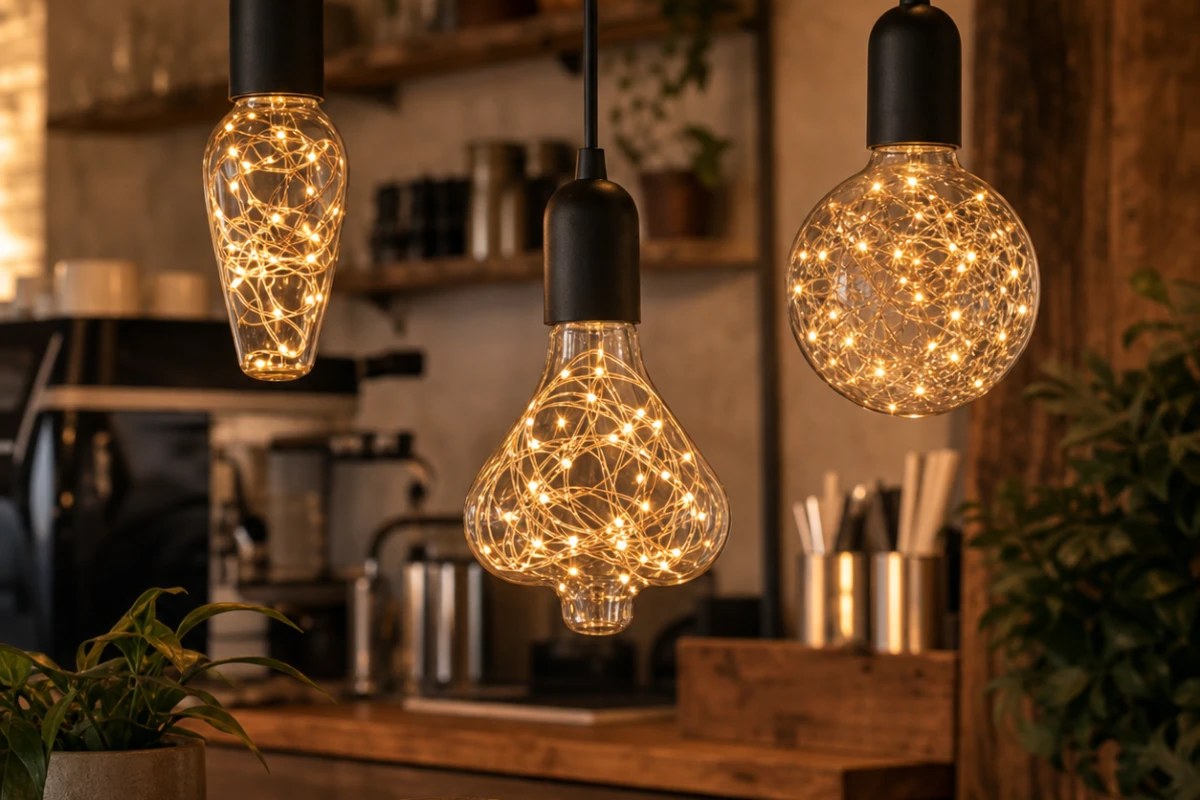
The current New Lights product page publishes six copper-wire decorative LED bulb forms: ST64, HT115, ST125, G80B, TreeA and BOTTLE80. Their silhouettes and internal volumes change how the light points are distributed and how the lamp relates to the shade or pendant.
Measure maximum diameter, overall length, base-to-shoulder dimension and available fixture clearance. A tall bottle or tree form may not fit a shallow shade. A broad globe or heart-like outline may dominate a compact pendant or collide with neighboring bulbs in a cluster.
The internal wire may appear dense in a small envelope and more dispersed in a larger one. Approve the chosen shape rather than assuming the same light-point arrangement will look identical across forms. For broader vintage styling choices, see how to create a vintage look with LED filament bulbs.
Define the Light-Point Pattern and Effect
The New Lights family includes published 0.8 W and 1.4 W configurations with different envelope forms and visible micro-LED networks. A project specification should identify the exact shape, point count or pattern, lit color, static or flash behavior and any switching sequence.
| Visual attribute | Sample requirement | Production acceptance |
|---|---|---|
| Point distribution | Approve front, side and normal viewing angles | No collapsed cluster or unintended empty zone beyond tolerance |
| Color appearance | View beside surrounding materials and lamps | Approved color boundary and lot-to-lot comparison |
| Lit brightness | Compare at the intended room level | Consistent visual hierarchy across the installed group |
| Unlit appearance | Review wire, supports, glass and base in daylight | Acceptable color, cleanliness and alignment |
| Effect sequence | Record startup, flash and switch behavior | Same sequence and reset behavior as approved sample |
Do not expect installers to rearrange the internal wire. Bending, shaking or striking the envelope can damage supports or conductors and can change the approved pattern.
Verify Base, Voltage and Fixture Fit
Match the lamp base and lampholder mechanically and electrically. Confirm base designation, rated voltage and frequency, contact geometry, insertion depth and fixture rating. Catalogue icons or family options should not be interpreted as every possible combination being available.
Check the complete envelope against shades, cages, retaining rings and nearby surfaces. The bulb should seat fully without forcing the glass or base. If the fixture is enclosed, verify that the exact lamp is permitted for that condition; a visually open wire arrangement inside the bulb does not remove driver and base temperature limits.
The LED filament bulb fixture compatibility guide provides the wider base, voltage, dimensions, enclosure and location checks that also apply here.
Treat Dimming and Switching as System Properties
Do not place the bulb on a dimmer unless the exact lamp and control combination is approved. Very low-power decorative electronics may flicker, fail to start, step unevenly or glow when off with incompatible dimmers, electronic switches or illuminated wall controls.
Test the actual number of lamps on the intended control. One sample on a bench may behave differently from a group connected to the same dimmer. Record startup, minimum stable level, restart behavior, audible noise and any change in flash or memory mode.
For a structured compatibility test, use the filament LED dimming guide. If the design requires a static effect only, specify that clearly so a production variant with different control logic is not substituted.
Build a Full-Scale Visual Mockup
Renderings are useful for arrangement, but reflections and high-contrast light points depend on real glass, surfaces and viewing positions. Install the actual bulb, lampholder, shade and nearby materials at the intended height.
Review daytime and nighttime conditions. Walk the normal approach path and sit or stand at the expected positions. Check direct glare, pattern legibility, reflections in windows and mirrors, color interaction with wood or metal finishes and balance with other luminaires.
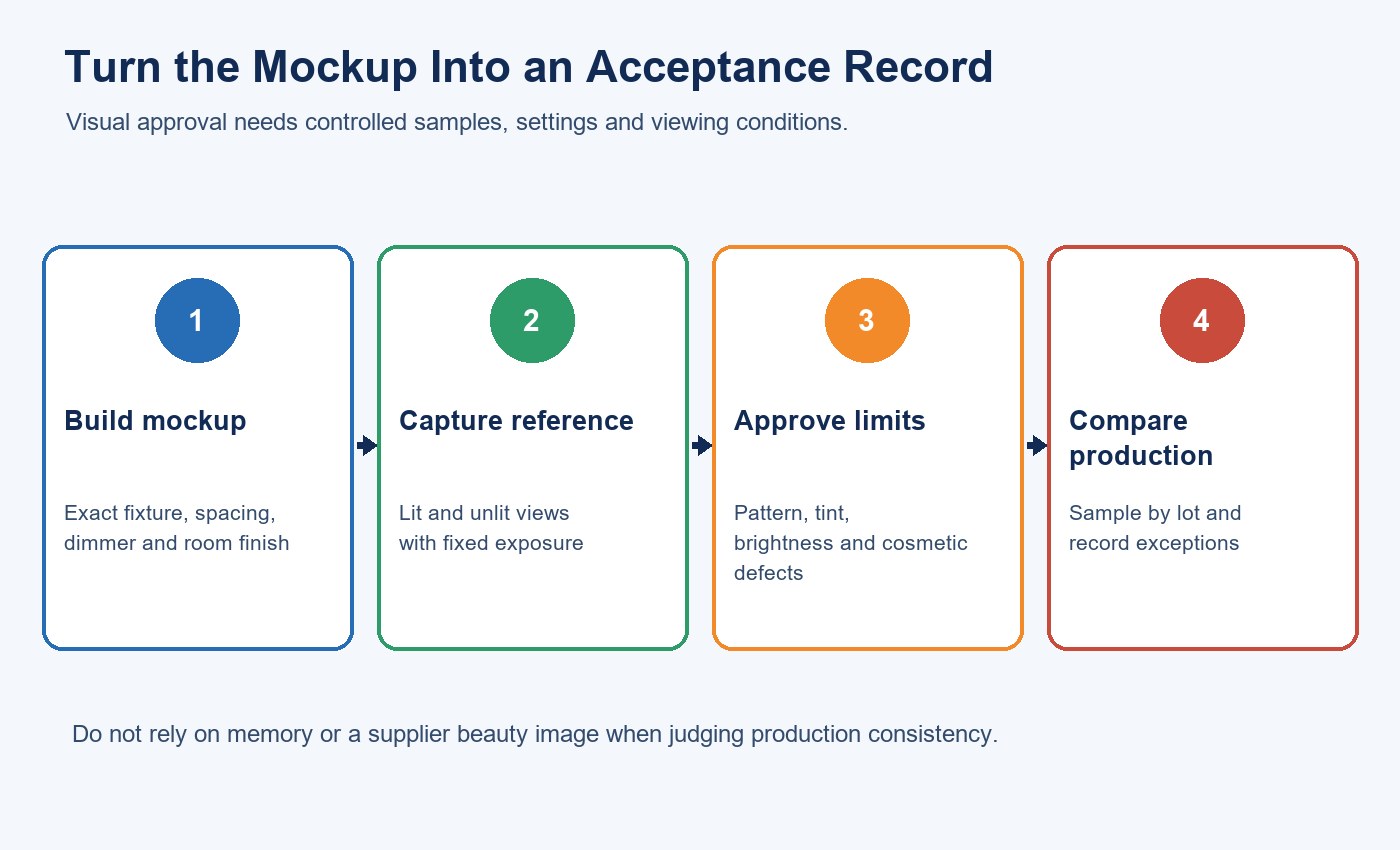
Use a Repeatable Mockup Record
| Record item | Minimum evidence | Decision supported |
|---|---|---|
| Installation geometry | Height, spacing, shade, sightline and room photos | Scale and clearance |
| Lighting context | Other luminaires on/off and room surface colors | Contrast and visual hierarchy |
| Camera record | Fixed exposure, white balance and viewpoint | Fair sample comparison |
| Human review | Named viewpoints and acceptance notes | Comfort and pattern recognition |
| Approved configuration | Model, base, voltage, effect and sample ID | Production reference |
Use photographs as a controlled comparison record, not as the only approval method. Automatic camera exposure can make a dim lamp appear brighter and hide variation between points.
Inspect Point Consistency and Internal Arrangement
Define how many dark or visibly weak points are acceptable, if any. Inspect spacing, color consistency, wire position, contact with the envelope, foreign material and movement after handling.
Some variation may be part of the handmade visual character. The acceptance boundary should distinguish that character from tangles, collapsed sections, asymmetry, loose supports or conductor damage. Keep an approved golden sample and controlled photos for custom arrangements.
Operate the lamp through every intended mode. Check startup, switching order, memory behavior and whether multiple lamps in a cluster are expected to synchronize. Aesthetic variation and electrical instability are different defects and should be recorded separately.
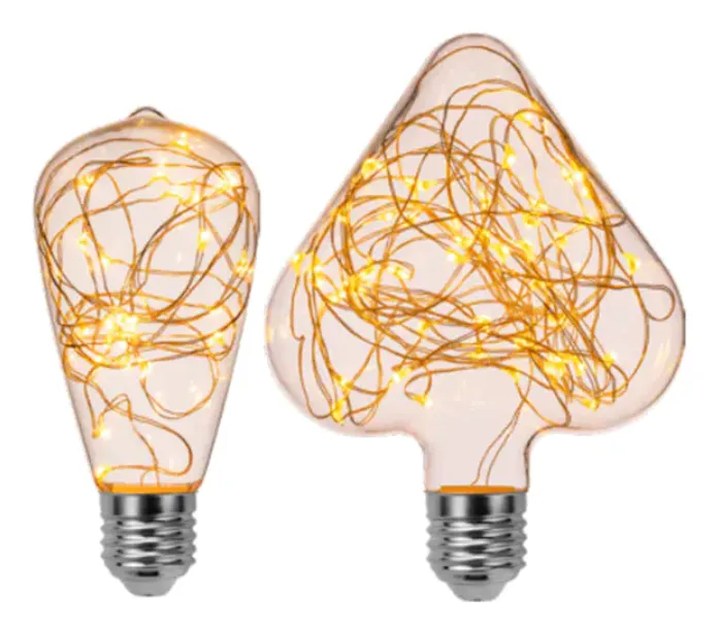
The Copper-Wire Decorative LED Bulbs page lists the current family and model choices. Use the exact selected model in drawings, samples and production records.
Review Thermal, Electrical and Location Conditions
Confirm the lamp’s permitted orientation, enclosure condition, ambient range and installation location. Heat still develops at the LEDs, internal electronics and base even when the rated power is low. Do not cover the lamp or add decorative material inside the fixture without evaluating the complete assembly.
The U.S. Consumer Product Safety Commission identifies minimum wire size, strain relief and overcurrent protection as observable safety characteristics for its defined category of portable, plug-connected seasonal and decorative lighting products. A screw-base decorative bulb is a different product architecture, so determine its applicable requirements separately. The useful lesson is that fine decorative conductors and supports belong in the safety review, not only the visual review.
Match the final model, label and evidence to the destination market through qualified compliance review. Indoor positioning should not be extended to exposed outdoor or damp use without a separately suitable lamp, lampholder and fixture system.
Install and Handle the Bulb Correctly
Disconnect power and allow the lamp to cool before installation or removal. Inspect the envelope, base and internal assembly for cracks, looseness, exposed conductors, foreign material or unusual movement. Do not energize a damaged lamp.
Hold the bulb according to the manufacturer’s instructions and avoid twisting the glass relative to the base. Seat it fully without forcing it, then confirm that it does not touch the shade or cage. Restore power and check startup, effect mode and the group’s visual consistency.
For high pendants or hospitality installations, include access equipment and breakage handling in the maintenance plan. A distinctive envelope that is difficult to replace may require controlled spare stock.
Create Incoming and Production Acceptance Checks
Incoming inspection should connect the carton label to the approved lamp identity. Sample multiple cartons and production lots rather than inspecting only the presentation sample.
| Inspection stage | Checks | Record |
|---|---|---|
| Identity | Model, shape, base, voltage, effect and lot | Label and sample traceability |
| Unlit visual | Glass, wire layout, supports, cleanliness and base | Approved visual tolerance |
| Functional | Startup, point operation, color, sequence and off-state behavior | Test setup and result |
| Fit | Gauge or representative lampholder and fixture clearance | Dimensions and insertion result |
| Packaging | Separation, cushioning, movement and damage after agreed transport test | Pack configuration and reinspection |
Control changes to LEDs, wire, internal supports, driver, glass, base, firmware and packaging. A component that preserves rated power may still alter the visual pattern or switching behavior.
Put the Visual and Technical Requirements in the RFQ
Provide the envelope shape, dimensions, base, voltage, color or effect, fixture type, viewing distance, operating hours, control system, destination market and visual acceptance criteria. Include photos or drawings of the intended installation.
Request model-level specifications, labels, sample identity, applicable evidence and production inspection method. New Lights’ factory and manufacturing capabilities page explains the route for samples, controlled variants and production coordination.
To review a defined project, contact New Lights with the fixture photo, socket, voltage, chosen envelope, desired effect, quantity and destination market.
Frequently Asked Questions
Are copper-wire decorative bulbs the same as fairy-light strings?
No. This guide concerns a replaceable lamp with decorative light points inside a bulb envelope. Plug-connected strings use a different architecture and installation method.
Can one replace a normal general-lighting bulb?
Only if the exact lamp provides the required output and distribution. Many copper-wire bulbs are selected primarily for visible decorative effect.
Can the internal wire be reshaped?
Do not assume so. Altering the internal assembly can damage conductors or supports and change the approved appearance.
Will the bulb work with any dimmer?
No. Confirm the exact lamp, dimmer and connected quantity through a compatibility test.
Can it be used in an enclosed or outdoor fixture?
Only when the exact lamp and host fixture are suitable for those conditions. Verify enclosure, temperature, moisture and socket requirements together.
Editorial Sources
- New Lights, “Copper-Wire Decorative LED Bulbs”: https://www.new-lights.com/products/decorative-ambient-lighting/decorative-led-bulbs/copper-wire-lamp/
- New Lights, “Decorative Bulbs” catalogue: https://www.new-lights.com/new-lights/2024/12/06/decorativebulbs.pdf
- U.S. Consumer Product Safety Commission, “Seasonal and Decorative Lighting Products”: https://www.cpsc.gov/FAQ/Seasonal-and-Decorative-Lighting-Products