

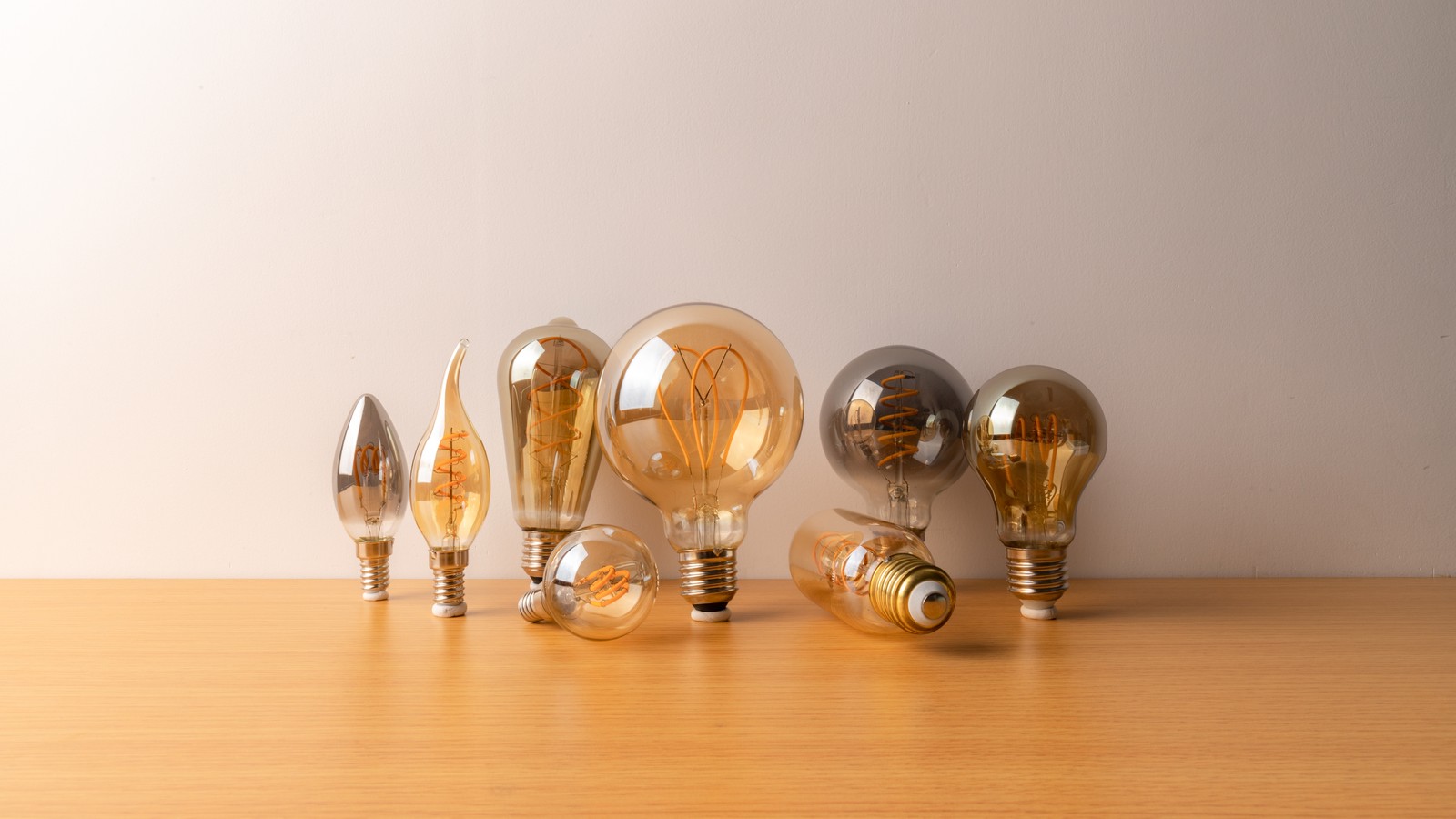
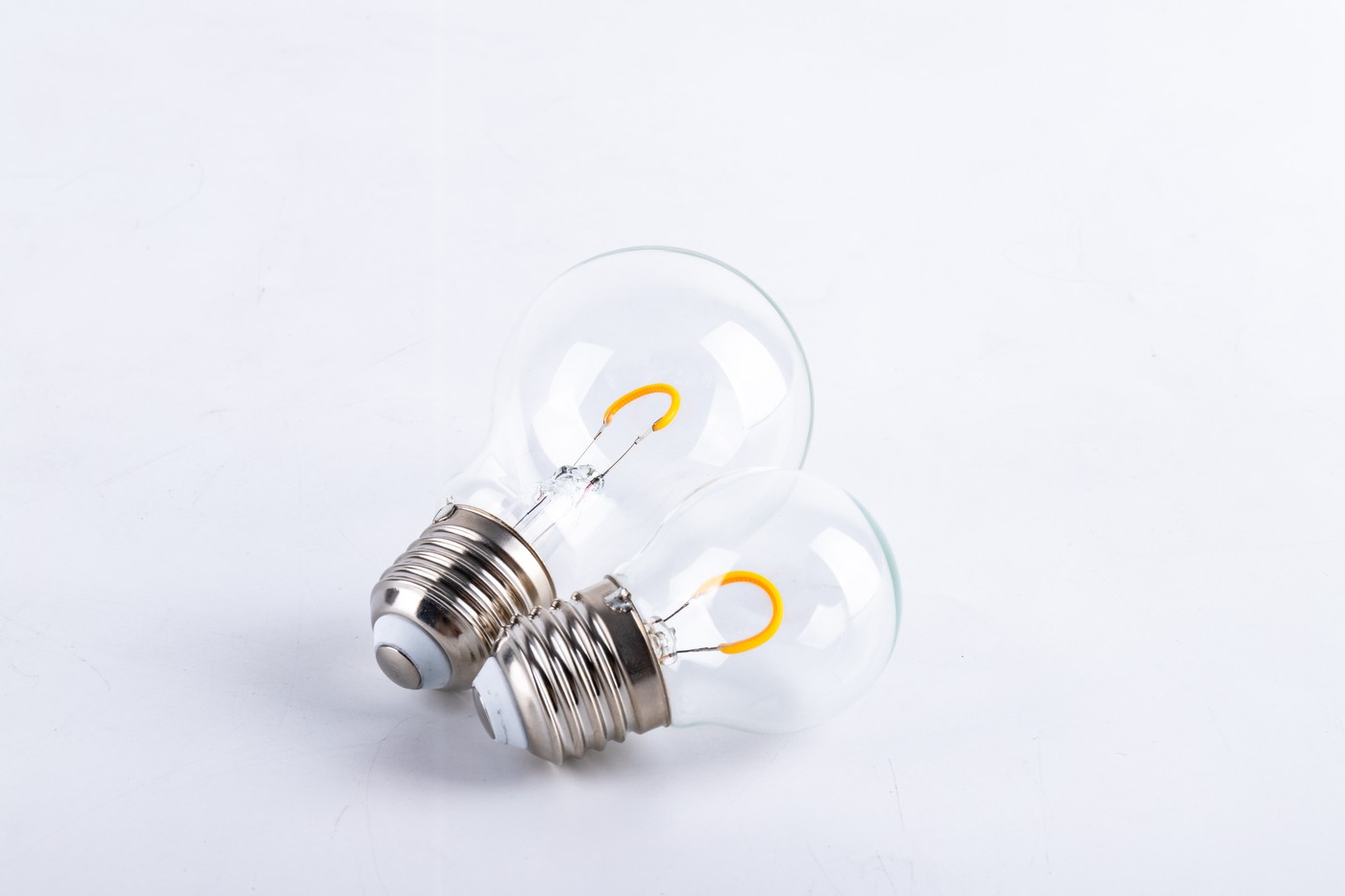
Flexible LED filaments help a bulb send light in many directions because the emitting strip can curve through several orientations inside the glass envelope. A loop, spiral or wave presents luminous surfaces toward more viewing angles than a flat LED board facing one direction. The result can be a broad, visually continuous glow that suits clear decorative bulbs.
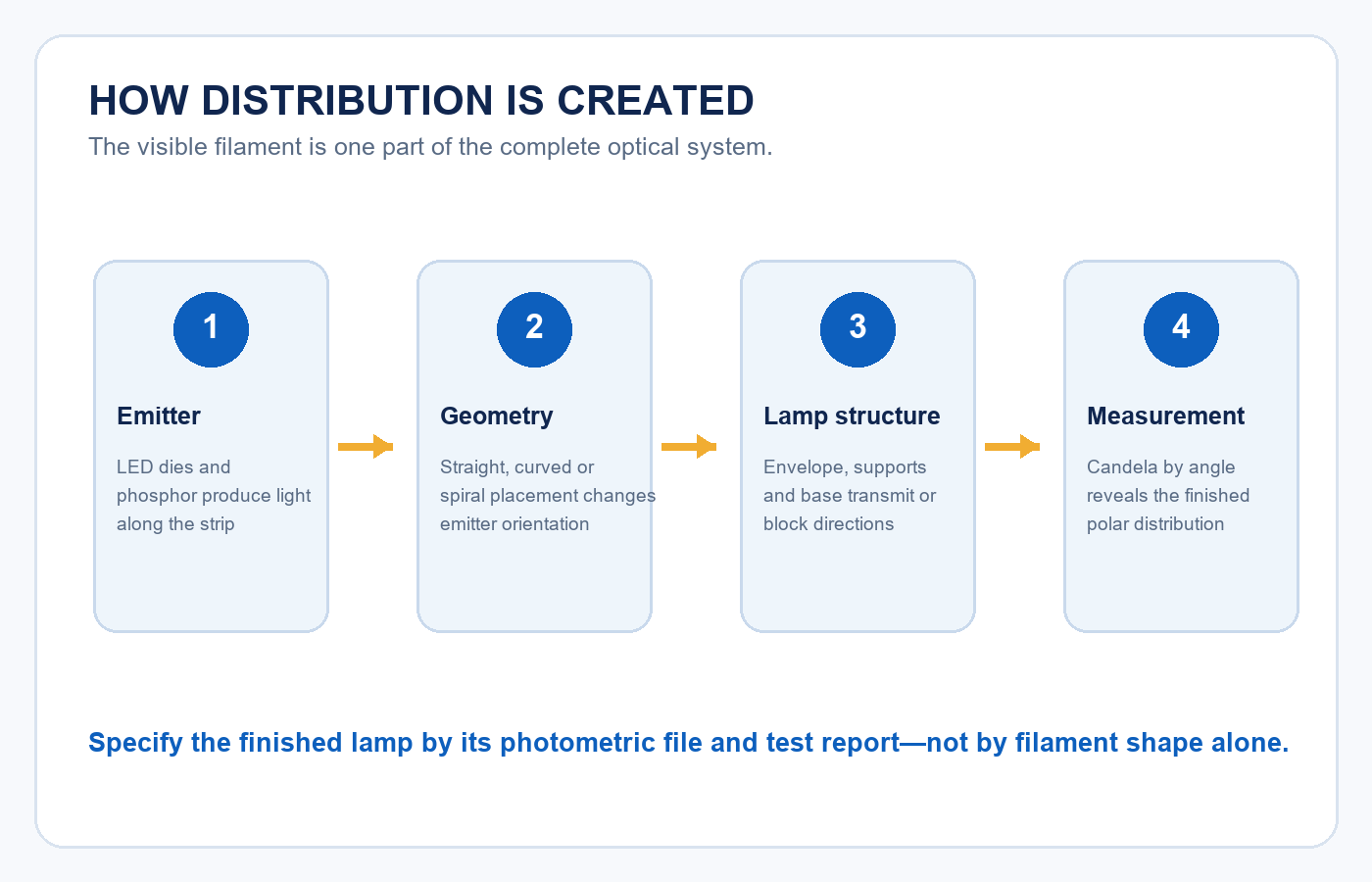
The filament shape is only the beginning. The finished distribution also depends on the LED and phosphor construction, support wires, envelope, stem, driver housing and lamp base. A buyer evaluating a 220°, 300° or 360° claim should therefore ask for the completed lamp’s photometric data, not judge the beam from the glowing filament alone.
What Is a Flexible LED Filament?
A flexible LED filament is a narrow light-emitting assembly with multiple LED dies distributed along a bendable substrate. Conductive paths connect the dies, while an encapsulating material containing phosphor converts part of the LED output into white light and blends the individual points into a more continuous luminous line.
Unlike a conventional flat LED board, the strip can be formed into a loop, spiral, wave, letter or other three-dimensional geometry. Unlike a rigid straight filament, it can change direction continuously inside the envelope. These properties make flexible filaments useful when the light source is intentionally visible and the bulb shape is part of the design.
The term “flexible filament” describes a construction category, not one fixed electrical or optical specification. Substrate material, die count, operating current, coating, dimensions and thermal design differ between products. For a purchase decision, identify the exact lamp and request its corresponding data rather than assuming every flexible-filament bulb behaves alike.
How a Filament Produces Light
Each LED die begins with a directional emission pattern. The die position, package, mounting surface and nearby materials affect where that light travels. Placing many small dies along a long strip spreads the emitting area, while the phosphor and encapsulant diffuse and convert their output into the desired white-light spectrum.
When the coating surrounds more than one side of a light-transmitting strip, the filament can appear luminous from several directions. That appearance is one reason filament bulbs resemble traditional incandescent lamps more closely than bulbs built around a flat board and opaque heat sink.
Multi-sided luminosity is not the same as perfectly equal intensity in every direction. Conductors, substrate layers and the physical orientation of the dies can create differences around the strip. The bulb’s glass, internal supports and base add further optical effects. This is why the finished lamp must be treated as one optical system.
Why Curving the Filament Broadens Coverage
Imagine a short luminous strip that is kept flat. Its surfaces face a limited set of directions. Bend that strip around a curve and each segment points somewhere different. The overlapping distributions from those segments fill more of the space around the lamp.
A spiral introduces both horizontal and vertical changes in orientation. One section may face outward, another upward and another partly downward. A loop can similarly spread emission around an axis. Multiple filaments arranged around the centerline can fill directional gaps left by a single element.
Peer-reviewed research on flexible spiral filament bulbs has compared horizontal and vertical filament arrangements in specific test lamps. The tested arrangements differed in junction temperature, surface temperature, thermal resistance, luminous flux and efficacy. The study is useful because it shows that filament placement affects both optical and thermal behavior; its measured ranking applies to the samples and conditions tested.
The Finished Lamp Determines the Distribution
The broadness and symmetry of a bulb’s light distribution come from the interaction of several parts:
- Filament geometry: straight, looped, spiral or multi-filament arrangements change the directions represented by the emitting surfaces.
- Filament position: height, diameter, spacing and distance from the stem influence overlap and shadowing.
- Envelope: clear, tinted, coated or diffusing glass changes transmission, scattering and appearance.
- Support structure: stems and wires can block narrow directions or create local shadows.
- Driver housing and base: opaque structures usually reduce output toward the base and prevent a truly uniform sphere of light.
- Operating condition: current, temperature and control mode can affect output and therefore the measured photometric result.
This system view also explains why two bulbs with a similar visible spiral may produce different polar plots. Envelope dimensions, filament location and base geometry can differ even when the photographs look alike. The filament LED versus standard LED comparison provides a broader construction comparison between visible-filament and board-based lamps.
What Does a 220° Beam Angle Mean?
A number such as 220° should be read together with its measurement definition. The Illuminating Engineering Society defines field angle as the angle between directions where luminous intensity falls to 10% of the maximum intensity in a plane through the beam centerline. For a lamp that is not rotationally symmetrical, more than one measurement plane may be needed.
Product literature does not always use “beam angle,” “field angle,” “distribution angle” and “omnidirectional” in exactly the same way. A buyer should therefore ask which threshold and plane produced the published number. The value should also be tied to an exact model, base, envelope and test condition.
| Term or claim | What it can communicate | What to request |
|---|---|---|
| Beam or field angle | Angular span defined at a stated intensity threshold | Threshold, measurement plane and test report |
| 220°, 300° or 360° | A numeric distribution claim for a completed lamp | Exact model, polar plot and photometric file |
| Omnidirectional | Broad output around much of the lamp | Minimum-intensity criteria and base-zone behavior |
| Wide distribution | General directional character | Candela-by-angle data rather than a photo alone |
| Luminous filament | Visible glowing source | Finished-lamp distribution and glare assessment |
An exact product can legitimately publish a very broad beam angle when its test data supports that value. For example, LEDVANCE lists a 300° beam angle for one specified T26 filament lamp. That figure belongs to that model and illustrates why the number must stay attached to an exact product record.
Read the Polar Plot, Not Just the Angle
An IES photometric file records luminous intensity in candela at different angles. Lighting software can use those values to model how a lamp distributes light in a fixture or room. A polar plot provides a visual summary of the same directional behavior.
When reviewing a plot, look beyond the widest angle:
- Check the measurement planes. Similar curves in perpendicular planes indicate rotational consistency; different curves reveal asymmetry.
- Look toward the base. A large opaque base or driver section commonly creates a lower-output zone.
- Check for sharp dips. Supports, the stem or uneven filament placement can create local reductions.
- Compare normalized and absolute data. A normalized curve shows shape; absolute candela values show how much intensity is present.
- Match the exact variant. Clear and frosted envelopes can distribute and soften light differently. See the clear versus frosted filament bulb guide for the visual and selection trade-offs.
A broad angle does not by itself establish useful illumination for every application. A decorative pendant, exposed-bulb wall light and enclosed luminaire place different demands on intensity, glare, diffusion and temperature. Evaluate the lamp inside the intended fixture whenever the fixture changes the optical path.
Flexible, Straight and Spiral Arrangements
The preferred geometry depends on the design objective rather than a universal ranking.
| Filament arrangement | Typical optical purpose | Design questions |
|---|---|---|
| Straight filaments around a center axis | Familiar incandescent-style appearance and broad radial coverage | How many filaments, at what spacing and height? |
| Flexible loop | Smooth visible line and emission across changing orientations | Does the loop leave gaps near the top or base? |
| Flexible spiral | Continuous decorative form with many segment directions | How are turns spaced, supported and thermally managed? |
| Dense decorative shape | Strong visual identity in an exposed bulb | Does overlapping brightness increase glare or visual hot spots? |
| Diffused envelope over any arrangement | Softer appearance and reduced filament visibility | How much output and sparkle are traded for diffusion? |
For exposed decorative luminaires, the filament’s appearance may be as important as its distribution. For shaded fixtures, the interaction with the shade can dominate the final result. For enclosed fixtures, thermal limits deserve equal attention because higher internal temperature can affect light output and life. The rated-life guide for filament bulbs explains why operating conditions matter when interpreting a lifetime claim.
Optical and Thermal Design Are Connected
Moving or lengthening a filament changes more than its appearance. It changes the distance between emitting segments, the path for heat to reach the supports, the surrounding gas volume and the temperature of nearby components. A geometry selected only for visual effect may create thermal or electrical constraints elsewhere in the lamp.
The spiral-filament study cited below found different thermal and optical results among the tested horizontal and vertical arrangements. That does not make one orientation universally superior. It shows why a supplier should validate the selected geometry at the intended electrical loading and inside the intended envelope.
For dimmable or connected lamps, control electronics add another layer. The visible filament can still offer broad distribution, but dimming range, flicker behavior, standby power and wireless functions depend on the driver and control architecture. Buyers comparing connected versions can use the smart filament bulb guide to separate optical appearance from control capability.
A Buyer’s Evidence Checklist
Requesting a single angle is rarely enough for OEM/ODM evaluation. A useful technical package connects the claim to the exact construction and test evidence.
| Evidence item | Why it matters | Acceptance question |
|---|---|---|
| Model and variant identity | Prevents data from one envelope or base being applied to another | Does every report name the exact orderable variant? |
| Filament drawing or approved sample | Records geometry, height, spacing and supports | Does the production sample match the approved optical structure? |
| Polar intensity plot | Reveals symmetry, base shadow and directional dips | Are the required planes and intensity scale included? |
| IES or LDT file | Enables calculation in the intended fixture or space | Can the file be traced to the same tested model? |
| Beam-angle definition | Makes the numeric claim interpretable | Which threshold and planes define the angle? |
| Luminous flux and efficacy report | Connects distribution with total output and input power | Were power, flux and test conditions recorded together? |
| Temperature and life evidence | Checks whether the geometry operates within design limits | Is the evidence relevant to the selected envelope and loading? |
| Clear or frosted envelope sample | Shows appearance, glare and diffusion differences | Has the selected finish been reviewed in the intended fixture? |
Use the lighting-project selection framework to translate application needs into measurable acceptance criteria. If the project includes custom filament geometry, envelope finish, base, CCT, dimming or packaging, record each approved variant separately so the photometric and production records remain traceable.
How to Compare Samples
Start with two or three representative samples rather than relying on catalog photographs. Install them in the actual or representative fixture and compare them under the same supply voltage, dimming condition and ambient environment.
Review the unlit construction first: envelope finish, filament position, support alignment and base dimensions. Then evaluate the lit appearance from normal viewing positions. Look for visible hot spots, abrupt brightness changes, glare and inconsistent color along the filament. Use an integrating sphere or suitable photometric setup for total output, and use goniophotometric data when the directional distribution is part of the specification.
Record any change between the approved sample and production sample. Flexible forms are visually distinctive, so small shifts in spiral spacing or support position can be noticeable even when electrical values remain within range. For projects that need model development or sample validation, New Lights’ factory and manufacturing overview explains the broader production context.
Frequently Asked Questions
Do flexible LED filaments emit light in all directions?
They can create broad multi-directional output because curved segments face different directions. The base, stem, supports and envelope still affect the finished distribution, so the lamp’s polar data should define the actual result.
Is a spiral filament automatically better than straight filaments?
No single geometry is best for every lamp. A spiral can provide continuous visual form and varied emitter orientation, while multiple straight filaments can also create broad radial coverage. The envelope, electrical loading, thermal path and intended appearance determine the better option.
Does a clear bulb have a wider beam than a frosted bulb?
Not necessarily. Frosting changes scattering and visual softness, but the measured angle depends on the complete lamp. Compare photometric data and fixture-level appearance for the exact clear and frosted variants.
Can I verify a 220° claim from a product photo?
No. A photograph shows construction and appearance, while a numeric angle comes from directional intensity measurement. Request the definition, polar plot and photometric file for the exact model.
What is the difference between wide distribution and omnidirectional light?
“Wide distribution” is a general description. “Omnidirectional” implies useful emission around most of the lamp, but suppliers may apply different criteria. Define the minimum intensity, angular zone and base-shadow allowance required for the project.
What should be fixed before approving a custom flexible-filament bulb?
Fix the filament geometry, envelope, base, electrical rating, CCT, color quality, dimming requirement, target flux, angle definition and test method. Keep the approved sample and its data linked to the same variant code.
Build the Specification Around the Finished Lamp
Flexible LED filaments make broad, decorative light possible by placing emitting segments through a three-dimensional path. The resulting distribution is shaped by the whole lamp and confirmed through photometric measurement. A strong specification therefore combines the desired visual form with an exact model identity, angle definition, polar plot, photometric file, output data and sample review.
To discuss a flexible-filament lamp for a defined market or fixture, send New Lights the target bulb shape, base, envelope finish and photometric requirements. Those inputs provide a practical starting point for sample and evidence planning.
Editorial Sources
- Illuminating Engineering Society, “Field Angle”: https://www.ies.org/definitions/field-angle/
- Illuminating Engineering Society, “Learn About IES Files”: https://ies.org/education/learn-about-ies-files/
- Applied Sciences, “Thermal and Optical Performance of Flexible Spiral LED Filament Bulbs”: https://www.mdpi.com/2076-3417/10/4/1373
- LEDVANCE, T26 Filament LED product example: https://legacy-www-p.ledvance.com/products/detail/en/408?category=303978&productId=288931