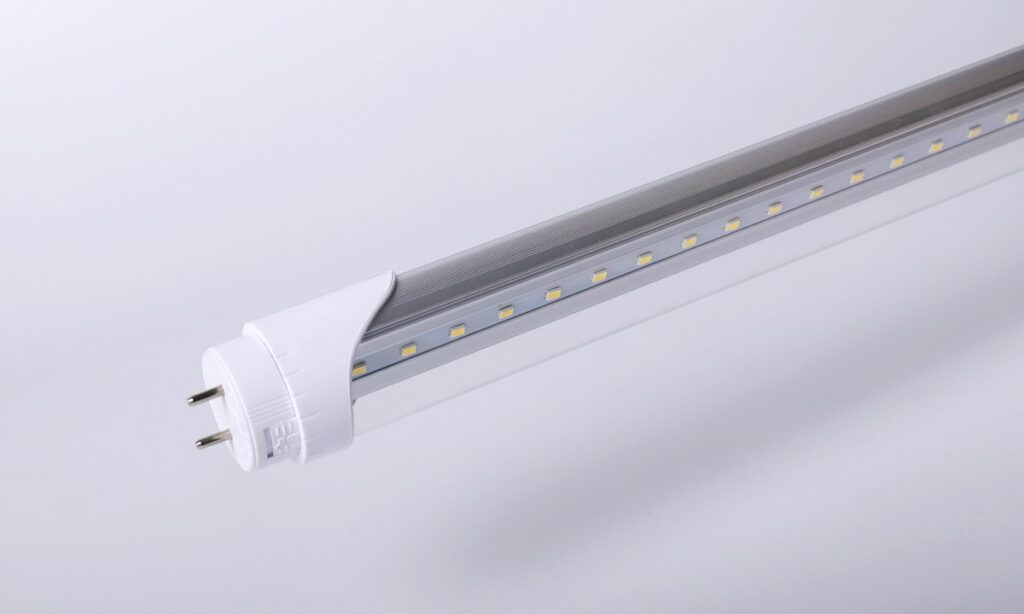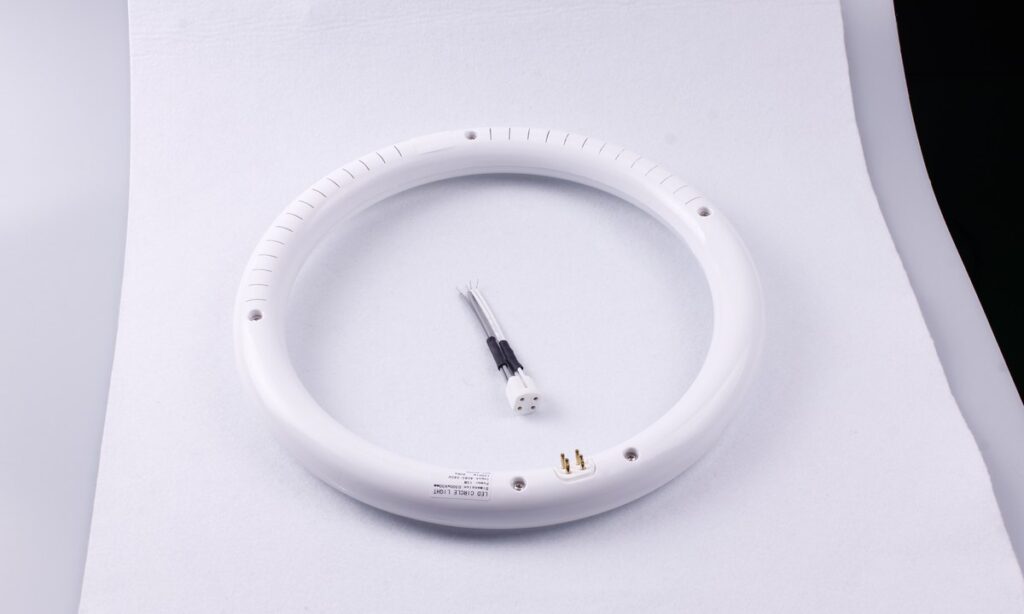


There is no single certificate that makes an LED tube legal or acceptable in every market. The correct route starts with the exact product architecture, destination, sales channel, responsible economic operator, installation method and launch date. Those inputs determine which laws, standards, tests, declarations, registrations and markings must be addressed.
This article is a procurement framework for scoping and verifying market-access evidence. Final requirements should be confirmed for the exact model and jurisdiction before commercial release, because product classifications and marking policies can change.
Start with Five Inputs That Change the Compliance Route
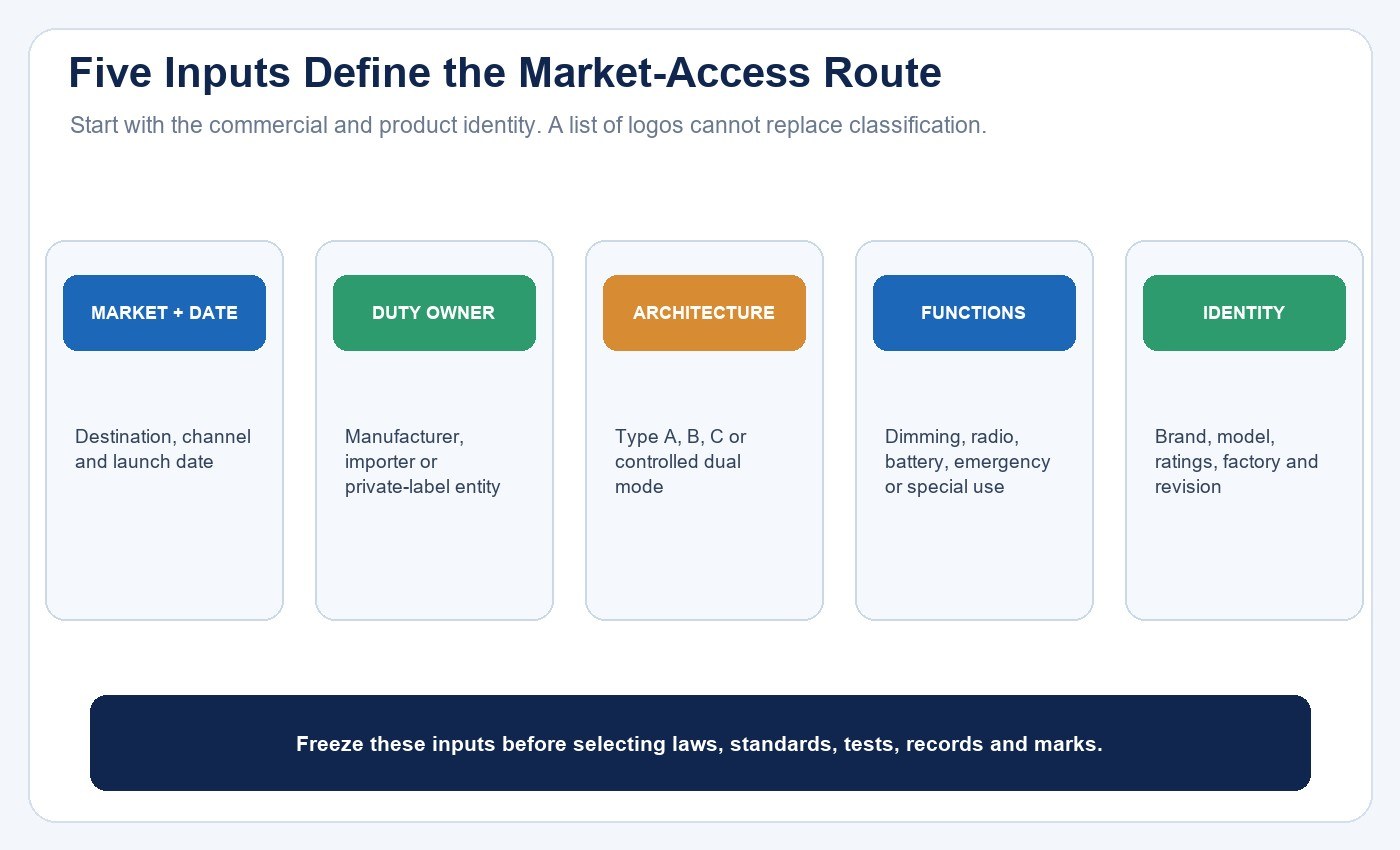
Two tubes can share the same length and G13 cap while following different market-access paths. Record these inputs before asking a laboratory or supplier for a certificate list:
- Destination and launch date: country or customs territory, sales channel, customer type and expected first shipment.
- Economic operator: manufacturer, importer, authorised representative, private-label owner, distributor, seller of record or another locally defined responsible party.
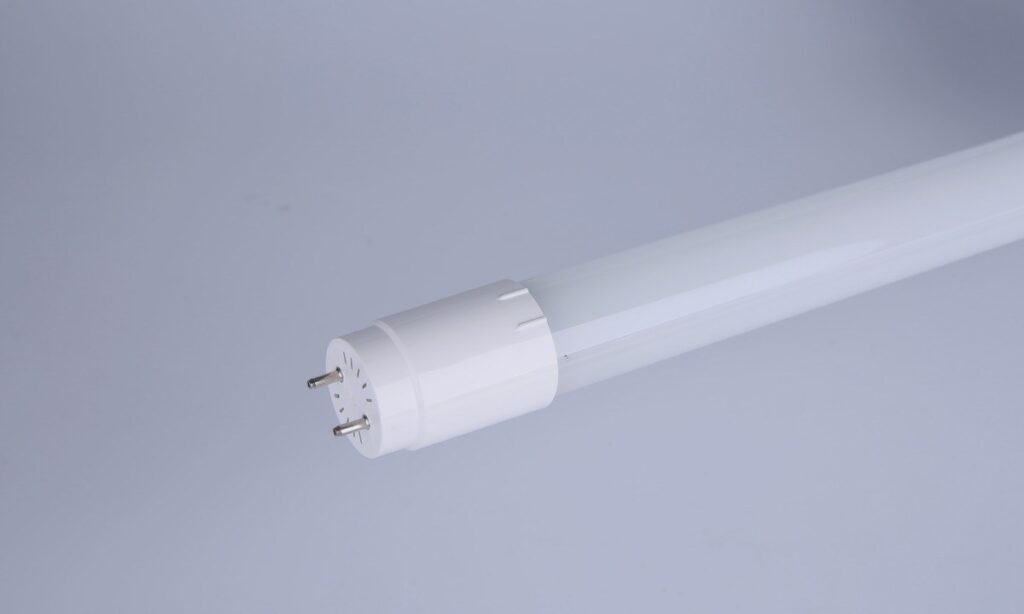
- Product architecture: ballast-compatible Type A, direct-wire Type B, external-driver Type C, or a documented dual-mode construction.
- Functions and use: dimming, sensors, radio, batteries, emergency use, refrigeration, damp or wet locations, hazardous locations and other special applications.
- Product identity: brand, model, ratings, factory, critical components, drawings, firmware where relevant, labels and production revision.
The commercial LED tube retrofit guide explains why Type A, B and C are different installation systems. That architecture decision also affects safety scope, instructions, markings and the evidence needed for a converted luminaire.
A Market Example Is Not a Universal Checklist
The examples below show how the same product category can be treated differently. They are starting points for classification, not a substitute for current local review.
| Market example | What the official source establishes | Procurement consequence |
|---|---|---|
| European Union | The European Commission identifies ecodesign requirements for in-scope light sources and separate control gear under Regulation (EU) 2019/2020, and energy-labelling duties under Regulation (EU) 2019/2015. Covered light-source models have supplier information and EPREL obligations. | Confirm whether the exact tube is an in-scope light source, then connect the energy record, label and product information to the same model used in the safety, EMC and substance-compliance file. |
| Great Britain | Current GOV.UK guidance separates GB and Northern Ireland and provides sector-specific marking routes. The accepted marking approach depends on the product regulation rather than one blanket rule. | Recheck the current sector table at launch. Do not reuse an old statement that UKCA is always mandatory or that CE always resolves every GB obligation. |
| United States | UL Solutions distinguishes a standalone lamp evaluation from a luminaire retrofit-kit evaluation. Type A/B lamps may be investigated to UL 1993 as standalone products and additionally to UL 1598C for conversion use. | Match the certification category and installation instructions to the intended use. A lamp listing alone should not be treated as approval for every field conversion. |
| Japan | METI’s product-scope material distinguishes bulb-shaped LED lamps from fluorescent-lamp-shaped LED tubes; the latter are shown outside that particular LED-lamp category. | Do not infer the classification from the English phrase “LED lamp.” Confirm the exact tubular construction and every other applicable Japanese requirement before choosing a PSE route or deciding that one is not applicable. |
The Japan example is especially useful because it exposes a common error: a broad product name can hide a narrower legal definition. Being outside one named category does not prove that the product has no other safety, radio, energy, installation or commercial requirements.
Separate Law, Standards and Evidence Types
Compliance files become unreliable when different document types are treated as interchangeable.
- Legislation and regulations create duties in a jurisdiction.
- Standards provide technical requirements or test methods and may support a conformity route when recognized by the relevant system.
- Test reports record the sample, method, conditions and results.
- Certificates or listings state a certification body’s finding within a defined scheme, product category and scope.
- Declarations are formal statements made by the responsible operator.
- Registrations place a model or business in a required database.
- Labels and instructions communicate the approved identity, ratings, warnings and installation boundaries to the market.
One document cannot automatically perform all of these jobs. An IEC or CB report may support a national process, but it does not by itself settle local deviations, registration, economic-operator duties, marking or market-surveillance requirements. A component approval does not establish compliance of the finished lamp or converted luminaire.
For the document-control side of this work, use the LED product compliance document checklist to connect declarations, reports, labels and instructions to the purchase-order model.

Build a Model-to-Market Matrix
Create one row for each exact model revision and destination. A family name is not enough unless the evidence includes a controlled rule showing how variants are covered.
| Matrix field | What to record | What closes the field |
|---|---|---|
| Market and date | Country or territory, channel and launch date | Current official scope and a named reviewer |
| Responsible operator | Legal entity, address and role | Confirmed duty owner for declaration, registration and records |
| Product identity | Brand, model, electrical ratings, architecture, functions, factory and revision | Approved specification and traceable production identity |
| Applicable route | Laws, product categories, standards and national deviations | Written classification and current conformity plan |
| Evidence | Reports, certificates, declarations, registrations and risk records | Valid document with exact model or documented family coverage |
| Market-facing files | Product label, carton, manual, warnings and languages | Approved artwork that matches the evidence set |
| Lifecycle control | Surveillance, expiry, renewals and change notices | Owner, review date and controlled escalation rule |
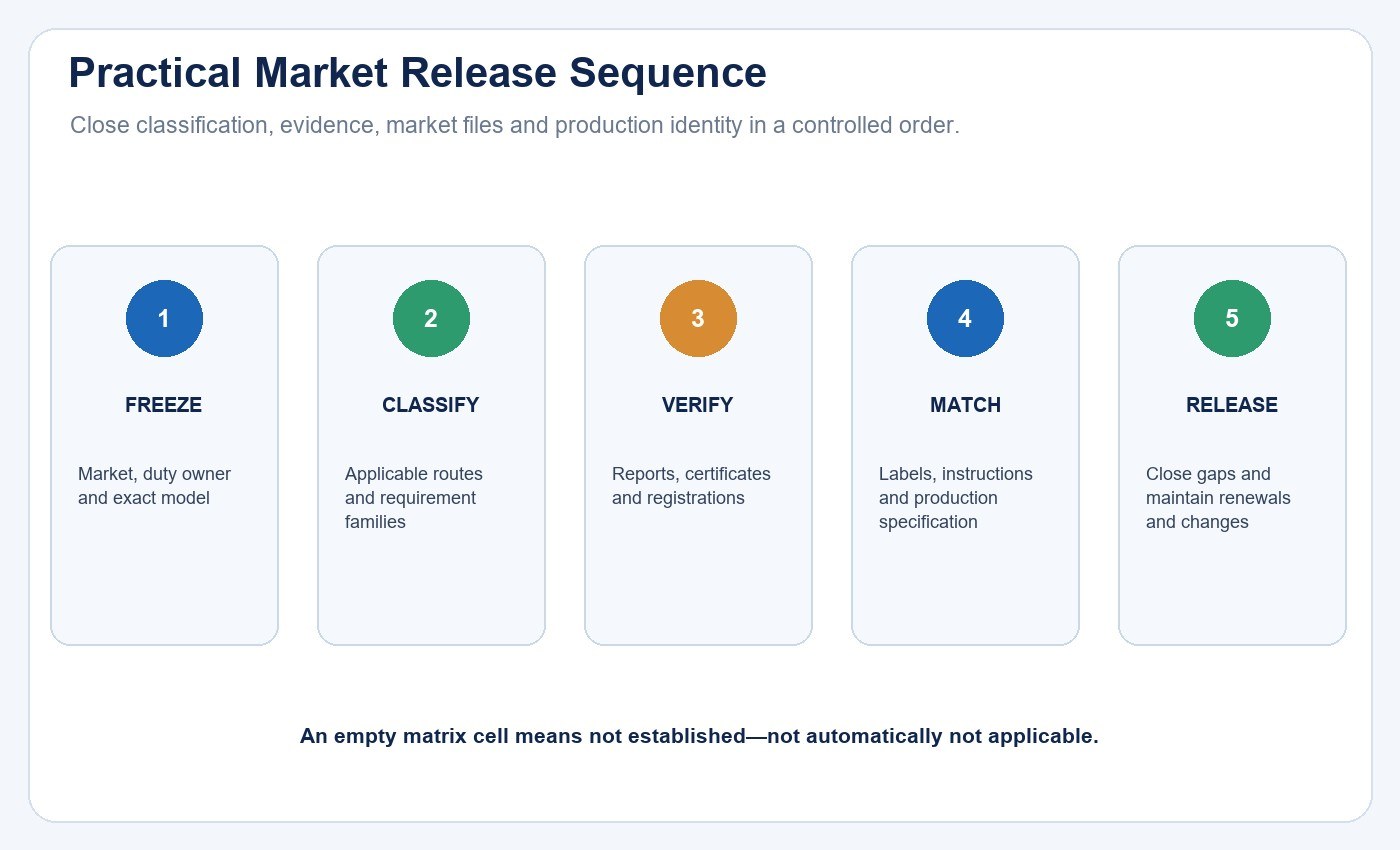
An empty cell means “not yet established,” not “not required.” Record “not applicable” only after a competent reviewer has documented why the requirement does not apply to that model and market.
Verify Product Architecture Before Certification Scope
A mechanically compatible tube can still create a different electrical system. Capture at least the cap, input range, power, frequency, wiring, single-ended or double-ended supply, ballast or external-driver dependency, host-luminaire conditions and installation instructions.
For North American retrofit work, UL’s current guidance explains that a Type A/B lamp used as a standalone product and the same lamp used as part of a luminaire conversion can involve different certification scope. The instructions and product category therefore matter as much as the mark itself. Similar scope questions arise when a tube adds emergency, refrigerated-display or hazardous-location use.
Map Requirement Families Before Naming Marks
For each market, screen the exact model against these families:
- electrical and fire safety;
- electromagnetic emissions and immunity;
- radio authorization for wireless functions;
- ecodesign, energy performance, energy labelling or model registration;
- restricted substances and other chemical requirements;
- waste, producer responsibility, packaging and batteries;
- photobiological or optical safety;
- installation, building, workplace, emergency or location-specific rules;
- traceability, responsible-party identification, language and instructions;
- incident reporting, record retention and market-surveillance cooperation.
Not every family applies in the same way. A non-radio Type A tube, a Bluetooth Type A/B tube and an external-driver emergency system should not share one unchecked compliance row merely because they use the same outer tube.
Audit Every Report, Certificate and Registration
Check the document itself and, where available, the issuing body’s official database. The review should answer:
- Does the legal company name match the applicant, certificate holder or responsible operator?
- Are the brand, exact model, ratings and variant rules listed?
- Which sample and construction revision were evaluated?
- Which standard and edition were used, and are national deviations addressed?
- Is the laboratory or certification body operating within the relevant accredited scope?
- Is the record active, suspended, withdrawn or expired?
- Are conditions of acceptability, installation limits and critical components recorded?
- Does the approved factory match the production source?
- Do labels, cartons and instructions reproduce the approved identity and warnings?
- Is there a renewal, surveillance or change-notification obligation?
A cropped logo or certificate cover is not enough. The decision depends on the complete scope and the relationship between the evidence and the shipped configuration.
Private Label Changes More Than the Artwork
A private-label buyer may become the named manufacturer or take on other market duties depending on the jurisdiction and commercial arrangement. Changing the brand or model code can also affect declarations, registrations, certificate coverage and traceability.
Before approving private-label artwork, document how the new identity is connected to the original evidence. Confirm whether the certification scheme permits alternate brands, whether the new model must be listed, who signs declarations, whose address appears on the product and who maintains the technical file. The factory and manufacturing overview provides context for New Lights production coordination, but project release still requires an exact model file.
Control Changes After Initial Approval
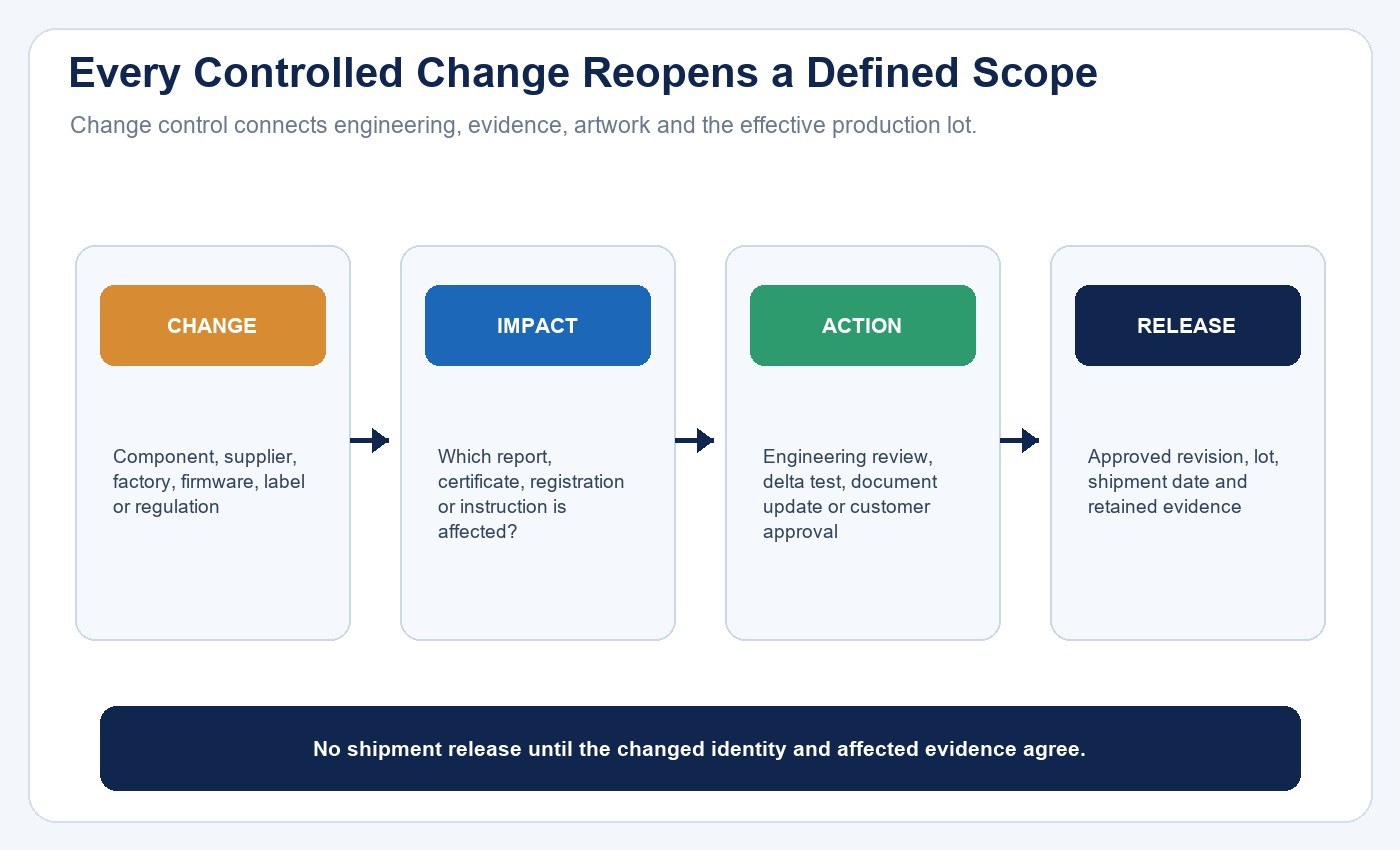
Market access is a lifecycle process. A change to the LED package, driver, capacitor, plastic, cap, wiring, firmware, radio module, label, supplier or factory can affect an earlier assessment. Regulations, designated standards, database fields and marking policies can also change.
Define which changes trigger engineering review, laboratory assessment, certificate update, customer approval, new registration or revised artwork. Link every approved change to effective production lots and shipment dates. A passing sample is not useful if mass production quietly moves to a different controlled construction.
The fluorescent lighting replacement solution can help frame the installation project, while the compliance matrix controls whether the selected architecture is ready for a particular market.
A Practical Release Sequence
- Freeze destination, channel, launch date and responsible legal entities.
- Freeze the exact tube architecture, ratings, functions, brand, factory and revision.
- Obtain current product classification and local scope confirmation.
- Build the model-to-market requirement and evidence matrix.
- Select laboratories, standards, samples and certification routes based on that matrix.
- Complete declarations, registrations, labels, instructions and technical files.
- Verify certificates and registrations in official systems where available.
- Compare the approved evidence with the production specification and shipment artwork.
- Close every mandatory field before release and maintain renewals and change control afterward.
Buyers can contact New Lights with the target countries, tube architecture, ratings, functions, private-label plan and importer details. That information is the minimum useful starting point for identifying evidence gaps without assuming that one certificate covers the program.
Frequently Asked Questions
Does CE marking cover every European LED tube requirement?
No. The responsible operator must identify all EU legislation applicable to the exact product and role, then complete the relevant conformity, documentation, registration, labelling and information duties.
Is UL certification required for every U.S. sale?
The accepted route can depend on the product, installation, adopted code, authority having jurisdiction, customer and sales channel. Confirm the certification category and intended use for the project rather than treating one mark as a nationwide answer to every installation.
Does a CB report allow immediate sales in every country?
No. It can support participating national conformity processes, but national deviations, local certification, registration, marking and responsible-party duties may remain.
Do fluorescent-shaped LED tubes automatically need Japan’s PSE mark?
Do not assume that from the phrase “LED lamp.” METI’s classification example separates bulb-shaped LED lamps from fluorescent-lamp-shaped LED tubes for that product category. Confirm the exact product classification and all other applicable Japanese requirements before release.
Can a private-label buyer use the original manufacturer’s reports?
Only when the applicable legal and certification route permits it and the new brand and model are properly covered. Verify declarations, registrations, certificate scope, traceability and the responsible party before changing artwork.
When should compliance evidence be reviewed again?
Review it whenever critical construction, ratings, firmware, factory, brand, label, instructions, law, standard, certificate status or target market changes, and before each new-country launch.
Editorial Sources
- European Commission, Light Sources: https://energy-efficient-products.ec.europa.eu/product-list/light-sources_en
- European Commission, EPREL: https://energy-efficient-products.ec.europa.eu/eprel_en
- GOV.UK, Product regulations by sector and current approaches to product marking: UKCA and CE regimes: https://www.gov.uk/government/publications/product-regulations-by-sector-and-current-approaches-to-product-marking-ukca-and-ce-regimes
- GOV.UK, Regulations: ecodesign of energy-consuming products: https://www.gov.uk/guidance/placing-energy-related-products-on-the-uk-market
- UL Solutions, FAQ — UL Certified LED Retrofit Luminaire Conversion Kits: https://www.ul.com/thecodeauthority/knowledge/faq-ul-certified-led-retrofit-luminaire-conversion-kits
- UL Solutions, New Edition and Scope Expansion of the LED Retrofit Standard: https://www.ul.com/news/new-edition-and-scope-expansion-led-retrofit-standard
- Japan METI, Electrical Appliances and Materials Safety Act: https://www.meti.go.jp/english/policy/economy/consumer/pse/index.html
- Japan METI, Electrical Appliances and Materials Safety Act overview and product-scope examples: https://www.meti.go.jp/policy/consumer/seian/denan/hourei/seirei/110706_presentation.pdf