

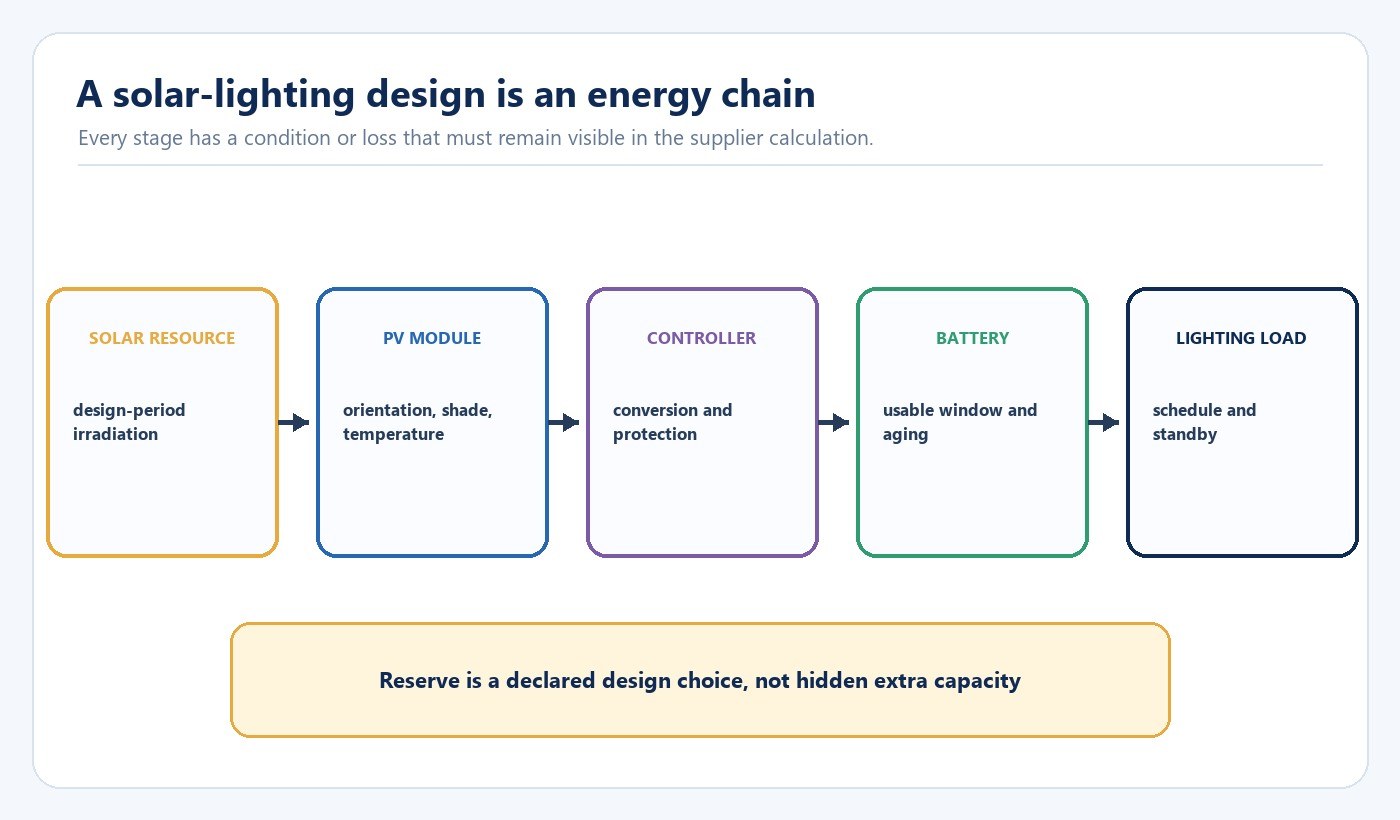
An outdoor solar light is a complete energy, lighting and structural system. A luminaire wattage, battery amp-hour value or catalogue autonomy statement cannot establish performance at a real site without the operating schedule, solar resource, shading, temperature, losses, optics, controls and reserve policy behind it.
Start with the maintained night-time task and the adverse design period. State the site and control schedule, then compare suppliers through the same load, generation, storage, structure, service and commissioning assumptions.
Define the Night-Time Lighting Task
Divide the site into paths, gates, parking areas, roads, signs or service zones. For each zone, record the operating hours, maintained lighting criterion, control behaviour, consequence of a dark period and limits on spill light. A decorative marker and a public access route should not share the same reliability assumption.
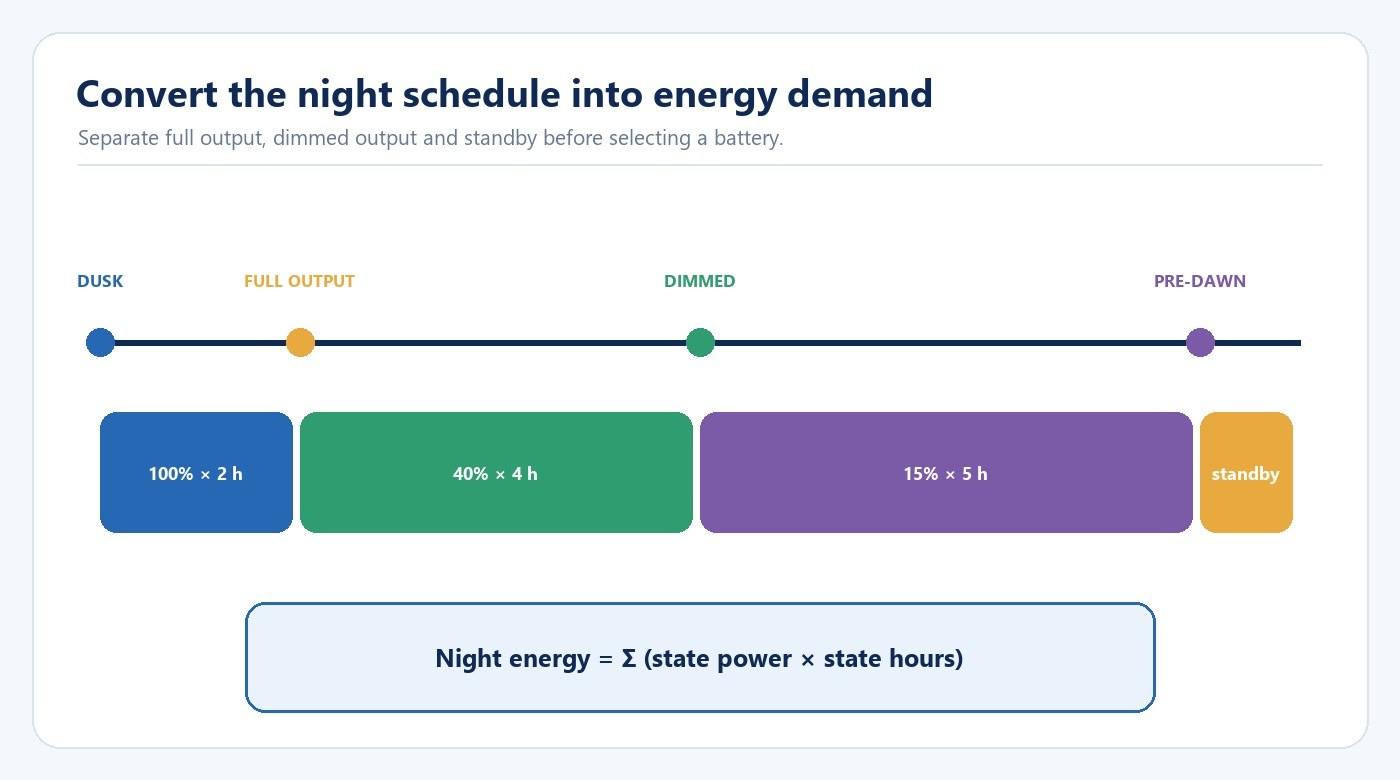
List power and duration in every state: full output, dimmed output, motion response and standby. A control schedule can reduce energy demand, but only if the accepted lighting task still remains satisfied.
| RFQ input | Evidence to request | Failure if omitted |
|---|---|---|
| Night load | Power in full, dimmed and standby states | Battery demand is understated |
| Solar resource | Design-period irradiation source and panel-plane assumption | Generation is overstated |
| Battery reserve | Usable energy basis, temperature and protection limits | Autonomy claims cannot be compared |
| Structure | Panel area, wind basis, pole and foundation responsibility | Site load is disconnected from hardware |
| Optics | Photometric file, mounting geometry and calculation | Wattage substitutes for useful light |
Build a Transparent Energy Balance
Use night energy = Σ (power in each state × hours in that state) as the load-side starting point. For example, a 30 W luminaire at full output for 2 hours, 12 W for 5 hours and 3 W for 5 hours uses 135 Wh before controller, battery and wiring losses. This example does not size a real system; it shows why a single nominal wattage or runtime claim is insufficient.
The supplier calculation should state the irradiation dataset and design period, module orientation, expected losses, controller behaviour, battery chemistry, usable state-of-charge window, temperature basis, aging allowance and reserve policy. Ask which constraint first stops operation and what output or schedule remains when the controller reaches a protection threshold.
| Calculation layer | Required input | Decision boundary |
|---|---|---|
| Lighting demand | State power and hours | Must satisfy the accepted night task |
| PV generation | Irradiation, orientation, temperature and losses | Use the adverse design period, not only an annual average |
| Battery storage | Nominal energy, usable window, temperature and aging | Compare usable energy rather than amp-hours alone |
| Reserve policy | Consecutive poor-sun assumption and control response | Define what is reduced before the site goes dark |
Survey Shade, Orientation and Obstructions
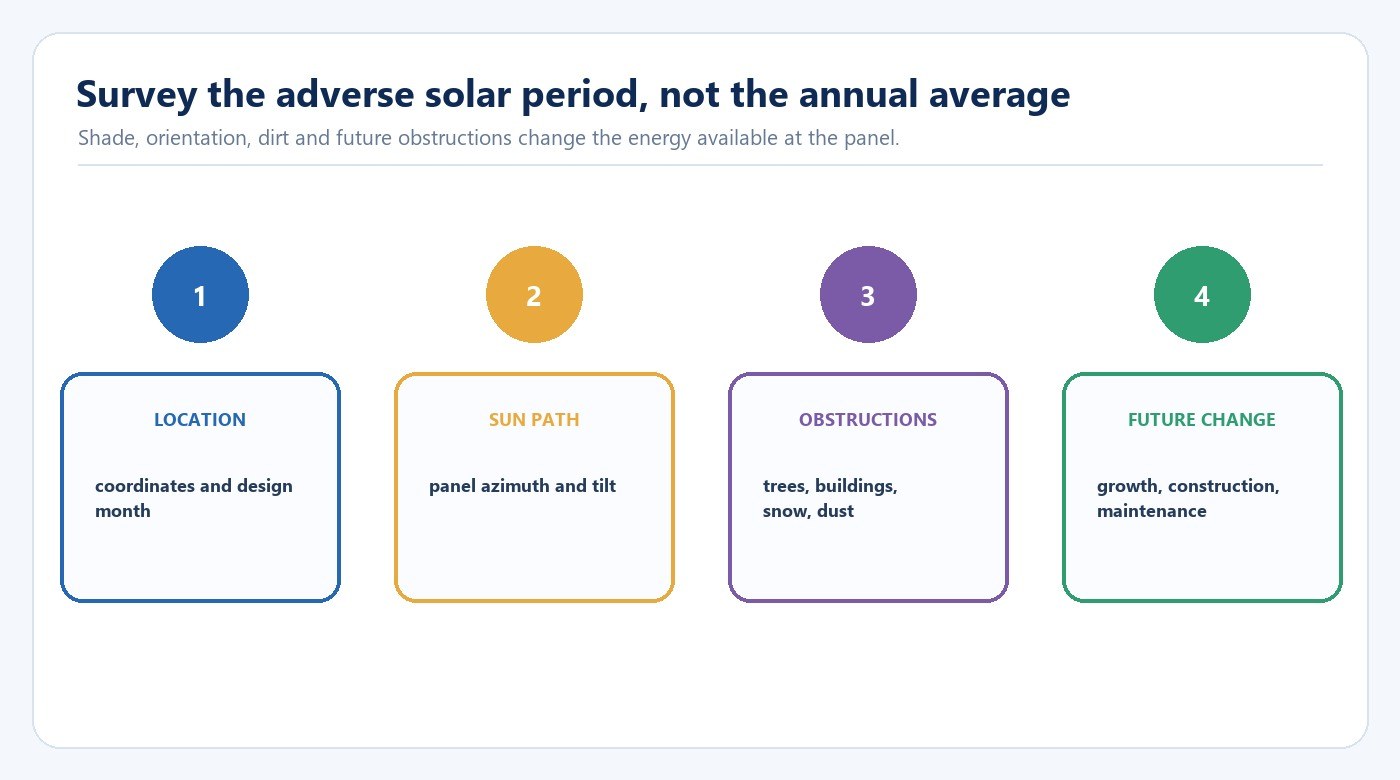
Record coordinates, panel azimuth and tilt, seasonal sun path, trees, buildings, dust, snow or debris and planned development. A clear panel at installation can become shaded by vegetation or new construction. Use the design month or adverse period rather than an annual average that conceals seasonal risk.
Separate site uncertainty from product capability. If shade varies between poles, one system size may not be appropriate for every location. Mark survey assumptions on the drawing so the final installation can be checked against them.
Match the Hardware Architecture to Service Needs
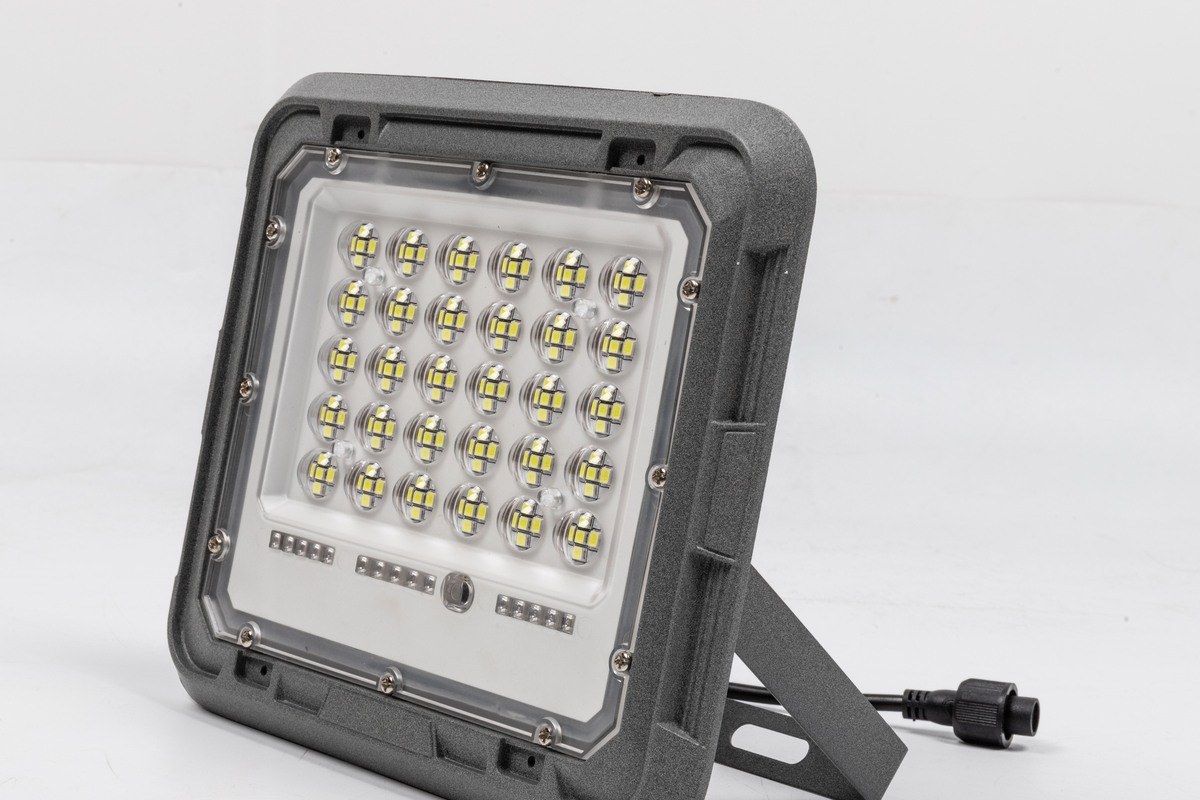
Integrated systems can simplify installation and reduce cabling, while split systems can allow independent panel orientation and different service access. Neither architecture is universally better. Compare mounting, cable routing, battery and controller access, working height, replaceable parts, tools and spare strategy at the actual site.
The International Electrotechnical Commission’s IEC 60529 classifies degrees of enclosure protection against access, solids and water for electrical equipment within its scope. Match the claimed IP configuration to the exact joints, cable entries and compartments supplied. Corrosion, UV exposure, temperature, impact and structural loading require separate evidence where relevant; a higher IP code does not prove coastal durability or wind resistance.
Use Optics and Controls to Reduce Unnecessary Load
Request a photometric file and calculation at the proposed mounting height, tilt, spacing and surface conditions. Direct light to the task rather than increasing wattage to compensate for poor distribution. DarkSky International and Illuminating Engineering Society describe responsible outdoor lighting through five principles: useful, targeted, low level, controlled and warm-coloured where possible.
Write the exact sequence: dusk start, full-output period, dim level, motion response, pre-dawn behaviour and fail-safe mode. State whether settings are fixed, remote or field-adjustable and who may change them after commissioning. Record the accepted configuration rather than relying on a generic remote-control photograph.
Assign Structural and Installation Responsibility
The PV module adds area and wind load. Define who supplies the pole, bracket, fasteners and foundation design, which wind and soil basis applies, and who confirms the installed panel direction and tilt. Electrical connectors, cable support, sealing and service loops should match the approved drawing.
Use the outdoor lighting installation checklist to connect the product package to access, mounting, wiring, aiming and handover requirements.
Commission the Complete Installed System
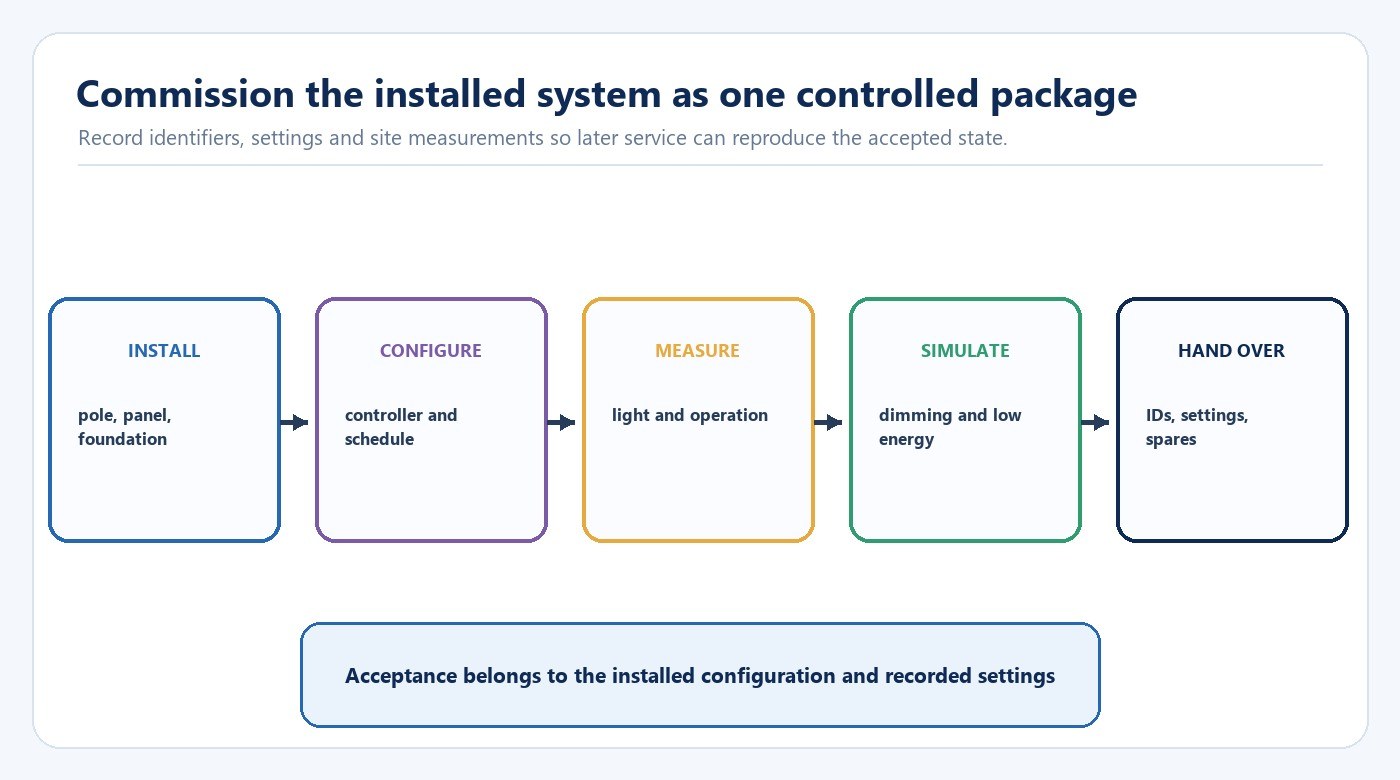
Confirm the pole, foundation, fasteners, panel direction and tilt against the approved drawing. Inspect cable entries, seals, battery compartment and controller settings. After dark, measure lighting at agreed points in the specified operating mode and verify dimming, motion response, timing and recovery from a simulated low-energy condition.
Record the battery, controller, luminaire and PV identifiers, firmware where applicable, final settings, measured results and open deviations. Schedule a follow-up after representative weather if the acceptance plan requires it.
Buyer Release Checklist
- The zone, lighting task and maintained acceptance criteria are stated.
- Site solar resource and seasonal shading assumptions are documented.
- Full, dimmed, response and standby energy are calculated separately.
- PV losses, usable battery window, aging and reserve policy are visible.
- Photometric evidence matches mounting geometry and control mode.
- IP scope and separate environmental requirements are identified.
- Wind, pole, bracket and foundation responsibilities are assigned.
- Controller sequence and field-adjustment authority are controlled.
- Commissioning, identifiers, spares and battery replacement are priced.
- Final settings and site evidence are included in handover.
Review the New Lights lighting solutions and send the site plan, coordinates and operating schedule through the project enquiry form.
Frequently Asked Questions
Can battery amp-hours prove all-night operation?
No. Voltage, usable state-of-charge window, temperature, aging, conversion losses, lighting schedule and controller limits determine delivered energy.
Does a higher IP rating prove coastal suitability?
No. IP classification addresses defined enclosure protection. Coastal corrosion, UV exposure, temperature and structural conditions require separate materials and evidence.
Should every pole use the same solar-light system size?
Only if the lighting task, mounting, solar access, shading and environmental assumptions are sufficiently equivalent. Map exceptions rather than forcing one calculation onto different sites.
What information matters most before quotation?
Provide the lighting task, coordinates, panel and luminaire geometry, seasonal shade, operating schedule, environmental exposure, structural responsibility and acceptance method.
Editorial Sources
- IEC — IEC 60529, Degrees of protection provided by enclosures (IP Code): https://webstore.iec.ch/en/publication/2452
- DarkSky International and IES — Five Principles for Responsible Outdoor Lighting: https://darksky.org/resources/guides-and-how-tos/lighting-principles/