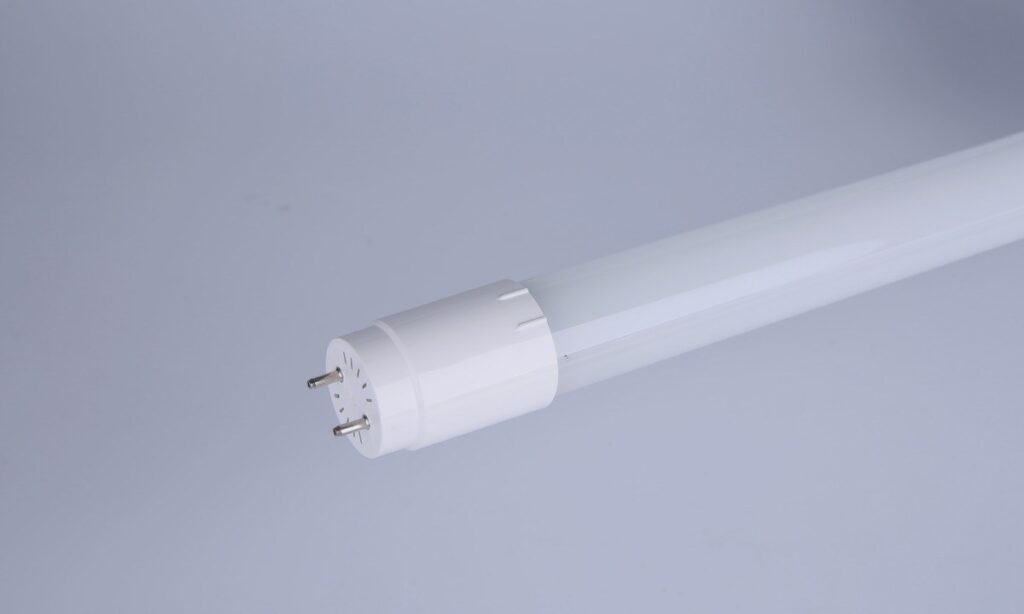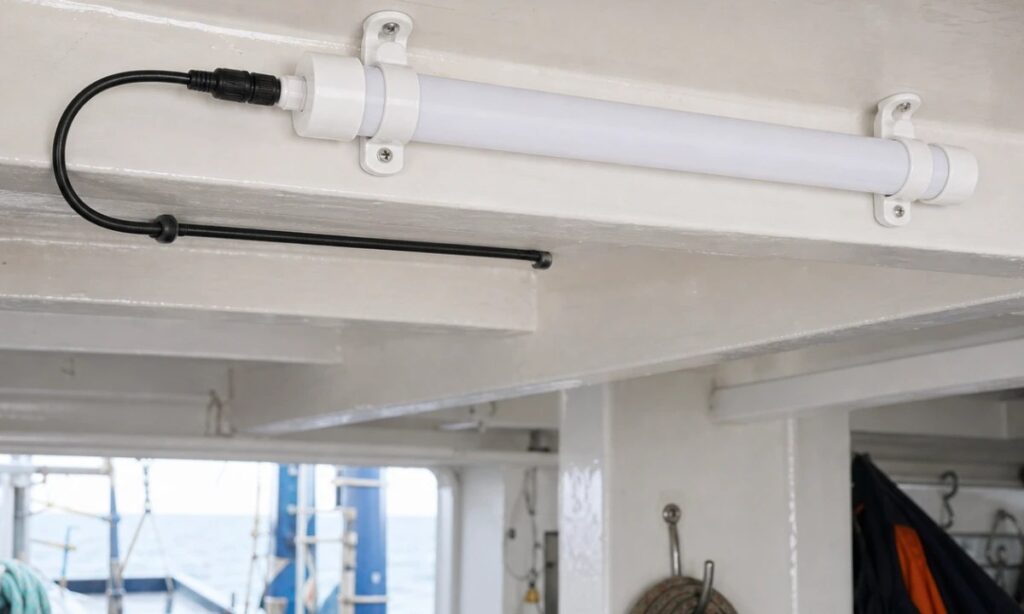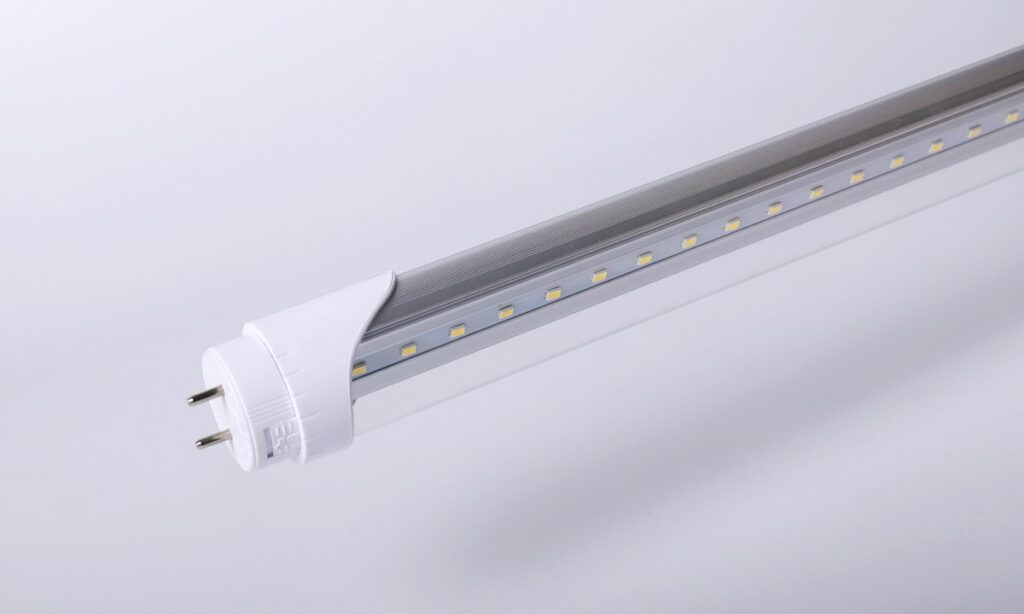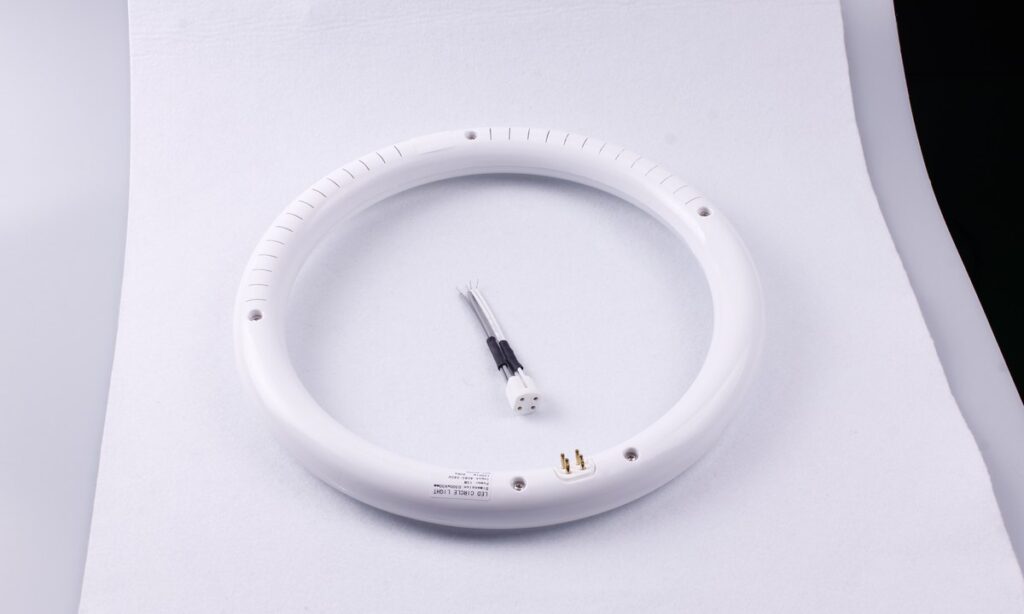


On a tube light, T8 identifies the bulb shape and nominal diameter:
- T means tubular.
- 8 means eight eighths of an inch, so the nominal diameter is one inch.
That is the complete meaning of the T8 size designation. It does not, by itself, tell you the tube’s length, wattage, base, voltage, ballast compatibility, LED wiring method, color temperature or light output.
This distinction is important during a retrofit. Two products can both be called T8 and still be electrically or mechanically incompatible.
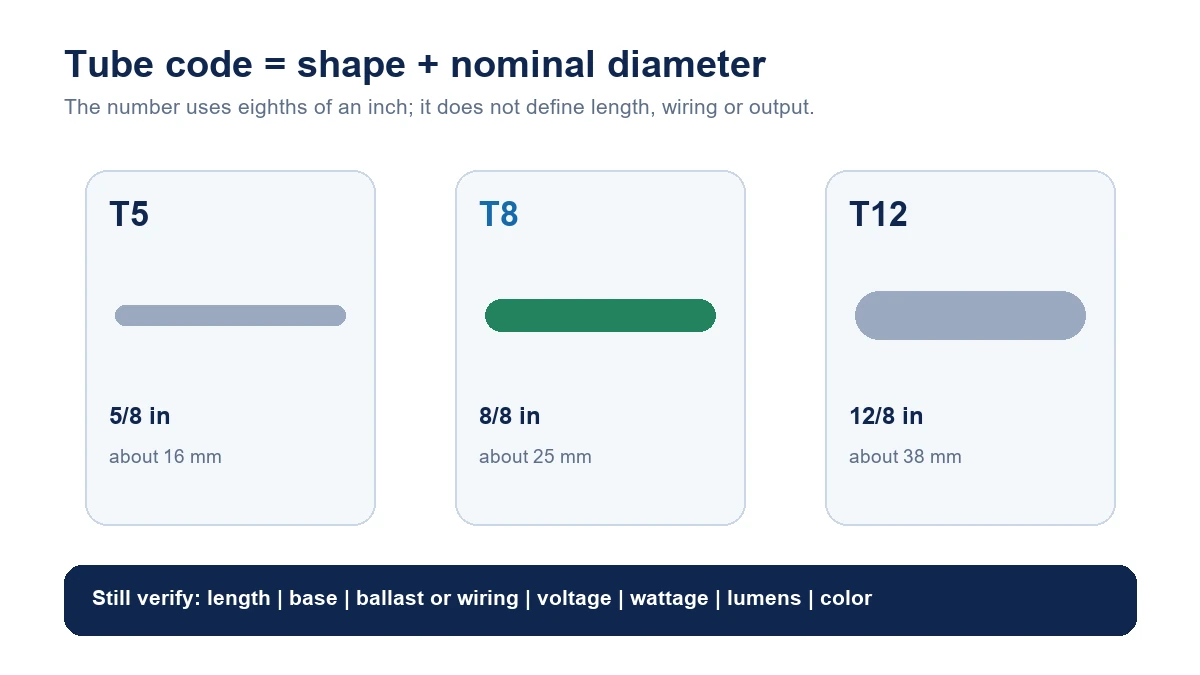
Why the number uses eighths of an inch
ANSI C78.81 explains that fluorescent lamp bulb diameters have long been identified in eighth-of-an-inch units. A one-inch nominal bulb is therefore called T8. DOE’s CALiPER report on linear LED lamps uses the same explanation: the first letter describes the shape, and the number gives the nominal diameter in eighths of an inch.
The same naming logic gives:
| Designation | Shape | Nominal diameter |
|---|---|---|
| T5 | Tubular | 5/8 inch |
| T8 | Tubular | 8/8 inch, or 1 inch |
| T12 | Tubular | 12/8 inch, or 1.5 inches |
These are nominal families, not a guarantee that every measured tube is exactly the mathematical value. Standards include tolerances for actual outside diameter and other dimensions.
Nominal diameter is not the same as complete size
A tube must fit both the luminaire and its lampholders. Diameter is only one dimension. Length conventions can also refer to different points, such as base face, pin tip or overall span.
Record:
- complete lamp marking;
- nominal and actual length;
- base-face-to-base-face dimension;
- pin-to-pin dimension;
- outside diameter;
- base designation;
- pin arrangement;
- available clearance in the luminaire.
Do not order from a description such as “four-foot T8” alone. The exact regional product, base and dimensional data should match the existing system or the approved retrofit design.
Does T8 always mean a G13 base?
Many familiar straight T8 fluorescent and LED tubes use a G13 medium bi-pin base, but T8 is a bulb-shape and diameter designation, not the base definition itself. Specialty, U-bend or other products can require additional identification.
Even when both lamps have a G13 base, the electrical arrangement may differ. The base tells you the physical contact pattern. It does not prove:
- ballast compatibility;
- direct-wire compatibility;
- single-ended or double-ended input;
- required lampholder type;
- supply voltage;
- permitted circuit.
Read the full product and installation documentation.
Fluorescent T8 and LED T8 are not the same electrical system
The T8 nomenclature originated with conventional tubular lamps and was later applied to LED products adapted to that form factor. A fluorescent T8 requires a compatible ballast. An LED T8 may be designed for one of several system arrangements. Review the LED tube family by electrical configuration, not by the T8 label alone.
UL Solutions distinguishes the following LED retrofit categories:
- UL Type A: operates through a compatible existing ballast;
- UL Type B: operates from branch-circuit power after the luminaire is rewired according to the retrofit instructions;
- UL Type A+B: supports specified ballast-compatible and direct-wire modes;
- UL Type C: uses an external LED driver supplied as part of the system.
These labels describe electrical approaches, not quality levels. A Type A lamp can simplify installation only when the installed ballast appears on the approved compatibility list and remains in acceptable condition. A Type B conversion removes ballast dependence but changes the luminaire wiring and must follow the certified retrofit instructions. Type C introduces a matched external driver.
The word T8 does not choose among them.

Why the existing ballast matters
For a fluorescent system or a Type A LED retrofit, identify the exact ballast manufacturer and model. “Electronic ballast” is not specific enough. Compatibility can depend on ballast starting method, output, lamp count and circuit configuration.
DOE CALiPER also notes that lampholder electrical paths differ. Shunted and unshunted lampholders are not interchangeable assumptions, especially in direct-wire LED retrofits. Visual inspection alone may not establish the internal connection.
Before any electrical work, de-energize and verify the circuit according to applicable safety procedures. Retrofit wiring should be performed by a qualified person using the exact lamp or kit instructions and required labels.
T8 does not define wattage or brightness
Traditional fluorescent product markings often combine wattage, shape and other codes. LED replacements can deliver a different lumen output at a different input power while keeping the T8 form.
Compare these fields separately:
- system input power;
- lamp luminous flux;
- light distribution;
- color temperature and color quality;
- power factor and harmonic data where relevant;
- dimming or control capability;
- rated life and warranty basis.
Do not assume a lower-watt LED is an equivalent replacement without checking delivered light and the luminaire’s optical behavior. An LED tube may send more light downward than a fluorescent tube, which can change luminaire efficiency and appearance. A photometric comparison is more useful than lamp watts alone.
T8 does not define color
Codes elsewhere in the product name may describe color temperature or color rendering, but they are separate from T8. For example, different T8 products can be offered at multiple CCTs and output levels.
When replacing tubes in an occupied space, confirm:
- intended CCT;
- color-rendering requirement;
- consistency among lamps;
- compatibility with existing and adjacent lighting;
- any color-shift or maintenance criteria.
Mixing tubes with different color codes can create an obvious visual mismatch even when their physical dimensions are identical.
T5, T8 and T12 are not automatic substitutes
The nominal diameters differ, but substitution involves more than tube thickness. Length, base, ballast, current, voltage, optical position and luminaire construction can differ.
A T8 and T12 may appear to fit the same style of bi-pin lampholder in some legacy systems, but that does not prove the installed ballast is correct for the replacement. A T5 generally uses a different system and should not be treated as a thinner plug-in replacement for T8.
For an upgrade, identify the complete existing luminaire rather than asking only whether one T-number can replace another.
How to read a tube marking
A complete marking can contain several information groups. The order and abbreviations vary by manufacturer, but look for:
- lamp technology;
- rated wattage;
- T designation;
- nominal length;
- color code;
- base;
- input voltage or ballast requirement;
- wiring or retrofit type;
- dimming status;
- certification and model identifiers.
Photograph the whole marking before removing the old tube. Also record the ballast label and luminaire label. A partial code copied from memory can lead to the wrong replacement.
A T8 retrofit checklist
Before selecting a T8 LED tube, confirm:
- existing lamp’s full code;
- tube length and base;
- ballast model and starting method;
- lampholder configuration;
- supply voltage;
- desired Type A, B, A+B or C approach;
- single-ended or double-ended input;
- lamp count per luminaire;
- required output, distribution and color;
- emergency, sensor or dimming functions;
- luminaire condition and certification implications;
- required retrofit labels and instructions.
Buyers can review the verified LED tube category above and the broader New Lights product range as a starting point. For a model-level recommendation, contact New Lights with the full tube marking, ballast model, supply voltage, luminaire photos and required retrofit approach.
FAQ
Is a T8 tube exactly one inch in diameter?
T8 is a nominal one-inch designation. Applicable standards provide dimensional tolerances, so an actual product is not required to measure exactly 1.000 inch.
Does T8 mean the tube is four feet long?
No. T8 describes shape and nominal diameter. T8 products are available in different lengths and forms.
Are all T8 tubes G13?
Many common straight T8 tubes use G13 bases, but verify the exact product. T8 itself does not define the base.
Can any LED T8 replace a fluorescent T8?
No. Check length, base, ballast or wiring type, supply voltage, lampholders, output, controls and certified installation instructions.
What is the difference between T8 and T12?
The nominal diameter differs: T8 is one inch and T12 is 1.5 inches. Their electrical systems and product specifications may also differ, so they are not automatic substitutes.
What is the difference between T8 and T5?
T5 has a nominal 5/8-inch diameter. It commonly uses a different base and electrical system from T8 and should not be treated as a simple thinner replacement.
Does T8 tell me the wattage or color temperature?
No. Wattage, output and color are separate fields in the full lamp designation or datasheet.
Editorial sources
- U.S. Department of Energy CALiPER, “Application Summary Report 21: Linear (T8) LED Lamps”: https://www1.eere.energy.gov/buildings/publications/pdfs/ssl/caliper_21_t8.pdf
- UL Solutions, “FAQ – UL Certified LED Retrofit Luminaire Conversion Kits”: https://www.ul.com/thecodeauthority/knowledge/faq-ul-certified-led-retrofit-luminaire-conversion-kits