

There is no single lowest-wattage bulb across every lamp type, base, voltage and application. Very low-power products exist for indicators, decorative effects and night lighting, but their output and purpose may be completely different from a bulb used for general illumination.
The more useful question is: what is the lowest input power that still delivers the light, fit and electrical performance your application requires?
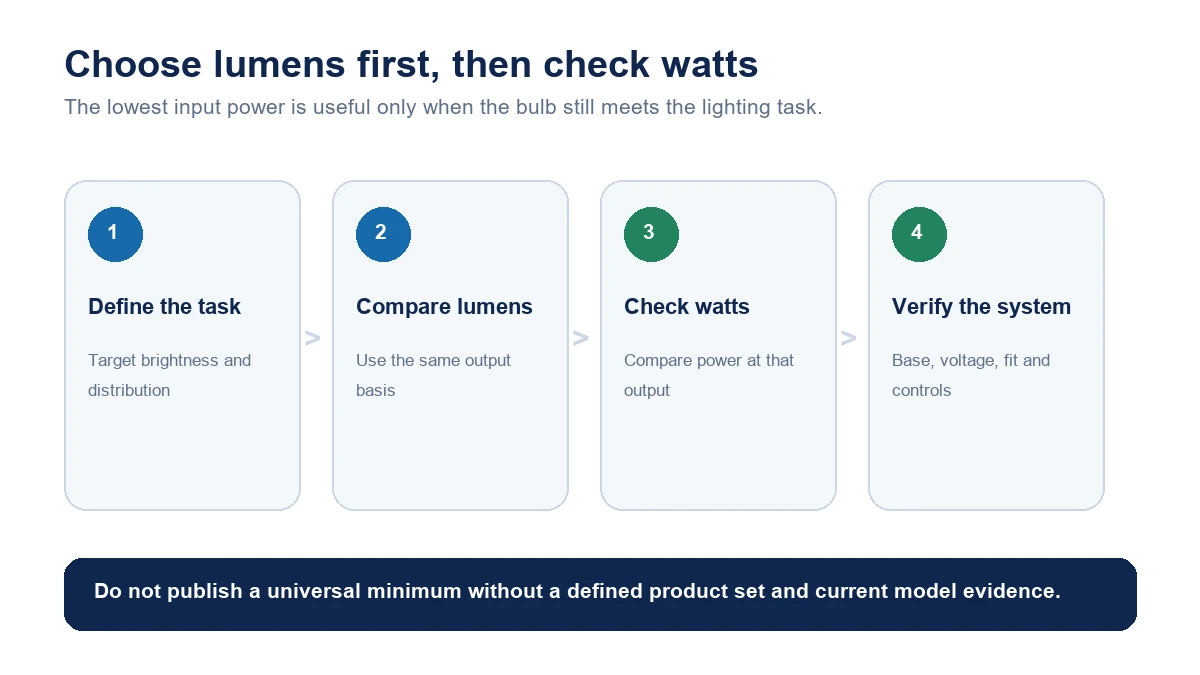
To answer that, start with lumens and the task. Compare wattage only after the required brightness, base, voltage, dimensions and fixture conditions are defined.
Watts do not measure brightness
The Federal Trade Commission explains the distinction clearly: watts describe energy use, while lumens describe brightness. More lumens generally means more light output; fewer watts means lower electrical input.
This matters because older shopping habits used incandescent wattage as a shorthand for brightness. With modern lamps, products using different technologies or designs can consume different wattages while producing similar lumen output.
Therefore:
- Watts: electrical power consumed under the stated conditions.
- Lumens: total visible light output.
- Lumens per watt: a measure of luminous efficacy, calculated by dividing output by input power.
A 1 W indicator lamp and a 1 W decorative bulb may use similar power but produce different light distributions and visual effects. Neither should be compared directly with a general-service bulb solely by wattage.
Why there is no stable universal minimum
The minimum changes when the comparison set changes. Ask what products are included:
- all electrically powered light sources;
- screw-base replacement lamps;
- mains-voltage household bulbs;
- decorative filament bulbs;
- night lights;
- indicator lamps;
- colored lamps;
- smart bulbs with standby electronics;
- low-voltage lamps for dedicated systems.
Each group has different purposes and electrical architectures. Product availability also changes as manufacturers update ranges. A claim that a specific wattage is “the lowest bulb you can get” can become inaccurate or meaningless without a stated market, base, voltage, category and date.
For an evergreen article, it is more accurate to explain the selection method and place current minimum values on verified product pages.
Start with the lighting task
| Lighting task | First requirement to define | Why the lowest wattage can mislead |
|---|---|---|
| Indicator or orientation light | visibility at the viewing distance | a general-service bulb may provide unnecessary output |
| Decorative effect | appearance, distribution and color | the visible effect may matter more than total lumens |
| Local task light | illuminance on the work area | optics and distance change useful light on the task |
| General illumination | room-level output and distribution | an extremely low-power lamp may not meet the required lumen target |
Before searching for the lowest wattage, classify what the light must do.
Indicator or orientation light
The goal may be to show equipment status, mark a path or provide very low-level nighttime orientation. Required output can be small, but the product may use a special base, low-voltage supply or dedicated housing.
Decorative effect
A visible filament, colored envelope or accent glow may be more important than task illumination. Compare appearance, distribution, dimming and fixture fit as well as lumens.
Local task light
The source must place enough light on a defined surface. Total lumens alone may not predict the result; beam distribution, distance, fixture optics and obstructions matter.
General illumination
The bulb contributes to lighting a room or larger area. Selecting only the lowest wattage can leave the space underlit or require more lamps, offsetting the expected power reduction.
The task establishes the required output and distribution. Wattage becomes a comparison field after those requirements are fixed. The LED bulb family provides a starting point for comparing real product formats rather than an abstract minimum.
Compare efficacy on an equivalent basis
If two bulbs provide similar usable output and distribution, the lower-wattage option may be more efficient. But comparing wattage without output is not an efficacy comparison.
Use:
`luminous efficacy = lumens ÷ watts`
Even this ratio does not capture every requirement. Color quality, dimming, optical control, thermal conditions, lifetime evidence, power quality and cost may differ. A product with the highest numerical efficacy is not automatically the best fit for a decorative or color-critical application.
Verify that the lumen and watt values refer to the complete lamp, the same operating condition and the exact model. Do not combine the output of one version with the power of another.
Fixture maximum wattage is not a target brightness
A fixture label may state a maximum lamp wattage. That is a safety or application limit, not a requirement to install a lamp at exactly that power.
FTC rulemaking retained wattage information partly because buyers may need it to check a fixture’s maximum allowable lamp wattage. Stay within the fixture’s instructions, but do not assume that any lower-wattage lamp is automatically compatible.
You still need to verify:
- permitted lamp type;
- base and voltage;
- physical fit;
- open or enclosed fixture conditions;
- operating orientation;
- dimmer or control compatibility;
- environmental rating.
A low-power LED can still be unsuitable for a sealed fixture, wrong voltage or incompatible control.
Base, voltage and dimensions narrow the choice
The lowest-watt product in a catalog may use the wrong base or electrical system. Record the actual requirements before comparing models:
- base designation;
- input voltage and frequency;
- maximum overall length and diameter;
- required bulb shape or optical position;
- fixture opening and shade clearance;
- dry, damp, wet or outdoor conditions;
- dimmable or non-dimmable operation;
- required color appearance and color quality.
For replacement projects, photograph the existing lamp markings and fixture label. Do not identify a lamp only as “small screw,” “low voltage” or “60-watt equivalent.”

Dimming is different from choosing a lower-watt bulb
A lower-watt lamp has a lower rated input at its stated operating condition. A dimmed lamp uses a compatible control to reduce output during operation. These are different design choices.
If the application sometimes needs full brightness and sometimes needs low light, a verified dimmable system may be more appropriate than permanently selecting an underpowered bulb. Conversely, if only a small fixed output is needed, a simple low-output lamp may avoid unnecessary control complexity.
Do not assume every low-watt LED is dimmable. Confirm the exact lamp and control combination.
Operating cost depends on power and time
For a simple energy-use estimate:
`annual energy use in kWh = watts ÷ 1,000 × hours per day × 365`
Then multiply annual kWh by the applicable electricity rate. This calculation compares use, not total lifecycle cost. Purchase price, maintenance, replacement labor, controls and the number of lamps can affect the business decision.
A small wattage difference may have little financial effect when a lamp operates rarely. The same difference may matter across a large quantity with long daily operating hours. Use the actual duty cycle rather than a generic savings percentage.
A practical selection sequence
Follow this order:
- Define the lighting task.
- Set the required lumens or project-specific illuminance criteria.
- Identify the needed light distribution.
- Confirm base, voltage, dimensions and fixture conditions.
- Confirm color appearance, color quality and controls.
- Compare compliant models by wattage and efficacy.
- Review lifetime, warranty and product evidence.
- Test a sample when appearance or control behavior is important.
This process may identify the lowest-wattage suitable lamp. That is a defensible project answer, unlike a universal market minimum.
Buyers can review the verified New Lights product range and LED bulb category above. For a model recommendation, contact New Lights with the required lumens, base, voltage, fixture dimensions, control method and application.
FAQ
Does a lower-watt bulb always look dimmer?
No. Wattage measures input power, not brightness. Compare lumens and light distribution for the exact products.
Is the lowest-watt LED always the most efficient?
No. Efficiency requires comparing output with power, commonly in lumens per watt, while also checking that the product meets the application requirements.
Can I install any bulb below a fixture’s maximum wattage?
No. Staying below the maximum is only one condition. Base, voltage, dimensions, lamp type, enclosure, environment and controls must also be compatible.
What wattage should replace an old incandescent bulb?
Select the required lumens rather than matching incandescent watts directly. Then verify fit, voltage, color and fixture conditions.
Are very low-watt bulbs suitable for room lighting?
Not necessarily. Some are designed for indicators, night lights or decorative effects. Review their lumen output and distribution against the room’s lighting needs.
Does dimming make a bulb a lower-wattage bulb?
No. Dimming changes operation through a control. The product retains its rated specification and must be compatible with the dimming system.
How can I compare operating cost?
Calculate annual kWh from rated watts and actual operating hours, then apply the local electricity rate. Include quantity and maintenance when comparing total cost.
Editorial sources
- Federal Trade Commission, “Shopping for Light Bulbs”: https://consumer.ftc.gov/articles/shopping-light-bulbs
- Federal Trade Commission, “The FTC Lighting Facts Label: Questions and Answers for Manufacturers”: https://www.ftc.gov/business-guidance/resources/ftc-lighting-facts-label-questions-answers-manufacturers
- Federal Trade Commission, Appliance Labeling Rule discussion: https://www.ftc.gov/sites/default/files/documents/federal_register_notices/appliance-labeling-rule-final-rule-and-opportunity-comment/100719noticeofrulemaking.pdf
- U.S. Department of Energy FEMP, “Purchasing Energy-Efficient Light Bulbs”: https://www.energy.gov/cmei/femp/purchasing-energy-efficient-light-bulbs