


 English
 Español
 Deutsch
We sincerely look forward to establishing a long-term development partnership with you with good quality and professional services.
Commercial lighting in 2026 is not being evaluated the same way it was a few years ago.
Buyers still look at efficacy, wattage, and unit cost, but those factors no longer carry the decision on their own. In offices, schools, retail chains, warehouses, and public buildings, the shortlist is increasingly shaped by a different set of questions:
-
Can this product work in a renovation project without creating extra ceiling work?
-
Can it support the control strategy on the job?
-
Can it stay eligible for rebates?
-
Will the light actually suit the visual task in the space?
That shift is happening alongside Europe’s renovation drive, stricter code expectations in the U.S., and a rebate environment in North America that still depends heavily on qualified non-residential products. The EU’s Renovation Wave aims to renovate 35 million buildings by 2030 and at least double the annual rate of energy renovations, while DOE’s determination for ASHRAE 90.1-2022 found weighted national average site-energy savings of 9.8% versus 90.1-2019.
Retrofit Is Becoming the Default Background for Many Projects
A large share of commercial lighting demand now starts with an existing building, not a blank plan.
That changes the purchasing conversation. Instead of asking only which fixture should be used, project teams are asking what can be installed with the least disruption, what can fit the current layout, and what can be rolled out across multiple sites without creating unnecessary installation risk.
In this context, retrofit-friendly product language matters more than it did before. Buyers are not simply looking for “energy-saving lighting.” They are looking for panel lights, battens, linear fixtures, and other commercial formats that can replace aging fluorescent-based systems without turning a simple upgrade into a ceiling rebuild.
In practice, that means dimensional fit, realistic installation paths, compatible control options, and documentation that helps contractors quote the job with fewer unknowns.
The value shows up in shorter shutdown windows, fewer site changes, and smoother rollout across offices, schools, and retail estates. Europe’s building-renovation agenda is part of why this logic is becoming more common.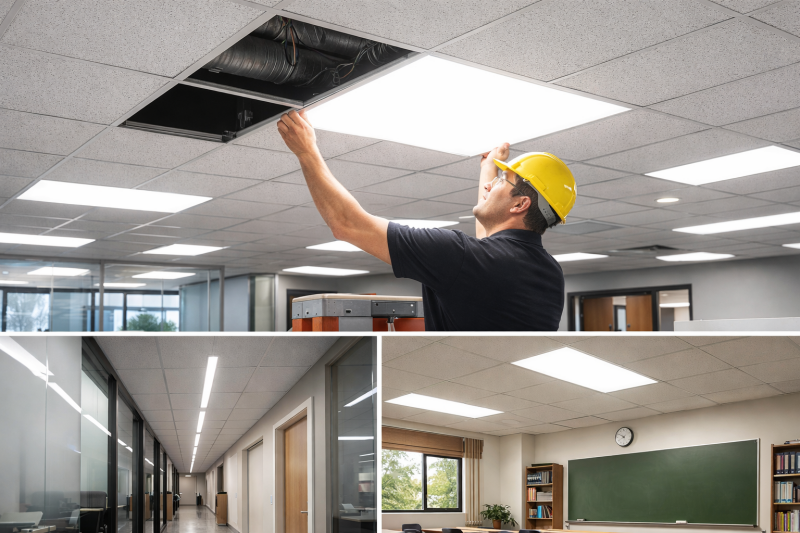
Fluorescent Replacement Is Moving from Maintenance Issue to Planning Issue
Retrofit demand has become more urgent because many building operators no longer want to rely on fluorescent continuity as a long-term plan.
Once the question becomes “how long can we keep the old system alive?” instead of “which lamp do we reorder?”, the project moves into a different stage.
Procurement teams start comparing:
-
lamp-for-lamp retrofit
-
full luminaire replacement
-
phased upgrades by area
They also start asking whether one product family can cover classrooms, corridors, offices, and utility areas without creating a fragmented SKU structure.
This is one reason commercial LED upgrade conversations in 2026 often sound less like product promotion and more like asset planning.
Controls Are Getting Closer to Baseline Expectations
Controls are another area where buyer priorities have shifted.
In many commercial jobs, controls are no longer treated as a premium extra attached at the end of the discussion. They are part of the specification path from the beginning.
The practical issue is not whether “smart lighting” sounds attractive. The practical issue is whether the fixture can participate in the project’s sensing, dimming, daylight response, or control architecture without creating trouble at commissioning.
A luminaire that looks fine on wattage and lumen output can still become a weak option if it does not match the control logic expected on the project.
This is why control compatibility, sensor readiness, and luminaire-level control options are becoming much more common in quotations and submittals.
DOE’s determination for ASHRAE 90.1-2022 points in the same direction: control provisions are part of the code pathway tied to higher commercial-building efficiency.
Rebate Eligibility Still Influences What Gets Shortlisted
In North America, rebate access is still a real filter in non-residential lighting.
The DesignLights Consortium says its qualified product lists are required by nearly 700 utility and energy-efficiency programs for rebate eligibility. That matters because in a large number of commercial projects, rebate value still affects payback calculations, budget approval, and proposal comparison.
This is why phrases like DLC listed commercial lighting or rebate eligible LED fixtures are not just SEO phrases. They describe a real purchasing checkpoint.
If a product falls outside the relevant listing path, it may still be technically usable, but it can lose ground quickly in projects where incentives help justify the upgrade.
For distributors and contractors, that also affects stocking decisions. A product line with a clear qualification path is easier to bring into commercial conversations than one that creates uncertainty around rebate access.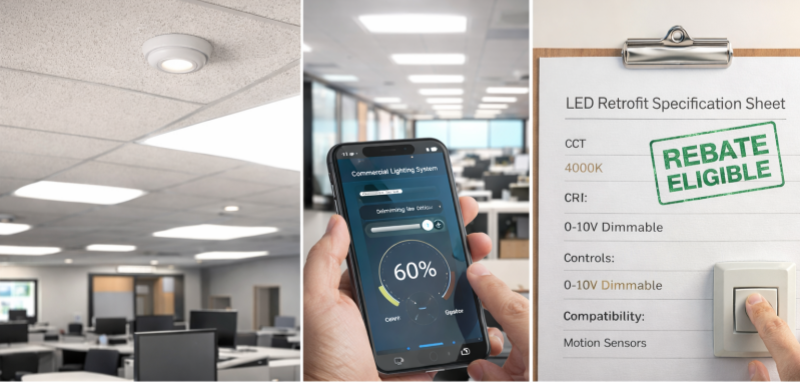
Light Quality Is Back in the Conversation, but in a More Practical Way
Another clear shift is that lighting quality has returned to the conversation, not as a design trend, but as a task-performance issue.
In workplaces and learning environments, buyers are paying more attention to glare control, flicker behavior, and visual comfort because these factors affect how the space functions over long operating hours.
UGR language now appears more often in office-lighting discussions because buyers want to understand whether the product is suitable for workstation environments rather than just whether it is bright enough. A UGR of 19 is widely treated as the upper limit of acceptable discomfort glare in office-type settings, and WELL guidance also references UGR 19 or lower as a practical route for workstation glare assessment.
What matters here is that buyers are becoming more specific.
For office projects, the discussion is not “make it more comfortable.” It is whether the luminaire family is suitable for low-glare planning, whether driver behavior is stable, and whether light distribution works for long-duration desk tasks.
For retail, the question is whether beam control and color consistency support display areas, aisles, and merchandise presentation.
For education, it is often about long-run practicality: lighting that does not feel harsh, does not create maintenance headaches, and can be repeated across classrooms with predictable results.
Sustainability Now Sounds More Like Lifecycle Management
Sustainability is also being framed differently.
A few years ago, it was often reduced to an efficacy number. In 2026, buyers are more likely to look at service life, maintenance exposure, component continuity, and long-term operating logic.
In B2B terms, sustainability increasingly overlaps with procurement discipline. It is not only about saving watts on day one. It is about reducing replacement frequency, simplifying maintenance planning, and avoiding product choices that create unnecessary operating friction later.
In that context, lifecycle value becomes a useful commercial term because it speaks to how the product behaves after installation, not just how it performs in a table of lab data.
Outdoor Projects Are Adding Environmental Constraints to the Specification Process
For exterior commercial lighting, the decision process is also becoming narrower and more application-specific.
The DLC’s LUNA requirements strengthen the discussion around light pollution and application discipline in outdoor lighting, especially in categories where shielding, directional control, and environmental sensitivity matter.
This does not mean every outdoor project has turned into a dark-sky seminar. It means parking areas, campus pathways, municipal-adjacent sites, and similar environments are being reviewed with more attention to ordinance exposure, community complaints, and where the light is actually going.
In those cases, generic claims about brightness or efficiency are not enough. Buyers want to know whether the product is appropriate for the site conditions and whether it reduces avoidable compliance risk.
What Commercial Buyers Are Really Screening for in 2026
When commercial buyers compare product options in 2026, they are usually screening for a combination of fit and risk.
If the project is renovation-led, they look at installation path, dimensional compatibility, and rollout speed.
If the project is rebate-sensitive, they look at listing status, control capability, and submittal readiness.
If the project is office or education focused, they look at glare discipline, flicker control, and maintenance practicality.
If the project spans multiple locations, they look at SKU rationalization and whether the same family can be repeated with fewer complications.
If the project is outdoor, they also look at shielding logic and site-specific compliance exposure.
That is why broad phrases such as “high quality” or “energy efficient” carry less weight than they used to.
Buyers are not really asking for adjectives. They are asking whether the product fits the job, the code path, the rebate path, and the maintenance path.
Frequently Asked Questions About Commercial Lighting in 2026
1. What is driving commercial lighting upgrades in 2026?
Retrofit demand, control requirements, rebate access, and long-term operating cost are shaping more projects than before.
Many upgrades now start with an existing ceiling layout, an aging fluorescent system, or a building that needs a lower-disruption LED replacement path.
2. Why is retrofit more important than full redesign in many projects?
Because many commercial buildings are being upgraded while they remain in use.
That makes installation path, dimensional fit, and rollout speed more important than starting with a blank design.
3. Why do controls affect product selection so early?
Because controls are often part of the compliance and commissioning path, not just an added feature.
If the luminaire cannot work with sensing, dimming, or daylight-response logic, it may create problems later even if the basic specs look acceptable.
4. Why do rebates still matter so much in North America?
Because rebate eligibility can directly affect budget approval and payback calculations.
Nearly 700 utility and energy-efficiency programs rely on DLC-qualified product lists for rebate eligibility.
5. What does “lighting quality” really mean in an office or school project?
It usually means glare control, flicker behavior, light distribution, and task suitability.
For workstation areas, buyers increasingly want products that fit low-glare planning rather than simply delivering high output.
6. What does lifecycle value mean in commercial lighting?
It means looking beyond the purchase price.
Buyers increasingly consider service life, maintenance exposure, replacement intervals, and how the product behaves over time in a real building.
7. What are commercial buyers really screening for now?
Not just performance claims, but fit.
They want to know whether the product fits the renovation path, the control path, the rebate path, and the maintenance path.
Conclusion
The real commercial lighting trend in 2026 is not a sudden shift in style. It is a tighter set of selection criteria.
Retrofit constraints, control compatibility, rebate eligibility, glare management, and lifecycle thinking are all playing a larger role in how products are screened and approved.
Suppliers that still describe commercial lighting only through wattage, lumen output, and generic energy-saving claims will sound interchangeable. Suppliers that can speak in the language of renovation, controls, documentation, and task fit will sound much easier to specify.
Looking for commercial lighting solutions for office, education, retail, warehouse, or retrofit projects? Contact New Lights for OEM/ODM support, project-based product matching, and commercial lighting options aligned with real project requirements.
 GET IN TOUCH


