


 English
 Español
 Deutsch
We sincerely look forward to establishing a long-term development partnership with you with good quality and professional services.
In recent years, the adoption of energy-efficient lighting solutions has gained significant attention across residential, commercial, and industrial sectors. Among these solutions, led filament bulb (letter bulb) has emerged as a prominent alternative to traditional incandescent bulbs. The primary factor driving this transition is energy consumption, which directly impacts operational costs, environmental sustainability, and long-term efficiency.
Technological overview of led filament bulb (letter bulb) and incandescent bulbs
Led filament bulb (letter bulb)
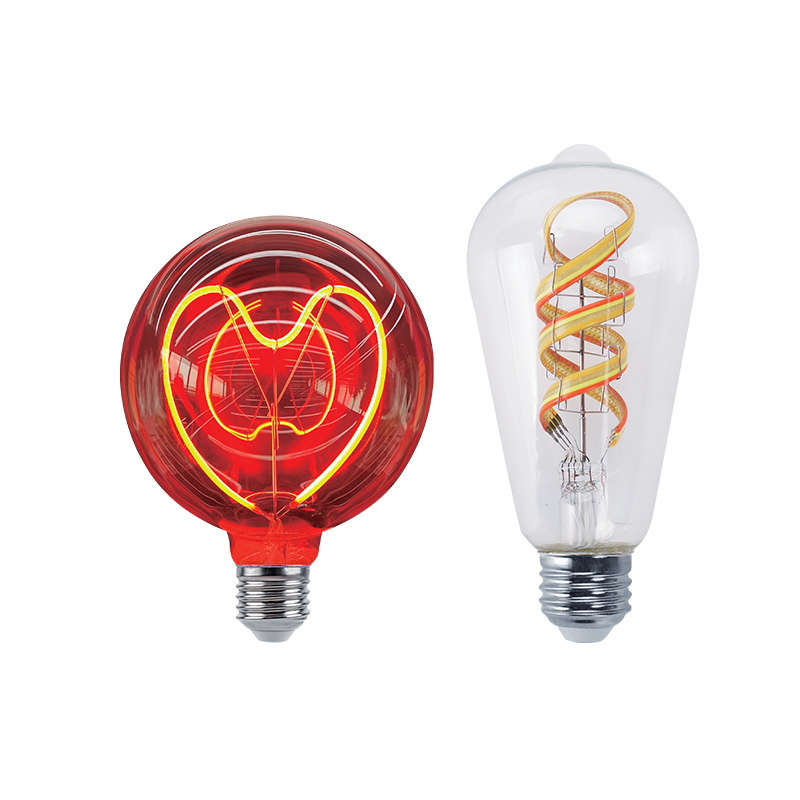
Led filament bulb (letter bulb) is a modern lighting solution designed to emulate the aesthetic of traditional incandescent bulbs while offering the efficiency benefits of LED technology. Unlike conventional LEDs that rely on a single chip, the filament design uses multiple LED filaments arranged in a linear or curved pattern within a transparent glass enclosure. This arrangement allows 360-degree illumination, closely resembling the warm glow of classic incandescent bulbs.
Key characteristics of led filament bulb (letter bulb) include:
- Low energy consumption: The bulb achieves the same light output as an incandescent bulb at a fraction of the power input.
- Long operational life: Typical lifespans range from 15,000 to 30,000 hours, significantly reducing replacement frequency.
- Minimal heat emission: Filament LEDs convert more energy into visible light rather than heat, unlike incandescent bulbs which release most energy as heat.
- Dimmable and versatile: Many led filament bulb (letter bulb) models are compatible with standard dimmer systems, enhancing user control over lighting ambiance.
Incandescent bulbs
Incandescent bulbs operate on the principle of resistive heating. When electrical current passes through a tungsten filament, it heats up and emits light. Despite their warm and natural light quality, incandescent bulbs are inherently inefficient due to:
- High energy consumption: A large portion of electricity is converted to heat rather than visible light.
- Short operational life: Typical lifespans range from 750 to 2,000 hours, requiring frequent replacements.
- Limited dimming efficiency: While dimming is possible, incandescent bulbs become less energy-efficient at lower intensities.
Table 1 summarizes the key differences between led filament bulb (letter bulb) and incandescent bulbs in terms of fundamental characteristics.
| Feature | Led Filament Bulb (Letter Bulb) | Incandescent Bulb |
|---|---|---|
| Power consumption | 4–10 W | 40–100 W |
| Luminous efficacy | 80–120 lm/W | 10–15 lm/W |
| Average lifespan | 15,000–30,000 hours | 750–2,000 hours |
| Heat emission | Low | High |
| Light distribution | 360-degree uniform | Directional, less uniform |
| Dimming compatibility | Yes | Limited efficiency |
Energy consumption comparison
Power rating and efficiency
The energy consumption of a lighting device is primarily determined by its power rating and luminous efficacy. Led filament bulb (letter bulb) typically consumes 4–10 watts while producing an equivalent luminous output to a 40–100 watt incandescent bulb. This demonstrates a reduction in energy consumption of approximately 80–90%.
Luminous efficacy, expressed in lumens per watt, highlights the conversion efficiency of electrical energy into visible light. Incandescent bulbs achieve roughly 10–15 lumens per watt, whereas led filament bulb (letter bulb) reaches 80–120 lumens per watt. This stark difference explains the lower power requirement and operational cost for filament LEDs.
Heat generation and energy waste
Another significant contributor to energy consumption is heat generation. Incandescent bulbs dissipate a substantial portion of electricity as heat, which is wasted energy in the context of lighting. Conversely, led filament bulb (letter bulb) minimizes heat emission, allowing more energy to produce light. This efficiency not only reduces electricity usage but also lowers ambient heat, which is beneficial for climate-controlled environments.
Practical energy savings
To illustrate practical energy consumption, consider a comparison in a typical household setting:
| Usage scenario | Led Filament Bulb (Letter Bulb) | Incandescent Bulb |
|---|---|---|
| Daily operation | 6 hours | 6 hours |
| Power consumption per bulb | 6 W | 60 W |
| Daily energy consumption | 36 Wh | 360 Wh |
| Monthly energy consumption | 1.08 kWh | 10.8 kWh |
| Annual energy consumption | 13 kWh | 131 kWh |
The table clearly demonstrates that led filament bulb (letter bulb) provides substantial energy savings, making it an ideal choice for reducing electricity bills and supporting sustainable practices.
Operational performance and longevity
The operational life of led filament bulb (letter bulb) is significantly longer than that of incandescent bulbs, further enhancing its cost-effectiveness. The long lifespan reduces maintenance requirements, which is particularly advantageous for commercial installations and hard-to-reach lighting fixtures. Additionally, the consistency of light output over time ensures that energy savings are sustained throughout the product lifecycle.
Incandescent bulbs degrade more quickly, often dimming or failing abruptly, leading to additional replacement costs and energy inefficiencies during their shorter lifespan.
Applications and industry relevance
Residential lighting
In homes, led filament bulb (letter bulb) is increasingly preferred for living rooms, dining areas, and bedrooms due to its warm aesthetic and energy efficiency. Consumers seeking vintage-style lighting can achieve the desired ambiance without incurring high electricity costs associated with incandescent bulbs.
Commercial and retail lighting
For commercial spaces such as restaurants, cafes, and retail stores, the low power consumption and long lifespan of led filament bulb (letter bulb) translate to substantial operational cost reductions. The bulbs’ 360-degree light distribution ensures uniform illumination, enhancing the presentation of products and interior decor.
Energy-sensitive industries
Facilities with strict energy management protocols, including offices and educational institutions, benefit from led filament bulb (letter bulb) due to its efficient energy profile, minimal heat generation, and reduced maintenance overhead. Implementing filament LEDs in such settings aligns with energy-saving targets and sustainability initiatives.
Environmental impact
Led filament bulb (letter bulb) contributes to environmental sustainability by lowering electricity consumption and reducing greenhouse gas emissions. The long lifespan also decreases waste associated with bulb disposal. In contrast, the frequent replacement of incandescent bulbs increases material usage and environmental burden.
Considerations for selection
When selecting between led filament bulb (letter bulb) and incandescent bulbs, users should consider:
- Lighting requirements: Desired brightness, color temperature, and ambiance.
- Energy savings potential: Projected reduction in electricity consumption.
- Maintenance implications: Frequency of replacement and associated costs.
- Environmental goals: Alignment with sustainability initiatives.
Incorporating led filament bulb (letter bulb) into lighting projects requires evaluating these factors to maximize energy efficiency and operational benefits.
Conclusion
The comparison between led filament bulb (letter bulb) and incandescent bulbs highlights the substantial energy consumption advantage of filament LEDs. Key findings include:
- Significant reduction in electricity usage due to higher luminous efficacy.
- Minimal heat generation, resulting in less wasted energy.
- Extended operational lifespan, lowering maintenance costs and energy use over time.
- Versatility in residential, commercial, and industrial applications while maintaining aesthetic appeal.
By adopting led filament bulb (letter bulb), users achieve both economic savings and environmental benefits, making it a superior choice over traditional incandescent lighting.
FAQ
Q1: How much electricity can I save by switching to led filament bulb (letter bulb) from incandescent bulbs?
A1: Switching to led filament bulb (letter bulb) can reduce electricity consumption by approximately 80–90%, depending on the wattage and usage patterns. Annual energy savings in typical household scenarios can exceed 100 kWh per bulb.
Q2: Can led filament bulb (letter bulb) be used in dimmable fixtures?
A2: Yes, most led filament bulb (letter bulb) models are compatible with standard dimmers, allowing adjustable lighting while maintaining energy efficiency.
Q3: Is the light quality of led filament bulb (letter bulb) similar to incandescent bulbs?
A3: Yes, filament LEDs mimic the warm glow and 360-degree light distribution of incandescent bulbs, providing comparable visual comfort.
Q4: How long does a led filament bulb (letter bulb) typically last compared to incandescent bulbs?
A4: Led filament bulb (letter bulb) typically lasts 15,000–30,000 hours, which is 10–20 times longer than incandescent bulbs.
Q5: Are led filament bulb (letter bulb) environmentally friendly?
A5: Yes, the energy efficiency and extended lifespan of led filament bulb (letter bulb) reduce electricity consumption and waste, contributing to lower environmental impact.
References
- U.S. Department of Energy. Solid-State Lighting Technology Fact Sheet.
- Lighting Research Center. LED vs. Incandescent Lighting: Energy Efficiency Comparison.
- International Energy Agency. Energy Efficiency in Residential Lighting.
 GET IN TOUCH


