


 English
 Español
 Deutsch
We sincerely look forward to establishing a long-term development partnership with you with good quality and professional services.
There was a time when commercial interiors were dominated by fluorescent troffers, visible tubes, and deeper recessed fixtures that were accepted mainly because they were familiar.
That changed.
Today, in offices, schools, meeting rooms, clinics, corridors, and many retail interiors, LED panel lights are one of the most widely accepted fixture formats in commercial interiors.
They did not become standard because they were fashionable.
They became standard because they solved several practical problems at once.
They fit ceiling systems that buildings already use.
They gave buyers a cleaner visual result.
They supported retrofit work without forcing a full ceiling rethink.
And they aligned with the market’s shift toward glare-conscious lighting, controls, and lower maintenance exposure.
A product category becomes standard when it keeps solving the same problem in building after building.
LED Panel Lights vs. Fluorescent Troffers: Why the Shift Happened
For decades, fluorescent troffers in formats such as 2x4, 2x2, and 1x4 were a familiar part of office, school, and institutional ceilings. DOE materials still frame these recessed troffers as long-standing commercial fixture types, which helps explain why LED panel lights spread so quickly: they entered a ceiling language the market already understood.
That point matters more than it may sound.
In commercial interiors, a product category moves faster when it works with the building instead of forcing the building to adapt. Panel lights gave the market a cleaner and more efficient replacement path for a familiar format.
So the shift was not really about introducing a completely new fixture logic.
It was about giving buyers a more acceptable version of an old one.
They Fit the Ceiling Grid Instead of Fighting It
One reason LED panel lights became standard so quickly is simple: they fit how many commercial interiors are already built.
Suspended ceiling grids remain common in offices, classrooms, administrative spaces, healthcare interiors, and many back-of-house retail areas. That is exactly the kind of environment where panel lights make immediate sense.
Instead of asking a building owner to redesign the whole ceiling, panel lights offer a more natural upgrade path: keep the grid, improve the fixture, modernize the light.
For retrofit work, this is a major advantage.
A product category moves toward “default” status when it reduces disruption before anyone even starts discussing higher-level design preferences.
They Arrived at the Right Time for Retrofit Demand
LED panel lights also gained ground because they matched the timing of the market.
In Europe, the Renovation Wave aims to renovate 35 million buildings by 2030 and at least double the annual rate of energy renovations. That matters because a huge amount of commercial lighting demand now comes from existing buildings rather than blank-sheet projects.
That environment naturally favors fixtures that are easy to specify in renovation work.
Panel lights fit this need well because they often provide a familiar replacement path for older fluorescent ceiling systems. DOE retrofit guidance notes that retrofitting or replacing fluorescent troffers with LEDs can deliver project-level energy savings of roughly 20% to 60%, depending on the chosen approach.
But the appeal is not only the energy number.
It is also the fact that panel lights often make the project easier to explain internally:
-
less visual disruption to the space
-
a cleaner replacement path in suspended ceilings
-
easier repetition across rooms or sites
-
fewer objections from end users who simply want the ceiling to look cleaner and more current
That combination is one reason panel lights moved so quickly from “common option” to “safe default.”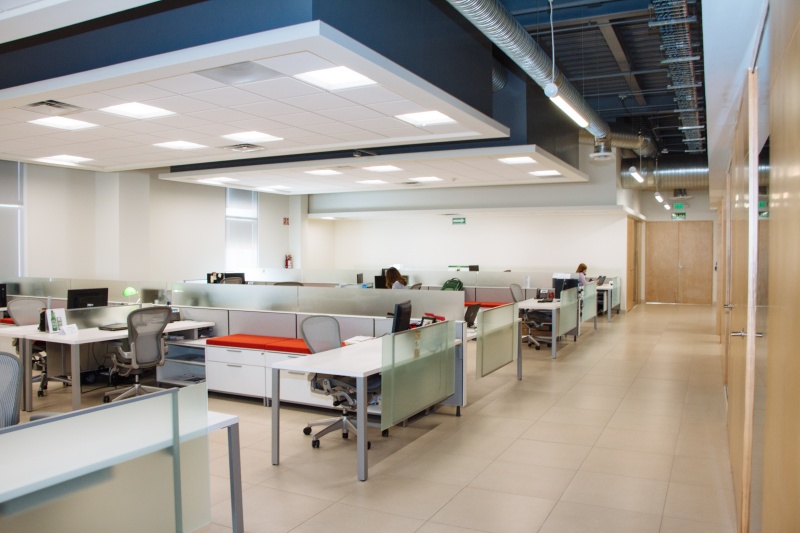
They Cleaned Up the Visual Language of Commercial Ceilings
Fluorescent-era ceilings often accepted a certain amount of visual clutter: deeper housings, visible tubes, uneven lamp appearance, and a more technical-looking ceiling plane.
LED panel lights helped change that.
They introduced a flatter, simpler, and more uniform luminous surface. That made many interiors feel more current without pushing them into an overly decorative look.
This matters because the ceiling is not just a mounting surface.
It is part of how a room feels.
When a ceiling looks quieter, more even, and less crowded with fixture detail, the whole space often feels more updated. That is one reason panel lights worked well not only in energy-upgrade projects, but also in commercial interiors that wanted a cleaner and more contemporary result.
They Matched the Shift Toward Low-Glare, Office-Friendly Lighting
Another reason panel lights became standard is that buyers became more demanding about what “good light” actually means in commercial interiors.
In office and workstation environments, output alone is not enough. Buyers increasingly care about glare control, visual comfort, and whether a fixture is suitable for long-duration desk work. WELL’s 2024 addenda explicitly notes that a UGR rating of 19 maintains a high bar of rigor while being more feasible for projects, which helps explain why UGR language remains active in office-lighting discussions.
That does not mean every panel light is automatically low glare.
It does mean the category was well positioned to support a different kind of commercial conversation:
-
wider luminous surfaces
-
more uniform ambient light
-
office-oriented low-glare options
-
cleaner distribution for general interior use
This is one reason panel lights became especially attractive in offices, classrooms, meeting rooms, administrative areas, and healthcare-related interiors.
At New Lights, this is also where panel-light selection becomes more specific. In office and education projects, driver stability, glare control, and flicker-free performance matter just as much as wattage and size.
In many commercial interiors, the winning fixture is not the one that looks brightest on paper. It is the one people can work under for eight hours a day.
Flicker-Free and Color Consistency Matter More Than They Used To
When buyers specify panel lights today, many are looking beyond basic output and efficacy.
They increasingly want light that feels stable in use.
That means glare control is only part of the discussion. Driver behavior, flicker performance, and color consistency also matter because these details affect how the ceiling looks over time and how comfortable the room feels during long operating hours. WELL’s ongoing refinement of glare thresholds and TM-30 alignment reflects that broader shift toward practical visual quality, not just raw brightness.
This is especially true in offices and schools.
A flicker-prone panel may still pass a quick showroom impression.
It is much less acceptable in a meeting room, classroom, or workstation environment where people spend long periods under the light.
So panel-light conversations today are more precise than they were a few years ago. Buyers are paying closer attention not only to the panel body, but also to the driver, optical system, and how the light behaves in real use.
Edge-Lit vs. Back-Lit: Which Panel Type Fits the Project Better?
Not all LED panel lights solve the same problem in the same way.
Edge-lit panels place LEDs along the frame and use a light-guide plate to distribute light across the surface.
Back-lit panels place LEDs behind the diffuser and send light directly through the panel. Technical guidance from NVC describes exactly this structural difference.
That difference matters in real projects.
Edge-lit panels are often chosen when a slimmer profile and a very clean visual look are priorities.
Back-lit panels are often chosen when the buyer is more focused on efficacy, simpler optical structure, and long-term value. Industry comparisons also note that because edge-lit designs rely on a light-guide plate, yellowing risk in lower-quality products often becomes part of the buying discussion over time.
In practice, the choice usually depends on project logic:
-
choose edge-lit when profile depth and a slim appearance matter more
-
choose back-lit when the project puts more weight on efficacy and lifecycle value
-
compare both against actual ceiling depth, budget, and operating expectations instead of assuming one type is always better
At New Lights, standard sizes like 600x600 and 625x625 are common, but we also support project-driven dimensional and configuration adjustments when existing ceiling grids do not follow the most common modern standard.
A Quick Comparison Buyers Can Read in 10 Seconds
| Feature | Legacy Fluorescent Troffer | Professional LED Panel |
|---|---|---|
| Ceiling fit | Familiar in commercial grids | Familiar in commercial grids |
| Light appearance | Visible lamps and deeper visual structure | Clean luminous surface and flatter ceiling look |
| Retrofit logic | Keeps legacy system alive | Supports full LED upgrade path |
| Control options | Often basic on/off | Can support 0-10V, DALI, sensor-ready options |
| Office comfort | Often acceptable but not optimized | Easier to specify for glare-conscious office use |
| Lifecycle focus | More re-lamping and ballast-related upkeep | Lower maintenance exposure and cleaner upgrade strategy |
They Worked Well With the Push Toward Controls
Commercial lighting also changed because controls moved closer to baseline expectations.
DOE’s determination for ASHRAE 90.1-2022 found weighted national average site-energy savings of 9.8% compared with 90.1-2019, and lighting-related control provisions are part of that broader efficiency direction. DOE guidance also notes that controls such as occupancy sensors, task tuning, dimming, and daylight response can deliver additional savings.
Panel lights fit this shift well because they are commonly used in spaces where these strategies make practical sense:
-
open-plan offices
-
classrooms
-
meeting rooms
-
reception areas
-
corridors and shared-use interiors
So buyers are not only choosing a luminaire.
They are also choosing how that luminaire will behave inside a control strategy.
That is one more reason panel lights became standard so easily in commercial interiors.
They Made Standardization Easier Across Projects
A product category becomes standard when it is not only useful once, but easy to repeat.
This is one of the biggest reasons LED panel lights spread so widely.
For multi-room and multi-site projects, buyers usually want fewer variables, not more. They want one family that can be repeated across office floors, classroom blocks, administrative spaces, meeting rooms, and corridors without unnecessary SKU fragmentation.
Panel lights work well here.
A buyer can often standardize around:
- one size for one ceiling type
- one or two lumen packages
- one emergency version
- one dimmable version
- one lower-glare version where needed
That is commercially attractive because standardization makes procurement, stocking, installation, and maintenance easier to manage.
A fixture becomes “standard” when it repeatedly reduces decision complexity.
Rebate and Procurement Systems Also Helped the Category Grow
In North America, rebate logic reinforced the role of panel-style commercial luminaires.
The DesignLights Consortium says its Qualified Product Lists are required by nearly 700 utility and energy-efficiency programs for rebate eligibility. That matters because once a product category becomes easy to qualify, easy to compare, and easy to justify financially, it gains momentum in the market.
At that point, a panel light is no longer being selected only because it looks modern.
It is being selected because:
- distributors can stock it
- contractors can install it
- facility teams can standardize it
- rebate systems can support it
- procurement teams can defend it internally
That is how a category moves from “common” to “standard.”
They Reached a Performance Level Buyers Could Trust
A category does not become standard permanently unless its performance reaches a useful threshold.
DOE procurement guidance notes that, for a commercial 2x4 LED troffer example, buyers can filter products to a minimum efficacy of 132 lumens per watt under that acquisition framing. DOE also states that lighting products compatible with controls such as occupancy sensors and dimming facilitate further savings.
That matters because it shows panel- and troffer-style LED luminaires are no longer compromise products.
They are expected to deliver:
-
credible energy performance
-
clean commercial aesthetics
-
realistic installation paths
-
control compatibility
-
usable light for work environments
Once those conditions came together, panel lights stopped needing to “win attention.”
They simply became normal.
What Buyers Still Need to Check Before Choosing a Panel Light
Panel lights may be standard, but selection still matters.
A panel light can still become the wrong choice if the buyer ignores the details that affect performance in use.
Before approving a panel light, buyers still need to check:
-
ceiling-grid compatibility
-
edge-lit vs. back-lit suitability
-
glare performance for office or educational use
-
driver quality and dimming compatibility
-
emergency or sensor options where needed
-
lumen package versus actual application
-
installation depth and site conditions
-
certification and documentation for the target market
Because panel light is a category, not a guarantee.
The category became standard because it works very well when specified properly.
Disappointing projects usually come from weak selection discipline, not from the panel format itself.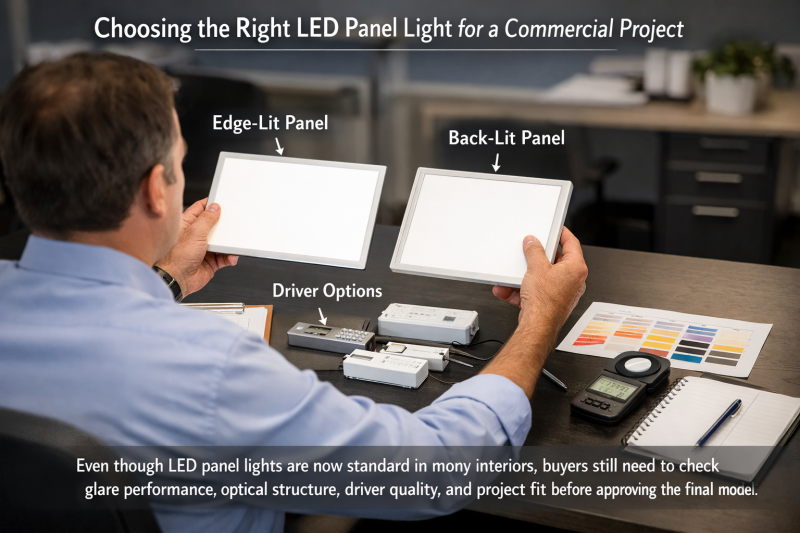
Frequently Asked Questions
1. Why are LED panel lights so common in offices and commercial interiors?
Because they fit common ceiling-grid systems, support clean visual layouts, and work well in spaces that need uniform ambient lighting. Their adoption also accelerated because they offered a familiar replacement path for legacy troffer-based interiors.
2. Are LED panel lights mainly used for retrofit projects?
They are used in both retrofit and new projects, but retrofits helped accelerate adoption because panel lights provide a practical upgrade path for existing fluorescent ceiling systems. Europe’s Renovation Wave adds to that broader renovation-driven market logic.
3. Why do buyers often choose panel lights for office lighting?
Because office projects often need a balance of clean ceiling appearance, broad ambient distribution, and glare-conscious specification. WELL’s updates keep UGR language active in workstation discussions.
4. Do all LED panel lights have low glare?
No. Low glare depends on the optical design and application, not just the category name. Buyers still need to check UGR-related suitability where workstation use matters.
5. What is the difference between edge-lit and back-lit LED panels?
Edge-lit panels use LEDs along the edge with a light-guide plate, while back-lit panels place LEDs behind the diffuser. The choice depends on project priorities such as fixture depth, efficacy, and lifecycle concerns.
6. Why do some LED panels turn yellow over time?
Yellowing is often associated with material aging, especially in designs that rely on a light-guide plate. Technical comparisons frequently point to LGP aging as one reason yellowing risk becomes part of the edge-lit versus back-lit discussion.
7. What should buyers check before selecting a commercial LED panel light?
They should check size, optical type, glare suitability, driver quality, control compatibility, certification, installation conditions, and whether the lumen package fits the actual space.
Conclusion
LED panel lights became a standard in commercial interiors because they solved more than one problem at once.
They fit existing ceiling systems.
They made retrofits easier to justify.
They cleaned up the visual language of the ceiling.
They matched the market’s shift toward low-glare lighting and controls.
And they were easy to repeat across rooms, floors, and sites.
That is how a product type becomes standard.
Not because it is fashionable.
Not because it is loudly promoted.
But because it keeps proving useful in real buildings.
Looking for LED panel lights for office, education, retail, or commercial retrofit projects? Contact New Lights for OEM/ODM support, market-specific specifications, and project-ready panel lighting solutions.
 GET IN TOUCH


