


 English
 Español
 Deutsch
We sincerely look forward to establishing a long-term development partnership with you with good quality and professional services.
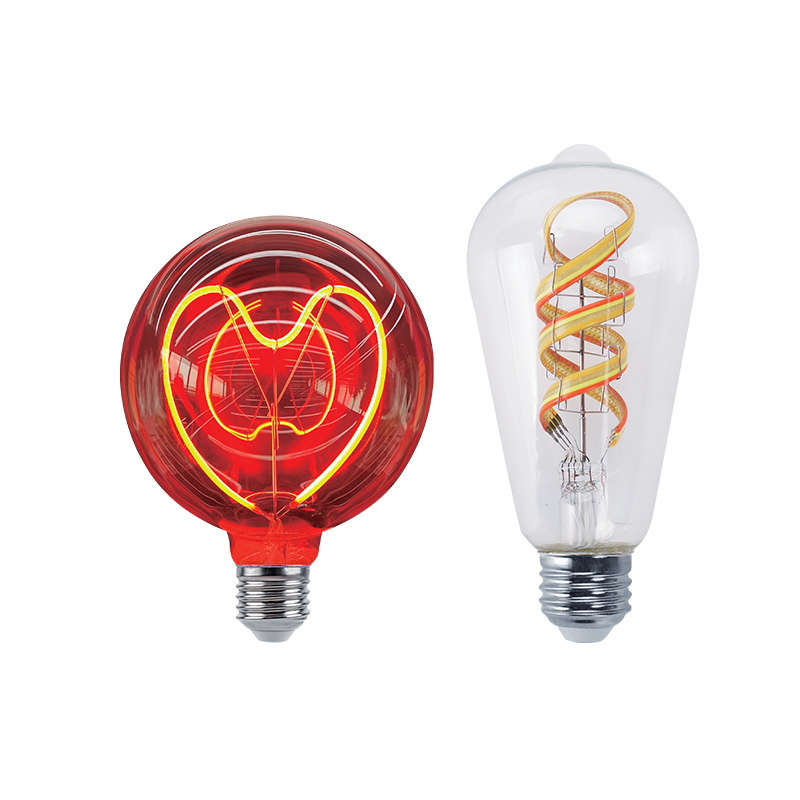
LED Filament Bulb (Flexible Filament) has emerged as a significant innovation in modern lighting solutions, combining energy efficiency, aesthetic appeal, and advanced optical performance. One of the key challenges in lighting design is glare control, which affects visual comfort, productivity, and safety. Glare reduction has become a crucial parameter for both residential and commercial lighting environments. The flexible filament design incorporated in LED Filament Bulb (Flexible Filament) plays a pivotal role in mitigating glare while maintaining high luminous efficacy and aesthetic value.
Understanding glare in lighting
Glare refers to excessive brightness or contrast that causes visual discomfort or reduces the visibility of objects. It can be classified into two primary types:
- Direct glare: Caused by light sources within the observer’s field of view.
- Reflected glare: Caused by light reflected off surfaces such as desks, walls, or floors.
Traditional lighting solutions often struggle to balance brightness and glare, particularly in high-lumen applications. Incandescent and standard LED bulbs may produce concentrated light points that result in direct glare, leading to eye strain and visual fatigue.
The introduction of flexible filament technology in LED Filament Bulb (Flexible Filament) addresses this challenge by distributing light more evenly and reducing hotspots, thereby enhancing visual comfort.
The principle of flexible filament design
The flexible filament design refers to the arrangement of LED emitters along a pliable substrate that can be shaped and positioned to optimize light distribution. Unlike rigid filaments, the flexible design allows the filaments to:
- Conform to various bulb shapes
- Maximize light spread across the surrounding area
- Minimize concentrated points of brightness that cause glare
This design ensures that light is emitted more uniformly, providing a softer, more diffused illumination. Light distribution uniformity is a key factor in glare reduction and is particularly important in environments such as offices, retail spaces, and hospitality venues where visual comfort is essential.
Table 1: Comparison of rigid vs. flexible filament light distribution
| Feature | Rigid Filament LED Bulb | Flexible Filament LED Bulb |
|---|---|---|
| Filament configuration | Fixed, linear or spiral | Adjustable, shaped along bulb curve |
| Light spread | Limited, concentrated | Uniform, diffused |
| Glare potential | Higher | Lower |
| Aesthetic adaptability | Moderate | High |
| Suitable applications | General residential | Residential and commercial |
Glare reduction mechanisms in LED Filament Bulb (Flexible Filament)
Flexible filaments contribute to glare reduction through several mechanisms:
- Diffused light emission: By distributing LEDs along a flexible substrate, the light intensity at any single point is reduced, lowering direct glare.
- Geometric positioning: The filament can be oriented to direct light away from critical viewing angles, minimizing visual discomfort.
- Integration with bulb coatings: Many LED Filament Bulb (Flexible Filament) models employ anti-glare coatings or frosted glass envelopes to further scatter light and reduce sharp brightness contrasts.
- Optimized filament spacing: Flexible filaments allow for precise spacing of LED chips, achieving a balance between luminous flux and glare control.
By combining these design elements, LED Filament Bulb (Flexible Filament) achieves a glare index that is significantly lower than conventional LED bulbs, improving user comfort without compromising illumination efficiency.
Applications and user benefits
Residential environments
In homes, glare can interfere with tasks such as reading, cooking, or using digital devices. LED Filament Bulb (Flexible Filament) provides:
- Soft, ambient lighting that reduces eye strain
- Enhanced aesthetic appeal through vintage or modern bulb designs
- Compatibility with dimming systems for adjustable lighting intensity
Commercial and office spaces
Glare in workplaces can affect productivity and safety. LED Filament Bulb (Flexible Filament) contributes to:
- Uniform lighting across workstations, minimizing direct glare on monitors
- Reduced flicker and improved color rendering for task-specific lighting
- Lower energy consumption compared to traditional high-glare bulbs
Retail and hospitality
Retailers and hoteliers require lighting that highlights products or interiors without creating discomfort. The flexible filament design enables:
- Focused illumination with soft edges
- Display of merchandise under natural-looking light
- Consistency in lighting aesthetics across large areas
Table 2: Application-specific benefits of LED Filament Bulb (Flexible Filament)
| Application | Glare control benefit | Additional advantages |
|---|---|---|
| Residential | Reduced eye strain | Decorative appearance, dimmable |
| Office | Uniform work surface illumination | Energy efficiency, improved visual comfort |
| Retail | Soft display lighting | Enhanced product presentation |
| Hospitality | Comfortable ambient lighting | Consistent aesthetic, flexible design |
Design considerations for glare optimization
Lighting engineers and designers must consider multiple factors to maximize glare reduction in LED Filament Bulb (Flexible Filament):
- Filament orientation: Aligning the filament to reduce direct exposure to viewers
- Bulb envelope selection: Using frosted or opal glass to diffuse light further
- Placement relative to surfaces: Positioning bulbs to minimize reflected glare from shiny surfaces
- Color temperature choice: Warm light (2700K–3000K) is less likely to produce discomforting glare than cool white light
- Filament density: Adjusting the number of LED chips per filament to balance brightness and softness
By integrating these considerations, lighting systems achieve optimal glare performance while preserving the benefits of LED efficiency.
Integration with smart lighting systems
LED Filament Bulb (Flexible Filament) can be incorporated into smart lighting solutions to further enhance glare management. Features include:
- Automated dimming based on ambient light levels
- Scene-based lighting to adjust glare for specific activities
- Remote control to modify light intensity without physically adjusting fixtures
Smart integration ensures that glare reduction is dynamic and adaptable, enhancing comfort in changing environments.
Environmental and energy implications
Glare reduction is not only a comfort issue but also contributes indirectly to sustainability. By optimizing light distribution, LED Filament Bulb (Flexible Filament):
- Requires fewer fixtures to achieve the same illumination level
- Reduces energy consumption due to better light utilization
- Supports compliance with energy efficiency standards and building codes
This reinforces the role of LED Filament Bulb (Flexible Filament) as an environmentally responsible lighting solution that does not compromise on performance.
Maintenance and longevity
Flexible filament designs typically support extended operational lifespans due to reduced thermal stress on LED chips. By minimizing hotspots and distributing heat evenly, these bulbs:
- Maintain consistent light quality over time
- Reduce the likelihood of premature failure
- Lower maintenance costs for commercial and residential users
Glare control also contributes indirectly to longevity by avoiding light over-concentration, which can accelerate material degradation in some environments.
Future trends in glare reduction
Research and development in LED Filament Bulb (Flexible Filament) are focusing on:
- Advanced phosphor coatings for enhanced diffusion
- Filament geometries tailored for human-centric lighting
- Integration with adaptive optics to dynamically control glare based on user position
These innovations aim to make LED Filament Bulb (Flexible Filament) increasingly effective in creating comfortable, glare-free illumination across diverse environments.
Conclusion
The flexible filament design in LED Filament Bulb (Flexible Filament) has a substantial effect on glare reduction. Through diffused light emission, strategic filament positioning, optimized spacing, and integration with bulb coatings, these bulbs deliver comfortable, visually appealing illumination suitable for residential, commercial, and hospitality applications. In addition to improving user comfort, they support energy efficiency, aesthetic flexibility, and long-term performance. As the lighting industry evolves, LED Filament Bulb (Flexible Filament) continues to play a critical role in meeting both functional and visual comfort requirements.
FAQ
Q1: Can LED Filament Bulb (Flexible Filament) completely eliminate glare?
A1: While no bulb can entirely eliminate glare, the flexible filament design significantly reduces direct and reflected glare compared to traditional LED or incandescent bulbs.
Q2: Are LED Filament Bulb (Flexible Filament) suitable for office monitors?
A2: Yes, their diffused light and adjustable orientation make them well-suited for workspaces, reducing glare on computer screens.
Q3: How does color temperature affect glare in LED Filament Bulb (Flexible Filament)?
A3: Warm white light (2700–3000K) generally produces less glare than cool white light, improving visual comfort.
Q4: Can these bulbs be dimmed to further reduce glare?
A4: Yes, LED Filament Bulb (Flexible Filament) is compatible with many dimming systems, enabling dynamic glare control.
Q5: Are flexible filament bulbs energy-efficient compared to standard LED bulbs?
A5: Yes, they maintain high luminous efficacy while reducing the number of fixtures needed, offering energy savings.
References
- Lighting Research Center. Glare and Visual Comfort in LED Lighting. 2022.
- International Commission on Illumination (CIE). CIE Guide on LED Lighting Technology. 2021.
- Journal of Modern Lighting Engineering. Flexible Filament LEDs: Optical Performance and Glare Control. 2023.
 GET IN TOUCH


